by
Susan Austin, ‘Freud, Sigmund (1856–1939)’, Oxford Dictionary of National Biography, Oxford University Press, 2004; online edn, May 2005 [http://www.oxforddnb.com/view/article/55514, accessed 6 May 2006]
Freud, Sigmund (1856–1939), founder of psychoanalysis, was born on 6 May 1856 at Freiberg, Moravia, in the Austro-Hungarian empire (later Príbor, Czech republic), the first of the seven surviving children of Jacob Freud (1815–1896), wool trader, and his second wife, Amalie (1835–1931), daughter of Jacob Nathansohn and his wife, Sara. His parents were both Jewish and Freud himself went to London as a refugee in 1938.
Childhood and adolescence
The Freud family occupied one large room on the first floor of a house owned by a blacksmith. His father, at one point registered as a wool merchant, made what must have been a somewhat precarious living through trade of various kinds. His mother was an attractive and strong-minded woman and by all accounts her love for Sigmund, the first-born of her eight children, was boundless. There followed two more boys, one of whom died at six months, and five girls, whose arrival stirred up intense jealousy in Freud. Freud's position in the family was unusual in that he also had two grown-up half-brothers from his father's first marriage, one of whom had a young son, so that Freud was born an uncle. This nephew, John, was Freud's closest child companion and rival. Freud remarked, in The Interpretation of Dreams, that his characteristic warm friendships as well as his enmities with contemporaries went back to this early relationship (Freud, Interpretation, 483). The two half-brothers and the young boy emigrated to Manchester at the end of Freud's third year, stimulating in him early thoughts of moving to England himself, which he was eventually to do some eighty years later.
Meanwhile, in 1860, when Freud was four, in common with many other Jews of the Austro-Hungarian empire at that time the family moved to Vienna in the wake of a recent liberalization of policy which gave Jews equal political rights and abolished ghettos. Although the family were largely non-observing Jews, ready to assimilate into Viennese society, and all his life Freud was himself an atheist, Jewishness in its religious, cultural, and political aspects was a lifelong preoccupation of his and very much a part of his identity.
The family settled in Leopoldstadt, a mainly Jewish part of the city, where they lived in straitened conditions. Little is known of these first years in Vienna and Freud's early schooling. Although it is unclear quite how Jacob Freud earned a living once there, the family seems to have been able to make ends meet. Freud's education at the excellent local Gymnasium, which he entered in 1865, proceeded without interruption and he received a classical education. He was consistently head of the class. He and his schoolfriend Eduard Silberstein, who remained a lifelong friend, formed their own ‘Spanish Academy’ with an exclusive membership of two, which involved corresponding in self-taught Spanish through which they divulged to each other their thoughts, fantasies, and preoccupations and developed a sort of private mythology. Their correspondence continued from Freud's mid-teens to his mid-twenties, stopping about the time that he met his future wife.
Freud's early biography is of fundamental significance to the history of psychoanalysis, as, through his own rigorous self-analysis—which he was to conduct from the mid-1890s—he effectively made himself the subject of the first psychoanalytic case-history. Freud makes thinly disguised references to his personal experience throughout his psychoanalytical writings, most notably in Die Traumdeutung (1900), published in English as The Interpretation of Dreams. A less intimately personal account is his Selbstdarstellung (‘Autobiographical study’, 1925), which was commissioned as part of a series of self-portraits by men of science, and focuses on his professional development. In a postscript of 1935 he writes: ‘The story of my life and the history of psychoanalysis … are intimately interwoven … no personal experiences of mine are of any interest in comparison to my relations with that science’ (p. 71). In fact Freud's most personal experience was inevitably bound up with psychoanalysis, while it is true that outwardly his private life, typical of a bourgeois doctor, appears unremarkable.
Studies in medicine, neurology, and psychiatry
In spite of the family's financial situation Freud was left by his father to make his own choice of career. He began his medical studies at Vienna University in 1873, availing himself of the considerable degree of academic freedom afforded by the curriculum to explore a variety of areas. His interest gravitated towards scientific research at the outset. He chose to supplement his studies with research in the laboratories of faculty members, undertaking such research for Ernst Brücke, a congenial teacher of physiology and histology, and he remained at Brücke's laboratory for six years. Beginning with studies of nerve cell structure in the Petromyzon, a primitive species of fish, and progressing to human anatomy and a minute study of the medulla oblongata, he established a solid reputation as a specialist in brain anatomy and pathology. In addition to Brücke himself, who was for Freud something of a father figure, Brücke's laboratory brought the young Freud into contact with distinguished colleagues. It was at Brücke's that Freud made the acquaintance of Dr Josef Breuer, another father figure whose personal support and professional collaboration he later acknowledged as crucial to the foundation of psychoanalysis.
It was during this period that Freud made his first long-awaited journey to England in 1875 to visit his half-brothers in Manchester, and which he acknowledged, seven years later, in a letter to his fiancée, as a decisive influence. He had dreamed of England since boyhood and had acquired an insatiable appetite for English literature, especially Shakespeare and Dickens. The trip stimulated renewed yearnings to settle there himself. Jacob Freud had hoped this stay with cousins more successful in business than himself would stimulate in Freud some enthusiasm in that line, but Freud was nurturing fantasies of pursuing a scientific career in England, for all its ‘fog and rain, drunkenness and conservatism’ (Letters to … Silberstein, 127). As a result of the excursion and his encounter with the consistent empiricism in the English scientific writings of the likes of John Tyndall, Thomas Huxley, Charles Lyell, and Charles Darwin, his own interests became more sharply focused. Correspondingly he declared himself increasingly wary of metaphysics and philosophy (ibid., 128).
Freud's studies were interrupted by military service in 1879–80, during which he translated four essays by John Stuart Mill for the German edition of the collected works. After receiving his medical qualification in 1881 he pursued his research at Brücke's laboratory, having been given a temporary post. In 1882 Freud suddenly left Brücke's laboratory and began to set himself up to pursue a clinical career, which afforded the eventual prospect of financial security by going into private practice. Significantly, the change of direction coincided with Freud's falling in love with Martha Bernays (b. 1861), his future wife, the daughter of an observing Jewish family well known in Hamburg. There followed a four-year engagement, during which he wrote his fiancée 900 letters while struggling to establish himself financially in keeping with conventional expectation.
In the meantime Freud somewhat belatedly began a three-year residency at the Viennese General Hospital, an internationally renowned teaching centre where the heads of department were almost invariably pre-eminent in their fields. Although Freud's career was full of promise during this period, the prospect of becoming materially secure remained remote and he was searching for new discoveries so as to make his name. One such project was concerned with the applications of cocaine, then new and relatively unknown. In 1884 Freud published an enthusiastic paper based on his experiments on himself and others. Unfortunately it was left to a contemporary, Koller, whose attention Freud had drawn to cocaine's anaesthetic qualities, to complete an investigation into such use in eye surgery and so to claim the considerable credit for the discovery.
In July 1885, a month after being appointed to the academic post of privat-docent, Freud left for Paris on a travelling scholarship to study at the Salpêtrière Hospital under the celebrated neurologist Jean-Martin Charcot. In contrast to the Viennese psychiatric approach Freud had so far encountered, which was concerned with physical symptoms and family pathology with little attempt to identify causes, Charcot was developing bold concepts for understanding neurosis through observing patients, in particular hysterics, with a view to characterizing disorders and establishing their aetiology. The trip to Paris was of fundamental significance to Freud's intellectual and professional development. Having arrived there primarily preoccupied with his anatomical researches, by the time of his return to Vienna his interest had turned, through Charcot's influence, to psychopathology and the applications of hypnosis.
In the wake of his formative experience in Paris, Freud gave addresses to the Vienna Medical Society championing Charcot's views on hysteria and hypnosis. These presentations met with cool receptions, to Freud's great disappointment. There was widespread scepticism concerning hypnosis and it is quite possible that Freud's youthful idealization of his French master may have rankled with his senior colleagues, reinforcing Freud's consistently held view of himself as an outsider embattled with the medical establishment.
Marriage and early career
Soon after his return from Paris, Freud set himself up in private practice as a consultant in nervous diseases, of which hysteria was one of the most important. Referrals came in particular from his older friend and benefactor Breuer, with whom he was later to collaborate. After years of relative poverty, Freud had generated enough income to marry Martha Bernays on 13 September 1886 at Wandsbeck, just outside Hamburg. The couple settled down to a domestic regime typical of a Viennese doctor's family and Martha had six children, three boys and three girls, within eight years. The household also included Martha's unmarried sister, Minna, who was able to provide Freud with intellectual companionship through the initial years of relative isolation.
During the first years of married life in addition to his private practice Freud was director of neurology at the Institute for Children's Diseases, where he continued his work on brain neurology in addition to clinical duties with neurological patients, enabling him to support his young family while he pursued his greater interest in clinical psychopathology through his private practice of neurotic patients. Of the neurological papers he published as a result of the neurological post one in particular foreshadows his later work. ‘Zur Auffassung der Aphasien: eine kritische Studie’ (‘On aphasia’, 1891) reviewed the existing literature, criticizing its mechanical approach and reliance on brain mythology, which attributed mental functioning to particular parts of the brain, proposing instead a subtle relationship between anatomy and psychology.
The talking cure
Freud's treatment of patients by hypnosis continued for a decade after his visit to Paris, although he became increasingly aware of its limitations. A fundamental shift in his thinking evolved following his re-encounter with a case history which his older friend Breuer had related to him as early as 1882. Breuer had been treating an intelligent and lively minded young woman, known as Anna O., whose severely debilitating symptoms included paralysis, loss of speech, and a nervous cough. Taking his lead from the patient Breuer developed a cathartic method, which the patient herself called a ‘talking cure’. Freud managed to persuade Breuer to revive the method, by which the doctor–patient relationship had effectively been transformed from one of passivity on the part of the hypnotized patient receiving suggestions from the doctor aimed at ridding the patient of the symptom, to that of a patient actively talking in a self-induced trance to a doctor who received information while the patient simultaneously relieved herself of the symptom, which emerged as the product of some early trauma which had not been resolved.
Implicit in the cathartic method which Freud adopted to treat his own patients were several concepts which were to be at the heart of psychoanalytic thinking: namely, that patients were suffering from ‘reminiscences’—there was a causal link between hysterical symptoms and psychological trauma; that the traumatic experience had been rendered unconscious through repression, yet continued to make its presence felt; and that the unconscious experience could be made conscious, bringing relief to the patient.
An account of the case of Anna O. was eventually published by Freud and Breuer in Studien über Hysterie (‘Studies on hysteria’, 1895). Breuer had been consistently reticent about the Anna O. case, which contained elements which he found personally embarrassing, and it was left to the intrepid younger man to explore the implications of the new method which had presented itself as a viable alternative to hypnosis. It was not until 1896 that Freud used the term ‘psychoanalysis’.
Freud widened the scope of the treatment by taking an interest in anything a patient might have to say, rather than inviting an account of the symptoms. Freud named this process free association and its encouragement was the object of the enduring fundamental rule of psychoanalysis, whereby a patient is asked to say whatever comes to mind. With the advent of free association came the demise of the last vestige of the hypnotic method, as Freud now refrained from applying gentle pressure to the patient's head during treatment. The setting for psychoanalysis later recommended by Freud, where the patient reclines comfortably while the analyst sits out of sight, was designed to facilitate free association. The request to patients to associate freely threw into relief resistance, a term which Freud used interchangeably with defence at that time. Listening to patients' accounts Freud became convinced that the traumas which lay behind hysterical symptoms had their origins in infancy and he was struck by their sexual content.
Family, friends, and colleagues
Freud's last daughter, Anna Freud, was born in 1895, the year of the publication with Breuer of Studien über Hysterie. His father died in the following year. Although he found pleasure in fatherhood and in the family home created by Martha Freud, there was no real intellectual outlet for Freud as he struggled to develop a theoretical framework for psychoanalysis and subjected himself to the emotional strain of a lengthy self-analysis. Freud's friendship with Breuer had been faltering since the late 1880s and eventually broke down, largely because Breuer was unwilling to concur with Freud's firm conviction about the sexual aetiology of hysteria. It was Wilhelm Fliess, a talented but ultimately discredited Berlin general practitioner, who fulfilled Freud's need for a friend, confidant, and critic. Fliess was closer in age to Freud and unlike Breuer could not be shocked by Freud's more audacious speculations. The relationship quickly developed a great intensity and the two kept up an intimate correspondence for fifteen years from 1887 to 1902 which sheds light on the otherwise obscure evolution of Freud's thinking at that time and on his concurrent self-analysis. It was in a long letter to Fliess written in 1895 that Freud set out his portentous ‘Project for a scientific psychology’ with a view to integrating mental and physical phenomena within a single theoretical schema. Freud began work on the ‘Project’ in the late summer of 1895 in a rush of creativity following one of his ‘congresses’ with Fliess. His ambition was to set out a psychology firmly grounded in neurology and biology, which he referred to as his ‘Psychology for neurologists’. Freud likened the task to an exhausting but exhilarating mountain climb, during which more peaks to be conquered kept appearing. Exhilaration soon gave way to frustration and dejection however, and by November he wrote to Fliess that he could ‘no longer understand the mental state in which I hatched the Psychology’ (Freud, ‘Project for a scientific psychology’, 1895, 152). The undeniably abstruse draft survives only among Fliess's papers, and Freud makes no mention of this momentous effort in his autobiographical accounts. It was published posthumously in English in 1954, four years after publication in German, having been rescued from Fliess's papers by Marie Bonaparte following his death in 1931, and edited by James Strachey (Standard Edition, vol. 1). As Strachey points out in his editor's introduction Freud clearly regarded this ostensibly neurological work as a failure. Although it cannot be said to constitute the foundation of psychoanalytic theory as such, it contained the seeds of many ideas elaborated in his later psychological writings, for example drive theory, repression, and an economy of mind based on mental conflict.
Freud's friendship with Fliess was destined to collapse amid recriminations, with Fliess alleging that Freud had appropriated his ideas on inherent bisexuality without acknowledgement. Ten years later Freud's friendship with Jung was also to end acrimoniously, with Jung's questioning of the sexual origins of neurosis at the centre of the dispute. Long before the split with Jung, and in the period preceding his violent quarrel with Fliess in 1900, Freud reflected on the nature of his relationships to contemporaries, which he linked to his intensely ambivalent attachment to his nephew John, who had moved to England when Freud was three.
My emotional life has always insisted that I should have an intimate friend and a hated enemy. I have always been able to provide myself afresh with both, and it has not infrequently happened that the ideal situation of childhood has been so completely reproduced that friend and enemy have come together in a single individual—though not, of course, both at once or with constant oscillations, as may have been the case in my early childhood. (Freud, Interpretation, 483)
Fortunately for Freud this easily discernible pattern of turbulent relationships prone to eventual breakdown was restricted to close male colleagues. His family relationships and other friendships were contrastingly consistent and loyal. It was no coincidence that the professional disagreements which caused these intimate friendships to break down were concerned with Freud's insistence on the centrality of sexuality. Sexuality represented to Freud the direct and essential instinctual link between psychology and biology, without which he would find himself caught up in the dichotomy of mind and body which he was desperate to avoid.
Establishment of psychoanalysis
Later in his career Freud recalled the 1890s as years in an intellectual wilderness. His papers on hysteria had not won the respect of the medical establishment and he was aware of his Jewishness in that largely Catholic milieu. In addition Freud had confessed his own surprise that ‘the case histories I write should read like short stories and that, as one might say, they lack the serious stamp of science’ (Standard Edition, 2.160).
Until the late 1890s Freud's observations of the infantile and sexual origins of hysteria had led him to believe, through listening to his patients' accounts, that his patients had fallen ill as a result of childhood sexual abuse by adults. In 1897 he modified this theory of actual childhood seduction and proposed instead that these accounts were often derived from infantile sexual fantasies and therefore belonged in the realm of the patient's own psychic reality and were not, as he had previously thought, necessarily objective facts. To Freud children were no longer assumed to be innocents in a world of adult sexuality: they possessed sexual feelings and wishes of their own which were liable to repression, elaboration, and distortion during development. This shift in Freud's thinking has proved enduringly controversial. Critics have argued that patients' experiences have been denied through their reassignment by Freud to subjective reality and that he changed tack in this way only because he shied away from alienating bourgeois Vienna by reporting widespread sexual abuse in its families. In fact, Freud never denied the reality of child sexual abuse, and it was his attribution of sexual feelings to children which most shocked his contemporaries. Freud was not to be deterred from his line of enquiry. Indeed the cynicism of his medical contemporaries and outrage from members of the wider public seem to have acted as a spur to new vistas opening up. In addition to setting the scene for the detailed exposition of human development, for example in the later Drei Abhandlungen zur Sexualtheorie (‘Three essays on the theory of sexuality’, 1905), the recasting of the aetiology of hysteria in the light of childhood sexuality paved the way to a more general understanding of the role of impulse and desire in the human mind, rendered unconscious through repression.
With the publication of Die Traumdeutung in 1900 Freud decisively challenged the accepted limits of scientific psychology, by bringing mental phenomena generally considered beyond the pale, such as dreams, imagination, and fantasy, into the fold. The leitmotif which runs throughout the book is that dreams represent the disguised fulfilment of repressed infantile wishes and that as such ‘the interpretation of dreams is the royal road to a knowledge of the unconscious activities of the mind’ (Freud, Interpretation, 608).
Freud stated at the outset that his theory of dreams was generally applicable and not restricted to neurotic patients. Indeed, his curiosity about the nature of dreams had been aroused during his self-analysis and the bulk of the illustrative material was trawled from his own dreams and autobiographical material, along with dreams of friends and children. It was in The Interpretation of Dreams that Freud, drawing characteristically on his classical schooling, introduced the Oedipus complex, which asserts the universal desire of a child for the parent of the opposite sex and consequent hatred of the parent of the same sex, which must be resolved through repression in order for normal development to proceed. Although sales were slow and a second edition was not needed until 1909, Freud's explorations of normal psychological functioning did stimulate interest in a wider public.
At the time of writing his dream book Freud was planning other studies of normal psychological processes which would none the less plumb the depths of the psyche, namely Zur Psychopathologie des Alltagslebens (‘The psychopathology of everyday life’, 1901), which explored the unconscious meaning of everyday slips of the tongue and bungled actions, and Der Witz und seine Beziehung zum Unbewussten (‘Jokes and their relation to the unconscious’, 1905) for which he drew on his repertoire of ‘profound Jewish stories’.
The early years of the century also saw the publication of the first of five substantial case histories which read rather like novellas, the case of Dora, under the title Fragment of an Analysis of a Case of Hysteria (1905 [1901]). The most important insight from the analysis of Dora, which broke down when the young woman left, came to Freud with hindsight. In a postscript, Freud reviews the analysis in the light of transference. The phenomenon of transference, whereby any individual's experience of early relationships is the blueprint for later relationships, had already been discussed in the Studies on Hysteria (1895) in terms of an unconscious false connection on the part of the patient between the physician and some earlier figure. Now, reflecting on Dora's inability to continue with her analysis, Freud became aware of the implications of the understanding of transference as a key factor in the therapeutic process of psychoanalysis: ‘Transference, which seems ordained to be the greatest obstacle to psychoanalysis, becomes its most powerful ally, if its presence can be detected each time and explained to the patient’ (Standard Edition, 7.117).
During this period Freud's home life remained settled. As his financial situation improved he was able to indulge his two great interests: Mediterranean travel and collecting antiquities, another natural consequence of a youth steeped in the classics. He also found time to follow the exciting archaeological discoveries being made at the time, and often cited archaeological excavation as a metaphor for psychoanalytic work, with its interest in painstakingly uncovering hidden layers and origins. In 1907 Freud made the first trip to England since his inspirational visit aged nineteen. He spent a fortnight visiting Manchester relatives who showed him Blackpool and Southport before he departed for London. He returned full of praise for the architecture and people, having seen the Egyptian antiquities at the British Museum. It was not until the hasty move to London in 1938 that Freud once again found himself in his childhood dreamland.
Freud's interests beyond the consulting room and the application of psychoanalytic theory to new areas became increasingly apparent in his writings in the years preceding the First World War. Greek literature had already yielded the Oedipus story and there followed other forays into literature and art history, with Der Wahn und die Träume in W. Jensen's ‘Gradiva’ (‘Delusions and dreams in Jensen's “Gradiva”’, 1907) and Eine Kindheitserinnerung des Leonardo da Vinci (‘Leonardo da Vinci and a memory of his childhood’, 1910). In Totem und Tabu (‘Totem and taboo’, 1913), Freud applied psychoanalysis to anthropological material for the first time.
The psychoanalytic movement
As a privat-docent and from 1902 a professor extraordinarius Freud was entitled to lecture at Vienna University. These lectures attracted a small group of followers composed of both laymen and doctors. From 1902 onwards they met as the Wednesday Psychological Society, which evolved into the Vienna Psychoanalytical Society in 1908. In the meantime, to his great satisfaction, Freud's reputation began to spread beyond Vienna and he began to attract interest from foreigners, among them the well-known psychiatrist Eugen Bleuler and his young assistant Carl Jung. Others included Karl Abraham and Max Eitington, also from the Burghölzli Clinic in Switzerland, who unlike Jung were to remain loyal disciples, the Hungarian Sándor Ferenczi, and the Welshman (Alfred) Ernest Jones, Freud's future biographer and the founder of the British Psycho-Analytical Society.
The year after the Vienna Psychoanalytical Society was founded Freud made his only trip to the United States to give a series of well-received lectures (Five Lectures on Psycho-Analysis, in Standard Edition, vol. 11) at the invitation of Clark University, Massachusetts, accompanied by Jung, Ferenczi, and Jones. The spread of psychoanalysis gained momentum and new societies were formed on the model of the Viennese. An international association was established in 1908, uniting the various groups and promising a structure which Freud hoped would facilitate the perpetuation of psychoanalysis through training. Inevitably psychoanalytic politics were in the air and Freud found himself at the centre of rivalries, jealousies, and dissenting views between individuals and groupings, notably his original Viennese colleagues and the Zürich analysts, whom he was felt to favour. Disagreements led to defection by some members, most significantly by Alfred Adler and Jung, whom Freud had thought of as his successor. In an attempt to protect the essence of psychoanalysis from distortion a ‘secret committee’ was formed, at the suggestion of Ernest Jones, which was intended to provide a secure setting within which theory and technique could be discussed among an inner circle of loyal colleagues which consisted of Ernest Jones, Sándor Ferenczi, Karl Abraham, Hanns Sachs, Otto Rank, and, later, Max Eitington. Although the committee met into the 1920s, its conspiratorial air set an unfortunate tone for the future functioning and reputation of the profession.
Further developments
Inevitably the First World War interrupted Freud's well-established working routine. His three sons, Martin, Ernst (father of the writer and broadcaster Clement Freud and the painter Lucian Freud), and Oliver were all in active service and the real possibility of losses within the family had to be faced. Patients stopped coming, and the international psychoanalytical movement's activities came to a halt. Freud was left more time for private study, which proved very productive. There were papers which resulted from reflections on the war itself, for example ‘Zeitgemässes über Krieg und Tod’ (‘Thought for the times on war and death’). The Vienna University lectures delivered during the war were published as the Vorlesungen zur Einführung in die Psychoanalyse (‘Introductory lectures on psychoanalysis’, 1916–17); of particular significance were his Papers on Metapsychology (Standard Edition, vol. 14), of which only five of an original twelve have survived. Dealing with five fundamental themes of psychoanalysis they are ‘On narcissism’, ‘Instincts and their vicissitudes’, ‘Repression’ (all 1915), ‘The unconscious’, and ‘Mourning and melancholia’ (both 1917). Freud went far beyond summing up his theories as they stood in these highly technical papers. In addition to containing new ideas they also hint at numerous revisions which would preoccupy him during the last phase of his career.
By the end of the First World War, Vienna—no longer at the centre of an empire—had become merely the capital of a small, impoverished country. After resuming his private practice Freud took on several British and American patients who proved a useful source of hard currency as a safeguard against soaring inflation. The most serious British interest in Freud came from the members of the Bloomsbury group, in keeping with their characteristic receptiveness to progressive European ideas. Frances Partridge, who lodged with the Stracheys in Gordon Square during their early years as practising analysts, recalled how psychoanalysis was very much part of the Bloomsbury scene, and that she would often recognize patients as they arrived at the house for their sessions. Among the British were the Bloomsbury couple, James Strachey and Alix Strachey [see under Strachey, James]. Introductions, through Ernest Jones, were eased by the fact that Freud admired the work of James's older brother, Lytton Strachey. Freud took James Strachey into analysis on condition that he begin translating his writings into English. Translating Freud, culminating with the publication of the complete works in twenty-four volumes by Virginia and Leonard Woolf's Hogarth Press, was to occupy Strachey for the rest of his life, and remains the standard text for the extensive scholarship on Freud in English, and for psychoanalysts without German. The Strachey translation has been criticized for its recourse to dry scientific neologisms where Freud made use of plain German. For example, Strachey's term ‘cathexis’, now well established as a psychoanalytic term, takes the place of Freud's ‘Besetzung’, a common German word with rich nuances of meaning.
The first international congress following the war was held at The Hague in 1920, which Freud attended in the company of his youngest daughter, Anna, the only one of his children to take an active interest in psychoanalysis, who was now training as an analyst herself and in analysis with her own father. Freud's three sons had survived the war, and the two elder girls, Mathilde and Sophie, were by now married. Disaster struck, though, in 1920, when Sophie, Freud's ‘Sunday Child’, died suddenly leaving a husband and two small boys. Three years later one of Sophie's children died of tuberculosis in the family's care in Vienna, aged four. Freud took the loss very hard—perhaps, as he reflected in a letter to his writer friend Romain Rolland, because it came soon after the shock of discovering that he was suffering from cancer of the jaw, from which he died some sixteen years later. The cancer, brought about by years of heavy cigar smoking, necessitated thirty-three operations and constant nursing attention from his daughter Anna in an attempt to contain it, and the fitting of an awkward oral prosthesis. Freud was not deterred from smoking cigars, however, and indeed remained convinced of their therapeutic qualities: ‘I believe I owe to the cigar a great intensification of my capacity to work and a facilitation of my self control’ (Ward, 14). The great majority of photographs of Freud show him holding a cigar. Always the perfect bourgeois, impeccably groomed throughout his life, his once well-filled features lost their softness in later years, probably as much from the illness as ageing. This has no doubt contributed to the popular image of Freud as a stern and distant figure. Less formal photographs and home movies taken on family occasions and holidays, however, convey a more relaxed and accessible family man, although his smile was rarely captured on camera.
Revisions
During the 1920s Freud expanded his metapsychological theories. Two key strands can be identified in his thinking from this period onwards: a systematic study of the ego and a preoccupation with cultural and social issues in response to the crisis of humanity during the recent war. At its more speculative, psychoanalytic theory now resembled the philosophical enquiry Freud had eschewed early in his career in favour of scientific methods.
In Jenseits des Lustprinzips (‘Beyond the pleasure principle’, 1920), Freud revised his theory of the instincts by positing a death instinct. Psychic conflict could now be construed in terms of the opposing forces of love and death, as could human behaviour and interaction at large. Broadly speaking the emphasis in his thinking had shifted from the unconscious itself to the phenomenon of resistance, which he understood to exert constant pressure to keep unacceptable desires from surfacing. Freud's interest turned to the ego, the agent of this defensive activity, and to the classification of the defences at the ego's disposal. It no longer made sense to think purely in terms of conscious and unconscious, because in any case the mechanisms of defence employed by the ego were themselves unconscious. This new phase of work on the ego was initiated in Massenpsychologie und Ich-analyse (‘Group psychology and the analysis of the ego’, 1921). Freud then set out an extensively revised tripartite model of the structure and functions of the mind, in Das Ich und das Es (‘The ego and the id’, 1923). The third agency, which he termed the super-ego, was conceived to take into account the crucial internalization of parental authority and prohibition which came about with the dissolution of the Oedipus complex.
Once again new avenues had opened up to Freud as the result of an innovation, for example the possibility of classifying mental illness in terms of its origins in a conflict between parts of the personality. In a brief paper entitled ‘Neurosis and psychosis’ (1923), Freud offered new clarity with the following formulation: ‘Transference neuroses correspond to a conflict between the ego and the id; narcissistic neuroses, to a conflict between the ego and the superego; and psychoses, to a conflict between the ego and the external world’ (Standard Edition, 19.152). Other rewards reaped by Freud from the new structural theory were the linking of particular defences to specific mental illnesses and new insights into the nature of anxiety (Hemmung, Symptom und Angst (‘Inhibitions, symptoms and anxiety’), 1926).
Late years
Freud continued working in great pain after an initial operation for the cancer in 1923. The international psychoanalytic movement had re-established itself, with important centres elsewhere, for example in Berlin, which was presided over by Freud's disciple, Abraham. Ernest Jones had founded the London Psycho-Analytical Society in 1913, which became the British Psycho-Analytical Society in 1919. The London Institute of Psycho-Analysis was formally founded by Jones in late 1924. An international structure for training was now in place, with a training analysis as its cornerstone, conducted by Freud and a growing number of senior analysts. Among the patients to consult Freud in the mid-1920s was Princess Marie Bonaparte, wife of Prince George of Greece, a woman endowed with a lively intelligence, tremendous energy, and great material wealth. She soon began training as an analyst and went on to become a leading figure in the international movement, a patron of psychoanalysis, and a close friend of the Freud family, who secured their safe passage from Vienna in 1938.
Another woman important to Freud was his youngest child, Anna, who was by now making her name as an analyst and who increasingly acted internationally as her father's ambassador as his illness rendered him more immobile. She represented her father at the 1929 International Congress in Oxford, in difficult circumstances following a dispute with the New York analysts about whether non-medical individuals should be allowed to become analysts. Freud was exasperated, and his deep-seated antagonism to all things American was fuelled. Freud stood firm: he had already tackled this problem in 1926 in response to allegations of quackery made to a lay colleague, arguing that psychoanalysis was more than a mere offshoot of medicine and that its practice should therefore not be restricted in this way (Die Frage der Laienanalyse; ‘The question of lay analysis’, 1926; in Freud, Standard Edition, vol. 20).
From the publication of Die Zukunft einer Illusion (‘The future of an illusion’, 1927), which dissected religious belief, Freud's other great bête noire, the majority of Freud's writing dealt with cultural and wider social issues. In 1930 came Das Unbehagen in der Kultur (‘Civilisation and its discontents’), in which he subjected civilization itself to scrutiny, asking, in the light of his experience with neurotics in clinical practice, whether instincts were unduly repressed by society. For Freud these works represented a return to his intellectual beginnings: ‘My interest, after making a lifelong détour through the natural sciences, medicine and psychotherapy, returned to cultural problems which had fascinated me long before when I was a youth scarcely old enough for thinking’ (Standard Edition, 20.72).
In the coming years Freud's consistent refusal to adopt an irrationally optimistic outlook on humanity was justified by the rise to power of Hitler in 1933. Freud's works were among thousands of books ritually burnt in Berlin that year. Freud's terse entry for 12 March 1938 in his Brief Chronicle, a diary of events he kept for the final decade of his life, reads: ‘Finis Austriae’ (Gay, 229). Despite Chancellor von Schuschnigg's attempt to stave off Hitler through much of the 1930s Austria had been absorbed into the German Reich which in any case was congenial to popular Austrian opinion. Freud, in his eighties and too unwell even to make trips to a summer house in the Vienna suburbs, was now trapped and in fact remained adamant about not leaving. It was only when Anna Freud was briefly arrested by the Gestapo and interrogated that he agreed that the time had come for the family to flee. In a flurry of crisis diplomacy Freud's well-connected friends, Princess Marie Bonaparte, Ernest Jones, and William Bullitt, the American ambassador to Paris, began diplomatic negotiations on his behalf. Three months later bureaucratic obstacles were finally overcome and Freud was able to leave Vienna in the company of Martha, Anna, the housekeeper, a young physician, and his pet chow. Thanks to the princess an extortionate tax raised by the Nazis on Jews' possessions leaving the country could be paid, and all the apartment's contents followed on, including Freud's library and collection of antiquities, which now numbered more than two thousand objects.
Freud in England
Freud arrived in London by train on 6 June 1938. His reputation had preceded him to the extent that the train had to be re-routed to another platform at Victoria, so as to avoid the enthusiastic attentions of the press. Freud was greatly heartened by the cordial welcome he received, although he wrote to friends of his sense of alienation resulting from the move and his concern over the worsening state of affairs in Europe. He was particularly anxious about four of his elderly sisters who remained in Vienna, for whom visas were being sought without success. Freud did not live long enough to know that they all perished in the camps.
Although Freud was separated from his sisters the move to London occasioned family reunions. He was now living in the same neighbourhood as his youngest son, Ernst, already well-established in London as an architect, having left Berlin in the early thirties. Sam Freud, his Manchester nephew, was among the first visitors. Before moving to 20 Maresfield Gardens, Hampstead (later the Freud Museum), the family lived temporarily nearby at 39 Elsworthy Road, backing on to the north side of Primrose Hill. In addition to being deluged with letters from friends, acquaintances, and complete strangers simply wishing to express their support, Freud received a stream of visitors at both addresses, regulated by his wife and daughter, Anna, with his declining health in mind. Although England had brought him respite from external persecution, the cancer was unrelenting and no longer operable by early 1939. Freud was gradually forced to withdraw from his work routine, although he continued to see a small number of patients, and to write.
Many visitors were listed by Freud in a small notebook, others in his Brief Chronicle. They reflect all aspects of his personal and professional life and interests as well as his preoccupations of that time, and testify to the wide variety of individuals prominent in their own fields whose work had felt the impact of psychoanalysis. In addition to visits from psychoanalysts who had been colleagues and loyal friends in Vienna, numerous members of the British Psycho-Analytical Society came, among them Melanie Klein, whose views on child analysis were at odds with the work of Anna Freud. (Melanie Klein had arrived in Britain in 1927 and had received enthusiastic support from James and Alix Strachey in particular.) A visit which gave particular pleasure was that of the president and two officials of the Royal Society, which had honoured him with membership by correspondence in 1936. Breaking with tradition the charter book was brought to Freud for signing, a privilege previously reserved for the king.
Several visitors outside the immediate psychoanalytic circles were writers, for example Stefan Zweig, who brought along Salvador Dalí, who sketched his hero, and H. G. Wells, one of the few British writers Freud had met personally in Vienna. Wells had proposed having immediate British citizenship conferred on Freud by act of parliament. Freud was interested in the idea and wrote to Wells in July 1939, with only three months to live:
You cannot have known that since I first came over to England as a boy of eighteen years, it became an intense wish phantasy of mine to settle in this country and become an Englishman. Two of my half brothers had done so fifteen years before. But an infantile fantasy needs a bit of examination before it can be admitted to reality. (Letters of Sigmund Freud, 459)
Given their shared interest in cultural matters it is likely that they would also have discussed Freud's Der Mann Moses und die monotheistische Religion (‘Moses and monotheism’, 1939), Freud's phylogenetic attempt to link the phenomenon of antisemitism to ancient inconsistencies around the identity of Moses, which was begun in 1934 soon after the rise of Hitler, and completed in London in 1938. The forthcoming publication brought Freud a number of visitors, including several from Jews urging him not to publish a work they felt would undermine the faith in their hour of need, but Freud was undeterred and pressed on with publication.
There were meetings at Maresfield Gardens with several publishers, including Leonard and Virginia Woolf. Leonard Woolf commented in his autobiography that it was
not an easy interview. He was extraordinarily courteous in a formal, old-fashioned way—for instance, almost ceremoniously he presented Virginia with a flower. There was something about him as of a half-extinct volcano, something sombre, repressed, reserved. He gave me the feeling … of great gentleness, but behind that, great strength. (Gay, 640)
A final paper was in hand during Freud's time in London: ‘Abriss der Psychoanalyse’ (‘An outline of psychoanalysis’, c.1940), an ambitious overview of his work, which he did not complete. Clinical work also continued in London for four hours a day, until Freud finally closed his practice seven weeks before the end of his life and some fifty-seven years since setting up in private practice.
Freud held Max Schur, his personal physician of many years, to a promise he had managed to extract years previously, that he should not let him go on living when there was no longer any point. Schur duly administered a lethal injection of morphine on 23 September 1939 in Freud's study at 20 Maresfield Gardens. Freud was cremated three days later with a fittingly simple memorial service at which Ernest Jones and Stefan Zweig gave addresses, at Golders Green crematorium, Middlesex. His remains are there, inside one of a favourite pair of Greek urns from his collection.
The Freudian legacy
In an obituary poem for Freud, W. H. Auden wrote: ‘Freud is no more a person now but a whole climate of opinion’ (Auden, 153). It is easy to identify Freud's language and ideas in everyday talk: human feelings and behaviour might be deemed repressed, narcissistic, or denied, whether or not an individual has read any Freud or even has any regard for his theories. Furthermore there is chronic confusion, usually unacknowledged, over what really comes from Freud. Given that people seldom react with bland indifference to his name, presumably because they feel in some way implicated by the findings of psychoanalysis, it is hardly surprising that Freud is more often than not misrepresented and misunderstood. It cannot be said that the British have responded to Freud with the same enthusiasm, regard, and affection which Freud maintained for Britain throughout his life. Psychoanalysis has never captured the imagination of the British to the extent that it did the North Americans in the post-war years, or the South Americans much later: the highest percentage of a population receiving psychoanalysis is in Argentina. British psychoanalysis and psychoanalytic psychotherapy remain largely based in London, and north London at that, although the British Psycho-Analytical Society has consistently retained its position as an innovative and influential body within the international psychoanalytic community. The International Journal of Psychoanalysis continues to be published in London.
Freud's impact also continues to be felt in the academic and cultural spheres, with a proliferation of postgraduate non-clinical courses in psychoanalytic studies and the widespread but often superficial application of aspects of psychoanalytic theory to academic fields such as literary and film criticism, gender studies, and politics. The death knell is regularly sounded for psychoanalysis. A frequent criticism of Freud is that he was a man of his time and psychoanalysis is therefore no longer relevant. His views on women are often cited in this connection. Indeed there are aspects of his thinking which few psychoanalysts would espouse nowadays, for example some of his ideas on female sexuality. Theoretical innovations have taken the place of those which have not stood the test of time. There has also been a deepened understanding of aspects of human experience which Freud did not fully explore—for example the complexity of the very early mother–infant relationship and its fundamental part in personality development. Yet while psychoanalysis has continued to evolve, the basic principles elaborated by Freud, such as the concept of mind going beyond mere conscious experience, the highly dynamic nature of mental processes, and the possibility of finding psychological meaning underlying apparently meaningless symptoms or states of mind, have held good, and indeed have underpinned subsequent developments.
Susan Austin
Sources
The standard edition of the complete psychological works of Sigmund Freud, ed. J. Strachey, A. Freud, and others, 24 vols. (1953–74) · Letters of Sigmund Freud, ed. E. L. Freud (1975) · E. Jones, Sigmund Freud: life and work, 3 vols. (1953–7) · R. Wollheim, Freud (1991) · P. Gay, Freud: a life for our time (1988) [incl. bibliographical essay] · H. J. Ellenberger, The discovery of the unconscious: history and evolution of dynamic psychiatry (1970) · P. Gay, A Freud reader (1989) · The diary of Sigmund Freud, 1929–39: a record of the final decade, ed. and trans. M. Molnar (1992) [known as the Brief chronicle] · I. Ward, Freud in England (1992) · The complete letters of Sigmund Freud to Wilhelm Fliess, 1887–1904, ed. J. Masson (1985) · The letters of Sigmund Freud to Eduard Silberstein, 1871–1881, ed. W. Boehlich (1990) · H. Lange, Freud family tree, Freud Museum, 20 Maresfield Gardens, Hampstead, London [unpublished document, unpaginated] · W. H. Auden, ‘Sigmund Freud’, Horizon (1940), 151–4 · S. Freud, Die Traumdeutung (Vienna, 1900)
Archives
Freud Museum, London, family and personal corresp. and papers · L. Cong. · Sigmund Freud Gesellschaft, Vienna | JRL, corresp., mostly with his nephew, Sam Freud
FILM
BFI NFTVA, documentary footage · Freud Museum, London, home footage
SOUND
BL NSA, recorded talk; performance recording
Likenesses
photographs, 1860–1939, Freud Museum, London · M. Pollock, drypoint etching, 1914, Freud Museum, London · M. Halberstadt, photograph, 1921, Mary Evans Picture Library [see illus.] · F. Schmutzer, chalk and mixed media, 1926, Freud Museum, London · L. Willinger, photograph, 1930–39, Wellcome L. · S. Dalí, pen-and-ink drawing on blotting paper, 1938, Freud Museum, London · O. Nemon, bronze statue, c.1970, corner of Fitzjohn's Avenue and Belsize Lane, London; maquette at Freud Museum, London
Wealth at death
£22,850 3s. 2d.: probate, 1 Dec 1939, CGPLA Eng. & Wales
© Oxford University Press 2004–6
All rights reserved: see legal notice
Susan Austin, ‘Freud, Sigmund (1856–1939)’, Oxford Dictionary of National Biography, Oxford University Press, 2004; online edn, May 2005 [http://www.oxforddnb.com/view/article/55514, accessed 6 May 2006]
Sigmund Freud: doi:10.1093/ref:odnb/55514
[Previous version of this biography available here: September 2004]
Saturday, May 06, 2006


Friday, May 05, 2006
(A kind of) Villanelle for Dr. Alois Alzheimer (1864-1915)
Dear Dr. Alzheimer:
Thank you for discovering this disease,
especially for lending it your name.
What a mitzvah!
So many people honor you.
Aren’t you pleased with your celebrity, Dr. Alzheimer?
Such fame!
There you were a German neuropathologist, a psychiatrist
already with a name.
And as a professor of psychology, with Franz Nissl,
you wrote a treatise on the pathologic anatomy of mental illness.
I salute you both, Dr. Alzheimer.
My husband Abe was brilliant too, a pathologist,
born on your birthday, June 14th. Now he has your disease.
I wonder if he’ll forget his name.
Alois Alzheimer, you’ve become part of our family
and will not leave. Listen, your welcome is worn out,
Dr. Alzheimer.
It’s time for you to move on
because we have to,
Dr. Alzheimer.
Please, won’t you please, take back your name.
*historical info from
http://www.uic.edu/depts/mcne/founders/page0002.html
Thank you for discovering this disease,
especially for lending it your name.
What a mitzvah!
So many people honor you.
Aren’t you pleased with your celebrity, Dr. Alzheimer?
Such fame!
There you were a German neuropathologist, a psychiatrist
already with a name.
And as a professor of psychology, with Franz Nissl,
you wrote a treatise on the pathologic anatomy of mental illness.
I salute you both, Dr. Alzheimer.
My husband Abe was brilliant too, a pathologist,
born on your birthday, June 14th. Now he has your disease.
I wonder if he’ll forget his name.
Alois Alzheimer, you’ve become part of our family
and will not leave. Listen, your welcome is worn out,
Dr. Alzheimer.
It’s time for you to move on
because we have to,
Dr. Alzheimer.
Please, won’t you please, take back your name.
*historical info from
http://www.uic.edu/depts/mcne/founders/page0002.html
Edward Field
I had the most wonderful time sitting on a bench outside my neighborhood library tonight. A caregiver moved in and I had two whole hours to read in the open air. Picked up the Edward Field book I had on hold. He's sooo good, the way he tells my grandmother's history as well as his own, albeit his started in New York and my grandmother's, my Bubbe Esther's, began in Europe and ended in Baltimore. Here's from his 1972 collection, A Full Heart:
Both My Grandmothers (first of 7 stanzas)
Both my Grandmothers came from far away
on the difficult journey alone with their children.
They had the courage to do that
but only enough strength
to get here, raise their kids, and die.
I myself have stood on the shore of the Caspian Sea
crying my eyes out
and knowing how far away far can be
and how far this America - strange and difficult even for me -
was from their homes,
from the life they yearned back to.
But they lived here uprooted the rest of their lives.
...
[my Bubbe Esther, for whom I am named, had seven children. So did my Bubbe Kayla, but some of hers were left in Russia].
and from Field's Being Jewish (5th of 7 stanzas)
...
Women were always tired in those days and no wonder,
with the broken-down bodies they had
and their guts collapsed,
for with every child they got a dragging down.
My mother finally had hers
tied back up in the hospital and at the same time
they tied those over-fertile tubes
which freed her from 'god's terrible curse on women.'
...
Both My Grandmothers (first of 7 stanzas)
Both my Grandmothers came from far away
on the difficult journey alone with their children.
They had the courage to do that
but only enough strength
to get here, raise their kids, and die.
I myself have stood on the shore of the Caspian Sea
crying my eyes out
and knowing how far away far can be
and how far this America - strange and difficult even for me -
was from their homes,
from the life they yearned back to.
But they lived here uprooted the rest of their lives.
...
[my Bubbe Esther, for whom I am named, had seven children. So did my Bubbe Kayla, but some of hers were left in Russia].
and from Field's Being Jewish (5th of 7 stanzas)
...
Women were always tired in those days and no wonder,
with the broken-down bodies they had
and their guts collapsed,
for with every child they got a dragging down.
My mother finally had hers
tied back up in the hospital and at the same time
they tied those over-fertile tubes
which freed her from 'god's terrible curse on women.'
...
Thursday, April 27, 2006
Death Sentence?
I think I'm turning a corner, coming to terms with the sadness of Alzheimer's in a new way. I've said from the beginning that Abe and I are just living in a different kind of normal, but certainly there is a standard Normal just as there is a standard morality (well, that's getting into shady territory too. One person can not tell another what's right and wrong, except thou shalt not kill, I suppose). It’s not "normal" to forget all you’ve ever known - especially your professional knowledge base - or where you live or the directions to the bathroom inside your own home once you’ve found it or who you are. And he knows who he is. Who I am. Who the people who come to see him are.
A few weeks ago, I wrote that Alzheimer’s need not be a death sentence, that other parts of us are as valuable as the mind. They mean too. The personality, the spirit: the sweetness and goodness that still are. The sense of values. The belief or un-belief in god and the Democratic party. But today I realize and admit that Alzheimer's is a death sentence.
It is. It takes the mind, steals it from the self. I generally make the best of life's exigencies and that is good; but in another sense I am guilty of denial, saying everything is ok when it’s not, that I can handle this – and I can even when I can’t, but to expect myself to go on with the ordinariness of life is pushing it.
I guess this is why doctors and social workers screamed nursing home, nursing home, assisted living facility assisted living facility. Fear of caregiver burnout. And that’s true, more than just possible; it’s true.
Still, I want something in between: more people on board, more folks not to give up on him, on us. I actually find it harder to deal with people we run into who say, “Oh, I must call you. We’ll do lunch,” then run away than I do confronting this disease. Isn’t that funny.
I never dreamed I would be so disappointed in people; and actually now that I'm writing once again I know that Alzheimer's is really only a death sentence when other people make it so.
A few weeks ago, I wrote that Alzheimer’s need not be a death sentence, that other parts of us are as valuable as the mind. They mean too. The personality, the spirit: the sweetness and goodness that still are. The sense of values. The belief or un-belief in god and the Democratic party. But today I realize and admit that Alzheimer's is a death sentence.
It is. It takes the mind, steals it from the self. I generally make the best of life's exigencies and that is good; but in another sense I am guilty of denial, saying everything is ok when it’s not, that I can handle this – and I can even when I can’t, but to expect myself to go on with the ordinariness of life is pushing it.
I guess this is why doctors and social workers screamed nursing home, nursing home, assisted living facility assisted living facility. Fear of caregiver burnout. And that’s true, more than just possible; it’s true.
Still, I want something in between: more people on board, more folks not to give up on him, on us. I actually find it harder to deal with people we run into who say, “Oh, I must call you. We’ll do lunch,” then run away than I do confronting this disease. Isn’t that funny.
I never dreamed I would be so disappointed in people; and actually now that I'm writing once again I know that Alzheimer's is really only a death sentence when other people make it so.
Tuesday, April 25, 2006
I went for a walk in the neighborhood last night and paid witness to the tulips and periwinkles. He was sitting in his chair watching television when I left. Our new live-in helper was with him. They had just turned on 60 minutes when I walked out the door. This was the first time in I-don't-know-how-long that I was able to go for a fast-paced walk by myself after dinner, and at first I thought the world had changed. But when I came home an hour later and saw him sitting in that same spot, with the same affect, I felt the old familiar sadness return, the same sadness I felt a few hours earlier when I was taking his blood pressure and realized that he no longer understood the meaning of the numbers I was reading. When I got him to bed I thought I would work at my writing but my mind will not go there. It is in bed with him wondering what language Alzheimer victims dream in.
Wednesday, April 19, 2006
Ars Poetica
A poem should be palpable and mute
As a globed fruit
Dumb
As old medallions to the thumb
Silent as the sleeve-worn stone
Of casement ledges where the moss has grown -
A poem should be wordless
As the flight of birds
A poem should be motionless in time
As the moon climbs
Leaving, as the moon releases
Twig by twig the night-entangled trees,
Leaving, as the moon behind the winter leaves,
Memory by memory the mind -
A poem should be motionless in time
As the moon climbs
A poem should be equal to:
Not true
For all the history of grief
An empty doorway and a maple leaf
For love
The leaning grasses and two lights above the sea -
A poem should not mean
But be
-- Archibald MacLeish
As a globed fruit
Dumb
As old medallions to the thumb
Silent as the sleeve-worn stone
Of casement ledges where the moss has grown -
A poem should be wordless
As the flight of birds
A poem should be motionless in time
As the moon climbs
Leaving, as the moon releases
Twig by twig the night-entangled trees,
Leaving, as the moon behind the winter leaves,
Memory by memory the mind -
A poem should be motionless in time
As the moon climbs
A poem should be equal to:
Not true
For all the history of grief
An empty doorway and a maple leaf
For love
The leaning grasses and two lights above the sea -
A poem should not mean
But be
-- Archibald MacLeish
Thursday, April 13, 2006
Pesach Poem, 5766 (2006)
Erev Pesach, 14 Nisan
I am from a place of long ago
where women held timbrels
and danced by the sea.
My name is not Miriam
and Moses was not my brother
but I carry their hearts within me
and hold their hands
as I sing.
-Esther Altshul Helfgott
I am from a place of long ago
where women held timbrels
and danced by the sea.
My name is not Miriam
and Moses was not my brother
but I carry their hearts within me
and hold their hands
as I sing.
-Esther Altshul Helfgott
Monday, April 10, 2006
Early Morning Fragment
I awaken this morning feeling fat and lax.
I don’t know how long we can go on this way,
how long I can. Holding on is the ripple,
the small sound, the slip of a turn or move-
ment, the hope in the night.
But ripples dissipate. They fade.
And what remains is chore,
the same as yesterday:
getting him up
for breakfast news-
paper, forget the change of clothes
the shower, just get him fed ...
This is an early morning fragment.
I’ll finish later when a ripple
returns.
-Esther Altshul Helfgott
I don’t know how long we can go on this way,
how long I can. Holding on is the ripple,
the small sound, the slip of a turn or move-
ment, the hope in the night.
But ripples dissipate. They fade.
And what remains is chore,
the same as yesterday:
getting him up
for breakfast news-
paper, forget the change of clothes
the shower, just get him fed ...
This is an early morning fragment.
I’ll finish later when a ripple
returns.
-Esther Altshul Helfgott
Saturday, April 08, 2006
Alzheimer Couple
They have grown
into each other
like two plants
in a small pot.
Arms and legs
encircling
the same
trunk
they wait
for some
one
to water
them.
-Esther Altshul Helfgott
Written in response to Gwendolyn Brooks' The Bean Eaters which I used as a trigger poem in class Friday.
The Bean Eaters
They eat beans mostly, this old yellow pair.
Dinner is a casual affair.
Plain chipware on a plain and creaking wood,
Tin flatware.
Two who are Mostly Good.
Two who have lived their day,
But keep on putting on their clothes
And putting things away.
And remembering . . .
Remembering, with twinklings and twinges,
As they lean over the beans in their rented back room that
is full of beads and receipts and dolls and cloths,
tobacco crumbs, vases and fringes.
-Gwendolyn Brooks
into each other
like two plants
in a small pot.
Arms and legs
encircling
the same
trunk
they wait
for some
one
to water
them.
-Esther Altshul Helfgott
Written in response to Gwendolyn Brooks' The Bean Eaters which I used as a trigger poem in class Friday.
The Bean Eaters
They eat beans mostly, this old yellow pair.
Dinner is a casual affair.
Plain chipware on a plain and creaking wood,
Tin flatware.
Two who are Mostly Good.
Two who have lived their day,
But keep on putting on their clothes
And putting things away.
And remembering . . .
Remembering, with twinklings and twinges,
As they lean over the beans in their rented back room that
is full of beads and receipts and dolls and cloths,
tobacco crumbs, vases and fringes.
-Gwendolyn Brooks
Saturday, April 01, 2006
Sam Hamill, Copper Canyon Press
Seattle P.I.
March 31 '06
Dear Editor:
As a Seattle poet, I appreciated John Marshall’s article (March 30th) covering Copper Canyon Press’s history and development, but I take issue with his one-sided characterization of founder Sam Hamill as “a cantankerous, abrasive person, who often seems steeling for a fight and usually finds it.” I’ve never been a card carrying member of the Sam Hamill fan club (and it is a large one), but in terms of Copper Canyon’s success as an international poetry house, representing the likes of Mahmoud Darwish, Ruth Stone, Ted Kooser, Lucille Clifton, Octavio Paz and a host of others, Hamill’s “outsized personality,” as Marshall describes it, is quite beside the point. He built the press and deserves more credit than Marshall gives him.
Esther Altshul Helfgott
(Note: John Marshall of the P.I. is not the John Marshall of Open Books).
March 31 '06
Dear Editor:
As a Seattle poet, I appreciated John Marshall’s article (March 30th) covering Copper Canyon Press’s history and development, but I take issue with his one-sided characterization of founder Sam Hamill as “a cantankerous, abrasive person, who often seems steeling for a fight and usually finds it.” I’ve never been a card carrying member of the Sam Hamill fan club (and it is a large one), but in terms of Copper Canyon’s success as an international poetry house, representing the likes of Mahmoud Darwish, Ruth Stone, Ted Kooser, Lucille Clifton, Octavio Paz and a host of others, Hamill’s “outsized personality,” as Marshall describes it, is quite beside the point. He built the press and deserves more credit than Marshall gives him.
Esther Altshul Helfgott
(Note: John Marshall of the P.I. is not the John Marshall of Open Books).
Friday, March 31, 2006
Anna's Last January
My copy of In Pieces: An Anthology of Fragmentary Writing edited by Olivia Dresher (Impassio Press) came today. I'm delighted to be between its pages with so many fine writers, including Kim and Bill Stafford and William Pitt Root. My piece, Anna's Last January, is a series of diary entries pertaining to my mother's death.
"In Pieces celebrates the diversity of contemporary fragmentary writing by offering a sampling of fragments written by 37 different writers—those who are known as well as new voices. Selections from diaries, notebooks, and letters; aphorisms; short prose pieces and vignettes... These are some of the fragmentary forms represented in this unique collection, the first of its kind to present a wide range of fragmentary writing as its own genre."
- from the back cover
“We learn in school that literature has a hierarchy: poem, play, novel, essay. All else—diary, journal, aphorism, letters—are secondary, jottings, ephemera. Reading tells us a different story. The engaging and memorable are found everywhere. In books like In Pieces we are ‘49ers panning for gold and finding nuggets.”
—William Corbett, author of Philip Guston’s Late Work: A Memoir
I love being in an anthology, feels like a pot luck Thanksgiving, everybody sitting around playing music, telling stories, singing, just being themselves.
"In Pieces celebrates the diversity of contemporary fragmentary writing by offering a sampling of fragments written by 37 different writers—those who are known as well as new voices. Selections from diaries, notebooks, and letters; aphorisms; short prose pieces and vignettes... These are some of the fragmentary forms represented in this unique collection, the first of its kind to present a wide range of fragmentary writing as its own genre."
- from the back cover
“We learn in school that literature has a hierarchy: poem, play, novel, essay. All else—diary, journal, aphorism, letters—are secondary, jottings, ephemera. Reading tells us a different story. The engaging and memorable are found everywhere. In books like In Pieces we are ‘49ers panning for gold and finding nuggets.”
—William Corbett, author of Philip Guston’s Late Work: A Memoir
I love being in an anthology, feels like a pot luck Thanksgiving, everybody sitting around playing music, telling stories, singing, just being themselves.
Tuesday, March 28, 2006
The Importance of Diary Keeping
This NPR piece is an important example of discussing personal issues publicly. First, I read it and then I listened. Stewart and Rebecca's openness and desire to be heard and understood lifts me above my own care giving issues. That 48 year old Stewart kept a diary of his year of dying from a brain tumor is a gift, as is his wife Rebecca's response. Mary Beth Kirchner moderated. Her interaction with the material is gentle, her presentation soothing, hopeful. I love NPR. How could anyone want to get rid of it!
Tuesday, March 21, 2006
Lisel Mueller's Love Like Salt
This is the poem we used in last week's Thurs and Fri classes, plus today's (Tues) class. I'll post a new one Thurs.
Love Like Salt
It lies in our hands in crystals
too intricate to decipher
It goes into the skillet
without being given a second thought
It spills on the floor so fine
we step all over it
We carry a pinch behind each eyeball
It breaks out on our foreheads
We store it inside our bodies
in secret wineskins
At supper, we pass it around the table
talking of holidays and the sea.
Lisel Mueller
Reprinted from "Alive Together: New and Selected Poems" (LSU Press, 1996) by permission of the author. Poem copyright © 1996 by Lisel Mueller.
Love Like Salt
It lies in our hands in crystals
too intricate to decipher
It goes into the skillet
without being given a second thought
It spills on the floor so fine
we step all over it
We carry a pinch behind each eyeball
It breaks out on our foreheads
We store it inside our bodies
in secret wineskins
At supper, we pass it around the table
talking of holidays and the sea.
Lisel Mueller
Reprinted from "Alive Together: New and Selected Poems" (LSU Press, 1996) by permission of the author. Poem copyright © 1996 by Lisel Mueller.
Monday, March 20, 2006
Alzheimer's Need Not Be A Death Sentence
I've decided not to believe in doctors
social workers either,
those who would squirrel him away
in an Alzheimer's wing. Wrap him in a cocoon,
a locked ward where resident captives
drown in respiridone and haldol.
Pace. Mumble to relatives of sixty years ago.
An old woman makes bread for her dead children.
She opens an oven door,
pushes them in.
A man who used to be removes his clothes.
A sock here, a shirt there
and then comes his underpants.
In the hall, a low hum, the Devil's breath,
you wouldn't believe.
I sobbed the two hours we were there
and then I brought him home.
That was last October.
Now it's Spring. We plant our primroses.
Read each other poems: Jorie Graham, Bill Stafford.
Even me. We brush the dog, eat out.
Neighbors wave. At shul,
he schmoozes and prays.
A grandchild climbs
in his lap.
-Esther Altshul Helfgott
social workers either,
those who would squirrel him away
in an Alzheimer's wing. Wrap him in a cocoon,
a locked ward where resident captives
drown in respiridone and haldol.
Pace. Mumble to relatives of sixty years ago.
An old woman makes bread for her dead children.
She opens an oven door,
pushes them in.
A man who used to be removes his clothes.
A sock here, a shirt there
and then comes his underpants.
In the hall, a low hum, the Devil's breath,
you wouldn't believe.
I sobbed the two hours we were there
and then I brought him home.
That was last October.
Now it's Spring. We plant our primroses.
Read each other poems: Jorie Graham, Bill Stafford.
Even me. We brush the dog, eat out.
Neighbors wave. At shul,
he schmoozes and prays.
A grandchild climbs
in his lap.
-Esther Altshul Helfgott
Tuesday, March 14, 2006
The Next Step
John Fox led two three-hour workshops at Cancer Lifeline this week. He's absolutely terrific. If you get a chance to go to the one he's giving with Merna Hecht and Andy Himes tomorrow night, grab it. Titled Poems of Witness: Living with Heart in a Conflicted World, the interactive workshop will be at the University Friends Center from 7-9 pm. That's Wed night, the 15th.
One of the exercises we did today: "Commit your next step to what you love most dearly." After discussion, a free write. Here's mine:
The next step
is continuing on
with what has been --
holding you in the night,
watching your days
not surround your breath
with medical
negligence.
The next step
is more of the same --
figuring out ways
to bypass
the lack of hope
that permeates
a field of vision
that doesn’t
include
you.
John put together a useful booklet for us filled with Mary TallMountain, Rumi, Mary Oliver (Is there anyone who doesn't use Mary Oliver these days?, Mark Doty, Milosz, Hirsch, Walcott, Stafford and others. He also showed a marvelous and important film, Medicine and Poetry, one he helped develop with John Graham-Pole, a pediatric oncologyst from Shands Hospital at the University of Florida. Thanks John!
One of the exercises we did today: "Commit your next step to what you love most dearly." After discussion, a free write. Here's mine:
The next step
is continuing on
with what has been --
holding you in the night,
watching your days
not surround your breath
with medical
negligence.
The next step
is more of the same --
figuring out ways
to bypass
the lack of hope
that permeates
a field of vision
that doesn’t
include
you.
John put together a useful booklet for us filled with Mary TallMountain, Rumi, Mary Oliver (Is there anyone who doesn't use Mary Oliver these days?, Mark Doty, Milosz, Hirsch, Walcott, Stafford and others. He also showed a marvelous and important film, Medicine and Poetry, one he helped develop with John Graham-Pole, a pediatric oncologyst from Shands Hospital at the University of Florida. Thanks John!
Monday, March 13, 2006
Being interviewed
When I was asked to do this interview, I didn't feel like it, felt like an invasion of my time, and I don't quite understand interviews where you write the answers yourself. I'm still accustomed to the old fashioned kind where they question you over the phone and then when they go to record, get a good bit of it wrong. So I can't complain; if anyone screwed up here, it was me. I mean I.
Northwestwriters.com
An interview with Esther Altshul Helfgott:
Q: You said your husband has Alzheimer’s and that you are his caregiver. Did you begin writing after he contracted the disease?
A: No, I’ve been writing all my life, not just to survive a particularly traumatic time but in order to know what I am thinking and feeling, to know who I am. Writing has always been my way of figuring out how environment and familial context, say, work for me. When I’m stuck on a problem, I dialogue with myself; record my dreams, dialogue with others on the page, and record my interaction with other writers’ words on the page. I respond to my reading in my journal. I love that; it helps me know the author better and myself in relation to what I’m reading. I complain on the page, I complain a lot but nobody sees that part of me. Not that I don’t complain off the page, in real life, but not as much. I get my complaints and anger out in my journal/diary, whatever you want to call it.
In the case of my husband’s illness, my writing saves me, probably both of us, because it calms me down, centers me to do the hard stuff I have to do, whether I like it or not. You have to take care of someone you love and the tasks are not always easy or fun. So in order to do them, to get some release from the mean stuff that life divvies out, I write write write and write some more. It’s all I know to do. Perhaps if I could sing or dance I’d be doing that but writing is all that comes naturally to me, so that’s what I do. I really wanted to learn to play the piano and to tap dance but I don’t have the patience anymore than I have the patience to cook or sew. I have patience to write and read, that’s all, and more patience to write than to read.
My writing about my husband’s illness has taken the poem form, as it often does, because in poem I am able to write out my fears and sadness. The Alzheimer’s poems are very sad but as I told someone in one of the writing groups I’m in, if I couldn’t write my sadness out in poems, I probably wouldn’t be able to laugh when I’m not writing. I do my crying in the poems, then I can move on, do what I have to do.
Q: What type of writing do you do?
Read the rest of the interview here
Northwestwriters.com
An interview with Esther Altshul Helfgott:
Q: You said your husband has Alzheimer’s and that you are his caregiver. Did you begin writing after he contracted the disease?
A: No, I’ve been writing all my life, not just to survive a particularly traumatic time but in order to know what I am thinking and feeling, to know who I am. Writing has always been my way of figuring out how environment and familial context, say, work for me. When I’m stuck on a problem, I dialogue with myself; record my dreams, dialogue with others on the page, and record my interaction with other writers’ words on the page. I respond to my reading in my journal. I love that; it helps me know the author better and myself in relation to what I’m reading. I complain on the page, I complain a lot but nobody sees that part of me. Not that I don’t complain off the page, in real life, but not as much. I get my complaints and anger out in my journal/diary, whatever you want to call it.
In the case of my husband’s illness, my writing saves me, probably both of us, because it calms me down, centers me to do the hard stuff I have to do, whether I like it or not. You have to take care of someone you love and the tasks are not always easy or fun. So in order to do them, to get some release from the mean stuff that life divvies out, I write write write and write some more. It’s all I know to do. Perhaps if I could sing or dance I’d be doing that but writing is all that comes naturally to me, so that’s what I do. I really wanted to learn to play the piano and to tap dance but I don’t have the patience anymore than I have the patience to cook or sew. I have patience to write and read, that’s all, and more patience to write than to read.
My writing about my husband’s illness has taken the poem form, as it often does, because in poem I am able to write out my fears and sadness. The Alzheimer’s poems are very sad but as I told someone in one of the writing groups I’m in, if I couldn’t write my sadness out in poems, I probably wouldn’t be able to laugh when I’m not writing. I do my crying in the poems, then I can move on, do what I have to do.
Q: What type of writing do you do?
Read the rest of the interview here
Thursday, March 09, 2006
On Submitting Your Work
from Mickey Jim's blog
Advice for writers on submissions from Salmon Poetry
A d v i c e f o r W r i t e r s
O n S u b m i s s i o n s
Salmon's editor, Jessie Lendennie, answers your Frequently Asked Questions
Some people despise what they see as the pretentious, insincere literary world. It certainly is desirable to have a critical sense, but not to confuse the context with the content. In other words, while any arts discipline (indeed, almost anything!) can seem corrupt from outside, unless one examines and participates in the give and take of it all (importantly adding your own experience) you are writing in a vacuum. Creativity feeds on experience - it's important to discriminate but not to block experience. It is useful to remember that what we despise and reject will haunt us; hampering creative development.
There's no getting away from the fact that it's necessary to have experience and exposure for your work by publishing individual poems before trying book publication. The reasons for this are many and varied: From establishing a reputation to honing your craft. There is a necessary period of apprenticeship for any art form which demands focus and dedication. The writing of poetry
unfortunately comes with a stock of misconceptions. Writing is a major part of communication, and we do it from an early age. Writing our feelings can come quite naturally, and we can lose sight of the fact that poetry is also an art form which demands that one is able to strike an intelligent balance between deeply felt experience and the rational, critical ability necessary to craft the experience into Poetry.
As with any art, there are people who derive great pleasure from their creativity for its own sake. There are people who make poetry for their own pleasure and don't want to go further. This is all part of what poetry means to us. However, if one aims to become professional and be taken seriously as a poet, one must go beyond the emotional high of creating. Insight is wonderful and necessary for a full life, but in poetry it has to blend with craft and originality.
We must all be very honest with ourselves about what we want for our poetry, our creativity. Above all never assume that your inner life is the only Truth. Catharsis is liberating, yes; then the work begins. Take the necessary steps to finely tune your writing - shaping it into an original piece.
...
Advice for writers on submissions from Salmon Poetry
A d v i c e f o r W r i t e r s
O n S u b m i s s i o n s
Salmon's editor, Jessie Lendennie, answers your Frequently Asked Questions
Some people despise what they see as the pretentious, insincere literary world. It certainly is desirable to have a critical sense, but not to confuse the context with the content. In other words, while any arts discipline (indeed, almost anything!) can seem corrupt from outside, unless one examines and participates in the give and take of it all (importantly adding your own experience) you are writing in a vacuum. Creativity feeds on experience - it's important to discriminate but not to block experience. It is useful to remember that what we despise and reject will haunt us; hampering creative development.
There's no getting away from the fact that it's necessary to have experience and exposure for your work by publishing individual poems before trying book publication. The reasons for this are many and varied: From establishing a reputation to honing your craft. There is a necessary period of apprenticeship for any art form which demands focus and dedication. The writing of poetry
unfortunately comes with a stock of misconceptions. Writing is a major part of communication, and we do it from an early age. Writing our feelings can come quite naturally, and we can lose sight of the fact that poetry is also an art form which demands that one is able to strike an intelligent balance between deeply felt experience and the rational, critical ability necessary to craft the experience into Poetry.
As with any art, there are people who derive great pleasure from their creativity for its own sake. There are people who make poetry for their own pleasure and don't want to go further. This is all part of what poetry means to us. However, if one aims to become professional and be taken seriously as a poet, one must go beyond the emotional high of creating. Insight is wonderful and necessary for a full life, but in poetry it has to blend with craft and originality.
We must all be very honest with ourselves about what we want for our poetry, our creativity. Above all never assume that your inner life is the only Truth. Catharsis is liberating, yes; then the work begins. Take the necessary steps to finely tune your writing - shaping it into an original piece.
...
Tuesday, March 07, 2006
This Week: Jane Kenyon's Who
Who
These lines are written
by an animal, an angel,
a stranger sitting in my chair;
by someone who already knows
how to live without trouble
among books, and pots and pans.
Who is it who asks me to find
language for the sound
a sheep's hoof makes when it strikes
a stone? And who speaks
the words which are my food?
- Jane Kenyon
These lines are written
by an animal, an angel,
a stranger sitting in my chair;
by someone who already knows
how to live without trouble
among books, and pots and pans.
Who is it who asks me to find
language for the sound
a sheep's hoof makes when it strikes
a stone? And who speaks
the words which are my food?
- Jane Kenyon

Monday, February 27, 2006
My Classes, Week of Feb. 13 '06
How To Be a Poet by Wendell Berry
(to remind myself)
Make a place to sit down.
Sit down. Be quiet.
You must depend upon
affection, reading, knowledge,
skill—more of each
than you have—inspiration,
work, growing older, patience,
for patience joins time
to eternity. Any readers
who like your work,
doubt their judgment.
Breathe with unconditional breath
the unconditioned air.
Shun electric wire.
Communicate slowly. Live
a three-dimensioned life;
stay away from screens.
Stay away from anything
that obscures the place it is in.
There are no unsacred places;
There are only sacred places
And desecrated places.
- Wendell Berry
How To Be a Poet by Wendell Berry from Given New Poems, © Shoemaker, Hoard, Washington, D.C. Reprinted FROM WRITER'S ALMANAC
(to remind myself)
Make a place to sit down.
Sit down. Be quiet.
You must depend upon
affection, reading, knowledge,
skill—more of each
than you have—inspiration,
work, growing older, patience,
for patience joins time
to eternity. Any readers
who like your work,
doubt their judgment.
Breathe with unconditional breath
the unconditioned air.
Shun electric wire.
Communicate slowly. Live
a three-dimensioned life;
stay away from screens.
Stay away from anything
that obscures the place it is in.
There are no unsacred places;
There are only sacred places
And desecrated places.
- Wendell Berry
How To Be a Poet by Wendell Berry from Given New Poems, © Shoemaker, Hoard, Washington, D.C. Reprinted FROM WRITER'S ALMANAC
Monday, February 13, 2006
In Honor of the Trees, Tu B'Shevat
Esther's CLL classes, Week of Feb. 13 '06
eahelfgott2@comcast.net
www.writingworks.homestead.com
Choices by Tess Gallagher
I go to the mountain side
of the house to cut saplings,
and clear a view to snow
on the mountain. But when I look up,
saw in hand, a nest is clutched in
the uppermost branches.
I don't cut that one.
I don't cut the others either.
Suddenly, in every tree,
an unseen nest
where a mountain
would be.
© Tess Gallagher
*****************
DON'T FORGET
Cancer Lifeline Women Writers Reading Series #2
Wed. Feb 15, 2006, 6 - 8:00 pm
Participants in Esther’s writing groups at the Greenlake site and at Northwest Hospital, will read from their work.
Ravenna's Third Place Books (in the Honey bear Bakery)
6504 20th Ave NE
206-525-2347
Wheelchair accessible. Free
Open mike as time allows
CANCER LIFELINE'S MISSION: Optimizing the quality of life of all people affected by cancer-- patients, survivors, family, friends, caregivers and coworkers.
eahelfgott2@comcast.net
www.writingworks.homestead.com
Choices by Tess Gallagher
I go to the mountain side
of the house to cut saplings,
and clear a view to snow
on the mountain. But when I look up,
saw in hand, a nest is clutched in
the uppermost branches.
I don't cut that one.
I don't cut the others either.
Suddenly, in every tree,
an unseen nest
where a mountain
would be.
© Tess Gallagher
*****************
DON'T FORGET
Cancer Lifeline Women Writers Reading Series #2
Wed. Feb 15, 2006, 6 - 8:00 pm
Participants in Esther’s writing groups at the Greenlake site and at Northwest Hospital, will read from their work.
Ravenna's Third Place Books (in the Honey bear Bakery)
6504 20th Ave NE
206-525-2347
Wheelchair accessible. Free
Open mike as time allows
CANCER LIFELINE'S MISSION: Optimizing the quality of life of all people affected by cancer-- patients, survivors, family, friends, caregivers and coworkers.
Sunday, February 12, 2006
Lisel Mueller's Curriculum Vitae
Esther’s CLL classes, Week of Feb. 6 '06
eahelfgott2@comcast.net
www.writingworks.homestead.com
Curriculum Vitae
by Lisel Mueller
1992
1) I was born in a Free City, near the North Sea.
2) In the year of my birth, money was shredded into
confetti. A loaf of bread cost a million marks. Of
course I do not remember this.
3) Parents and grandparents hovered around me. The
world I lived in had a soft voice and no claws.
4) A cornucopia filled with treats took me into a building
with bells. A wide-bosomed teacher took me in.
5) At home the bookshelves connected heaven and earth.
6) On Sundays the city child waded through pinecones
and primrose marshes, a short train ride away.
7) My country was struck by history more deadly than
earthquakes or hurricanes.
8) My father was busy eluding the monsters. My mother
told me the walls had ears. I learned the burden of secrets.
9) I moved into the too bright days, the too dark nights
of adolescence.
10) Two parents, two daughters, we followed the sun
and the moon across the ocean. My grandparents stayed
behind in darkness.
11) In the new language everyone spoke too fast. Eventually
I caught up with them.
12) When I met you, the new language became the language
of love.
13) The death of the mother hurt the daughter into poetry.
The daughter became a mother of daughters.
14) Ordinary life: the plenty and thick of it. Knots tying
threads to everywhere. The past pushed away, the future left
unimagined for the sake of the glorious, difficult, passionate
present.
15) Years and years of this.
16) The children no longer children. An old man's pain, an
old man's loneliness.
17) And then my father too disappeared.
18) I tried to go home again. I stood at the door to my
childhood, but it was closed to the public.
19) One day, on a crowded elevator, everyone's face was younger
than mine.
20) So far, so good. The brilliant days and nights are
breathless in their hurry. We follow, you and I.
From Alive Together: New and Selected Poems by
Lisel Mueller, published by Louisiana State University Press.
Copyright © 1996 by Lisel Mueller All rights reserved.
___________________________________________
Cancer Lifeline Women Writers Reading Series #2
Wed. Feb 15, 2006, 6 - 8:00 pm
Participants in Esther’s writing groups at the Greenlake site
and at Northwest Hospital, will read from their work.
Ravenna's Third Place Books (in the Honey bear Bakery)
6504 20th Ave NE
206-525-2347
Wheelchair accessible. Free
Open mike as time allows
CANCER LIFELINE'S MISSION: Optimizing the quality of life
of all people affected by cancer-- patients, survivors, family,
friends, caregivers and coworkers.
eahelfgott2@comcast.net
www.writingworks.homestead.com
Curriculum Vitae
by Lisel Mueller
1992
1) I was born in a Free City, near the North Sea.
2) In the year of my birth, money was shredded into
confetti. A loaf of bread cost a million marks. Of
course I do not remember this.
3) Parents and grandparents hovered around me. The
world I lived in had a soft voice and no claws.
4) A cornucopia filled with treats took me into a building
with bells. A wide-bosomed teacher took me in.
5) At home the bookshelves connected heaven and earth.
6) On Sundays the city child waded through pinecones
and primrose marshes, a short train ride away.
7) My country was struck by history more deadly than
earthquakes or hurricanes.
8) My father was busy eluding the monsters. My mother
told me the walls had ears. I learned the burden of secrets.
9) I moved into the too bright days, the too dark nights
of adolescence.
10) Two parents, two daughters, we followed the sun
and the moon across the ocean. My grandparents stayed
behind in darkness.
11) In the new language everyone spoke too fast. Eventually
I caught up with them.
12) When I met you, the new language became the language
of love.
13) The death of the mother hurt the daughter into poetry.
The daughter became a mother of daughters.
14) Ordinary life: the plenty and thick of it. Knots tying
threads to everywhere. The past pushed away, the future left
unimagined for the sake of the glorious, difficult, passionate
present.
15) Years and years of this.
16) The children no longer children. An old man's pain, an
old man's loneliness.
17) And then my father too disappeared.
18) I tried to go home again. I stood at the door to my
childhood, but it was closed to the public.
19) One day, on a crowded elevator, everyone's face was younger
than mine.
20) So far, so good. The brilliant days and nights are
breathless in their hurry. We follow, you and I.
From Alive Together: New and Selected Poems by
Lisel Mueller, published by Louisiana State University Press.
Copyright © 1996 by Lisel Mueller All rights reserved.
___________________________________________
Cancer Lifeline Women Writers Reading Series #2
Wed. Feb 15, 2006, 6 - 8:00 pm
Participants in Esther’s writing groups at the Greenlake site
and at Northwest Hospital, will read from their work.
Ravenna's Third Place Books (in the Honey bear Bakery)
6504 20th Ave NE
206-525-2347
Wheelchair accessible. Free
Open mike as time allows
CANCER LIFELINE'S MISSION: Optimizing the quality of life
of all people affected by cancer-- patients, survivors, family,
friends, caregivers and coworkers.
Linda Pastan - Week of Feb 2' 06
Meditation By the Stove
I have banked the fires
of my body
into a small but steady blaze,
here in the kitchen
where the dough has a life of its own,
breathing under its damp cloth
like a sleeping child;
where the real child plays under the table,
pretending the tablecloth is a tent,
practicing departures; where a dim
brown bird dazzled by light
has flown into the window-pane
and lies stunned on the pavement—
it was never simple, even for birds,
this business of nests.
The innocent eye sees nothing, Auden says,
repeating what the snake told Eve,
what Eve told Adam, tired of gardens,
wanting the fully lived life.
But passion happens like an accident.
I could let the dough spill over the rim
of the bowl, neglecting to punch it down,
neglecting the child who waits under the table
the mild tears already smudging her eyes.
We grow in such haphazard ways.
Today I feel wiser than the bird.
I know the window shuts me in,
that when I open it
the garden smells will make me restless.
And I have banked the fires of my body
into a small domestic flame for others
to warm their hands on for a while.
Copyright © Linda Pastan
Ploughshares, Summer 1980
http://www.pshares.org/
I have banked the fires
of my body
into a small but steady blaze,
here in the kitchen
where the dough has a life of its own,
breathing under its damp cloth
like a sleeping child;
where the real child plays under the table,
pretending the tablecloth is a tent,
practicing departures; where a dim
brown bird dazzled by light
has flown into the window-pane
and lies stunned on the pavement—
it was never simple, even for birds,
this business of nests.
The innocent eye sees nothing, Auden says,
repeating what the snake told Eve,
what Eve told Adam, tired of gardens,
wanting the fully lived life.
But passion happens like an accident.
I could let the dough spill over the rim
of the bowl, neglecting to punch it down,
neglecting the child who waits under the table
the mild tears already smudging her eyes.
We grow in such haphazard ways.
Today I feel wiser than the bird.
I know the window shuts me in,
that when I open it
the garden smells will make me restless.
And I have banked the fires of my body
into a small domestic flame for others
to warm their hands on for a while.
Copyright © Linda Pastan
Ploughshares, Summer 1980
http://www.pshares.org/
Wednesday, February 01, 2006
reason I quit poetry therapy
Christina Patterson: Is poetry the new Prozac?
Published: 27 January 2006
The Independent
Poetry is good for your health. That, at least, is the premise of studies currently under way for the Arts Council and the Department of Health. One study, published a couple of years ago in the journal Psychological Reports, suggested that writing poetry boosted levels of secretory immunoglobin A. Another, undertaken by a consultant at Bristol Royal Infirmary, concluded that poetry enabled seven per cent of mental health patients to be weaned off their anti-depressants. Poetry, it seems, is not the new rock'n'roll, but the new Prozac.
This was not instantly evident at the ceremony for the TS Eliot poetry prize last week. Perhaps it was the strip-lighting, but the assembled throng of pasty faces and panda-shadowed eyes did little to foster a sense of radiant health. As feel-good events go, it ranked just above a tussle with your online tax return, but probably below a Thai takeaway in front of Celebrity Big Brother. It was, of course, not fair of Cyril Connolly to describe poets as "jackals fighting over an empty well", but it is true that £10,000 prizes do not, on the whole, boost the health and happiness of those who don't win.
The prize, in any case, went to a paean to psychosis. Carol Ann Duffy's collection of love poems, Rapture, is a moving and, at times, skin-crawlingly accurate portrayal of a process that psychologists have recently identified as a form of madness. We have all been there: tending the mobile "like an injured bird", repeating the name "like a charm, like a spell". For most of us, falling in love is a season in what Duffy calls "glamorous hell", and not a sojourn. We might suffer a few sleepless nights, or even eat a bit less than usual, but we can't sustain life at this pitch. And, luckily for us, our minds comply.
Many poets - a higher proportion, apparently, than of the average population - are not so lucky. John Clare, Anne Sexton, Robert Lowell and, most famously, Sylvia Plath, all knew the torments of a mind that would, on occasion, burst out of the crucible of what Freud called "normal human misery" into the nameless horrors of mania. The mad poet may be a cliché, but it is not a myth. Poets continue to write of their experiences of mental illness. If poetry is some kind of wonder-drug, it sure ain't working for them.
So who is making these headline-hitting assertions, and why? The answer, of course, is arts administrators, and they're doing it for money. And kindness, and the philanthropic impulse, and passion and a desire to help the lost and the lonely and the miserable and the mad. But, to do all this, you need money, and to get money you need to go to funders, and to go to funders you need studies, evidence, and results.
A current project is a good example. Poems in the Waiting Room was set up by an enthusiastic social worker eight years ago. Run, like most of these things, on a shoestring, it has had little pots of funds from trusts and foundations as well as the Arts Council, the Poetry Society and the Foreign Office. It aims are, you'd have thought, worthy and modest: to cheer up miserable places (hospital waiting rooms) at an anxious time with a little injection of art.
Their online "evaluation", however, tells a different story. Amongst a dizzying range of aims and objectives listed in its executive summary are "to gauge the external consequences of displaying poems in waiting rooms", to see "what new behaviour follows" and "what new activities". An extensive discussion of the "methodology" follows, with tables of facts and figures. The one thing, in fact, that the project doesn't allow for is for someone to read a poem and keep quiet about it. This is poetry as life-coaching. You must read and act and reach your goal. And you must do this in an act of self-improvement in which most poets, critics and readers have failed.
In a brave moment of honesty and bathos, the project's organisers assert that "the precise impact of the poems displayed... was always going to be hard to measure". The final report consists, as these things always do, of pages of anecdote masquerading as science, and ends with the hope that further funding be found. My heart went out to the organisers. Like most of us, they're simply doing their best in a league-table culture where everything is judged by results.
There is, in the right hands, a fine role for poetry as social work, but let's not pretend that it's the same as poetry as art. Poetry, like all art, is not a panacea. Perhaps it's more like homeopathy. A great placebo - some people swear by it - but the studies are inconclusive. #
Published: 27 January 2006
The Independent
Poetry is good for your health. That, at least, is the premise of studies currently under way for the Arts Council and the Department of Health. One study, published a couple of years ago in the journal Psychological Reports, suggested that writing poetry boosted levels of secretory immunoglobin A. Another, undertaken by a consultant at Bristol Royal Infirmary, concluded that poetry enabled seven per cent of mental health patients to be weaned off their anti-depressants. Poetry, it seems, is not the new rock'n'roll, but the new Prozac.
This was not instantly evident at the ceremony for the TS Eliot poetry prize last week. Perhaps it was the strip-lighting, but the assembled throng of pasty faces and panda-shadowed eyes did little to foster a sense of radiant health. As feel-good events go, it ranked just above a tussle with your online tax return, but probably below a Thai takeaway in front of Celebrity Big Brother. It was, of course, not fair of Cyril Connolly to describe poets as "jackals fighting over an empty well", but it is true that £10,000 prizes do not, on the whole, boost the health and happiness of those who don't win.
The prize, in any case, went to a paean to psychosis. Carol Ann Duffy's collection of love poems, Rapture, is a moving and, at times, skin-crawlingly accurate portrayal of a process that psychologists have recently identified as a form of madness. We have all been there: tending the mobile "like an injured bird", repeating the name "like a charm, like a spell". For most of us, falling in love is a season in what Duffy calls "glamorous hell", and not a sojourn. We might suffer a few sleepless nights, or even eat a bit less than usual, but we can't sustain life at this pitch. And, luckily for us, our minds comply.
Many poets - a higher proportion, apparently, than of the average population - are not so lucky. John Clare, Anne Sexton, Robert Lowell and, most famously, Sylvia Plath, all knew the torments of a mind that would, on occasion, burst out of the crucible of what Freud called "normal human misery" into the nameless horrors of mania. The mad poet may be a cliché, but it is not a myth. Poets continue to write of their experiences of mental illness. If poetry is some kind of wonder-drug, it sure ain't working for them.
So who is making these headline-hitting assertions, and why? The answer, of course, is arts administrators, and they're doing it for money. And kindness, and the philanthropic impulse, and passion and a desire to help the lost and the lonely and the miserable and the mad. But, to do all this, you need money, and to get money you need to go to funders, and to go to funders you need studies, evidence, and results.
A current project is a good example. Poems in the Waiting Room was set up by an enthusiastic social worker eight years ago. Run, like most of these things, on a shoestring, it has had little pots of funds from trusts and foundations as well as the Arts Council, the Poetry Society and the Foreign Office. It aims are, you'd have thought, worthy and modest: to cheer up miserable places (hospital waiting rooms) at an anxious time with a little injection of art.
Their online "evaluation", however, tells a different story. Amongst a dizzying range of aims and objectives listed in its executive summary are "to gauge the external consequences of displaying poems in waiting rooms", to see "what new behaviour follows" and "what new activities". An extensive discussion of the "methodology" follows, with tables of facts and figures. The one thing, in fact, that the project doesn't allow for is for someone to read a poem and keep quiet about it. This is poetry as life-coaching. You must read and act and reach your goal. And you must do this in an act of self-improvement in which most poets, critics and readers have failed.
In a brave moment of honesty and bathos, the project's organisers assert that "the precise impact of the poems displayed... was always going to be hard to measure". The final report consists, as these things always do, of pages of anecdote masquerading as science, and ends with the hope that further funding be found. My heart went out to the organisers. Like most of us, they're simply doing their best in a league-table culture where everything is judged by results.
There is, in the right hands, a fine role for poetry as social work, but let's not pretend that it's the same as poetry as art. Poetry, like all art, is not a panacea. Perhaps it's more like homeopathy. A great placebo - some people swear by it - but the studies are inconclusive. #
Friday, January 27, 2006
David Whyte's Sometimes week of Jan 23 '06
Sometimes
if you move carefully
through the forest
breathing
like the ones
in the old stories
who could cross
a shimmering bed of dry leaves
without a sound.
you come
to a place
whose only task
is to trouble you
with tiny
but frightening requests
conceived out of nowhere
but in this place
beginning to lead everywhere.
Request to stop what
you are doing right now,
and
to stop what you
are becoming
while you do it,
questions
that can make
or unmake
a life,
questions
that have patiently
waited for you,
questions
that have no right
to go away.
©2003 by David Whyte
from Everything is Waiting for You
published by Many Rivers Press
if you move carefully
through the forest
breathing
like the ones
in the old stories
who could cross
a shimmering bed of dry leaves
without a sound.
you come
to a place
whose only task
is to trouble you
with tiny
but frightening requests
conceived out of nowhere
but in this place
beginning to lead everywhere.
Request to stop what
you are doing right now,
and
to stop what you
are becoming
while you do it,
questions
that can make
or unmake
a life,
questions
that have patiently
waited for you,
questions
that have no right
to go away.
©2003 by David Whyte
from Everything is Waiting for You
published by Many Rivers Press
Wednesday, January 18, 2006
Lea Goldberg poem, week of Jan 16 '06
Lea Goldberg (1911–1970), Israeli poet. Translation by Rachel Tzvia Black
Toward Myself
The years have made up my face
with memories of love
and have adorned my hair with light silver threads
making me most beautiful.
In my eyes
landscapes are reflected.
And the paths I have trod
have strengthened my stride-
tired and lovely steps.
If you should see me now
you would not recognize your yesterdays-
I am walking toward myself
bearing the face you searched for in vain
when I was walking toward you.
(From, "Selected Poetry and Drama," Toby Press, 2005, translated by Rachel
Tzvia Black and prose by T. Carmi)
Toward Myself
The years have made up my face
with memories of love
and have adorned my hair with light silver threads
making me most beautiful.
In my eyes
landscapes are reflected.
And the paths I have trod
have strengthened my stride-
tired and lovely steps.
If you should see me now
you would not recognize your yesterdays-
I am walking toward myself
bearing the face you searched for in vain
when I was walking toward you.
(From, "Selected Poetry and Drama," Toby Press, 2005, translated by Rachel
Tzvia Black and prose by T. Carmi)
Saturday, January 14, 2006
Inside Tales
Emily's job was to think.
She was the only one of us
who had that to do,
said Emily's
sister,
Lavinia,
on telling
her family's
inside
tales.
Whereas
in my family,
I took on the job
of think
er a
nd everyone else -
Mother
Father
Sister
Brother -
thought too,
think
ing was not
an act
that any one
of us
pronounced
useable.
It just was -
under
neath the bad
air,
fights
and scruffy furniture -
a way of liv
ing
with
the ag
o
ny
of
sel
f.
-Esther Altshul Helfgott
OR
Inside Tales
Emily's job was to think.
She was the only one of us
who had that to do,said Emily's
sister,
Lavinia,
on telling
her family's
inside
tales.
Whereas
in my family,
I took on the job
of thinker
and everyone else -
Mother
Father
Sister
Brother -
thought too,
thinking was not
an act
that any one of us
pronounced useable.
It just was -
underneath
the bad air,
fights
and scruffy furniture -
a way of living
with the agony
of self.
*******
No, I like the first one ...
She was the only one of us
who had that to do,
said Emily's
sister,
Lavinia,
on telling
her family's
inside
tales.
Whereas
in my family,
I took on the job
of think
er a
nd everyone else -
Mother
Father
Sister
Brother -
thought too,
think
ing was not
an act
that any one
of us
pronounced
useable.
It just was -
under
neath the bad
air,
fights
and scruffy furniture -
a way of liv
ing
with
the ag
o
ny
of
sel
f.
-Esther Altshul Helfgott
OR
Inside Tales
Emily's job was to think.
She was the only one of us
who had that to do,said Emily's
sister,
Lavinia,
on telling
her family's
inside
tales.
Whereas
in my family,
I took on the job
of thinker
and everyone else -
Mother
Father
Sister
Brother -
thought too,
thinking was not
an act
that any one of us
pronounced useable.
It just was -
underneath
the bad air,
fights
and scruffy furniture -
a way of living
with the agony
of self.
*******
No, I like the first one ...
Monday, January 09, 2006
Esther’s Classes, Trigger poem by Cathy Song, Week of Jan. 9, '06
A Poet in the House
by
Cathy Song
Emily’s job was to think.
She was the only one of us
who had that to do. - Lavinia Dickinson
Seemingly small her work,
minute to the point of invisibility –
she vanished daily into paper, famished,
hungry for her next encounter –
but she opened with a string of humble
words necessity,
necessary as the humble work
of bringing well to water, roast to knife, cake to frost,
the course, loud, grunting labor of the rest of us
who complained not at all
for the noises she heard
we deemed divine, if
claustrophobic and esoteric –
and contented ourselves to the apparent,
the menial, set our heads
to the task of daily maintenance,
the simple order at the kitchen table,
while she struggled with a different thing –
the pressure seized upon her mind –
we could ourselves not bear such strain
and, in gratitude, heaved the bucket,
squeezed the rag, breathed the sweet,
homely odor of soap.
Lifting dirt from the floor
I swear
we could hear her thinking.
Cathy Song, in Sweeping Beauty: contemporary women poets do housework, ed by Pamela Gemin, Univ of Iowa Prss, 2005
If anyone can figure out why the poet wrote the following lines in just so fashion, please let me know:
but she opened with a string of humble
words necessity,
necessary as the humble work
Don’t forget: CLL’s Women Writers Reading Series begins Jan. 18th at Ravenna 3rd Place Books, 6 pm. Sign up with Esther
by
Cathy Song
Emily’s job was to think.
She was the only one of us
who had that to do. - Lavinia Dickinson
Seemingly small her work,
minute to the point of invisibility –
she vanished daily into paper, famished,
hungry for her next encounter –
but she opened with a string of humble
words necessity,
necessary as the humble work
of bringing well to water, roast to knife, cake to frost,
the course, loud, grunting labor of the rest of us
who complained not at all
for the noises she heard
we deemed divine, if
claustrophobic and esoteric –
and contented ourselves to the apparent,
the menial, set our heads
to the task of daily maintenance,
the simple order at the kitchen table,
while she struggled with a different thing –
the pressure seized upon her mind –
we could ourselves not bear such strain
and, in gratitude, heaved the bucket,
squeezed the rag, breathed the sweet,
homely odor of soap.
Lifting dirt from the floor
I swear
we could hear her thinking.
Cathy Song, in Sweeping Beauty: contemporary women poets do housework, ed by Pamela Gemin, Univ of Iowa Prss, 2005
If anyone can figure out why the poet wrote the following lines in just so fashion, please let me know:
but she opened with a string of humble
words necessity,
necessary as the humble work
Don’t forget: CLL’s Women Writers Reading Series begins Jan. 18th at Ravenna 3rd Place Books, 6 pm. Sign up with Esther
Thursday, December 29, 2005
Two More Days for William Cumming Exhibit at the Frye
I just made it to the William Cumming exhibit at the Frye. Last day is Dec. 31st. His paintings of working people going about their daily lives --I love his drawings on newspaper: a man carrying boxes, a bag lady, a boy on a merry-go-round - the nudes, sculptures and cowboys - are striking for their accessibility, color, texture and motion.
I wish I could have gotten to the lectures and films - the Frye is so filled with erudition and magic! - associated with this Northwest painter's life, work and politics. I did venture into their seductive gift shop for curator Matthew Kangas' William Cumming: The Image of Consequence and Cummings' 1934 Memoir to keep my memory pumped.
Cummings is 89, I think, maybe 90 by now, and still painting here in Seattle. He reminds me of poet Stanley Kunitz. Wouldn't it be fun to match up some of Kunitz's poems with Cumming's paintings. Hmmm, and Philip Levine's too. Remember the not so long ago Poets and Writers Calendar? Don't you just miss hanging it up on your kitchen wall the first day of the New Year?
I wish I could have gotten to the lectures and films - the Frye is so filled with erudition and magic! - associated with this Northwest painter's life, work and politics. I did venture into their seductive gift shop for curator Matthew Kangas' William Cumming: The Image of Consequence and Cummings' 1934 Memoir to keep my memory pumped.
Cummings is 89, I think, maybe 90 by now, and still painting here in Seattle. He reminds me of poet Stanley Kunitz. Wouldn't it be fun to match up some of Kunitz's poems with Cumming's paintings. Hmmm, and Philip Levine's too. Remember the not so long ago Poets and Writers Calendar? Don't you just miss hanging it up on your kitchen wall the first day of the New Year?
Friday, December 16, 2005
Preamble, 2
begun 12/12/05
Part II - Weaknesses
When I ended the last poem
(After He's Gone/Nov 9th)
I thought I ended the manuscript
it was over
then I passed through four weeks
of nothing
and limbo
I stayed
with myself
in that form
until one morning
I realized
the book was not
over, anymore than the lives
and the disease
I was writing about were.
I see now that the book is
in two parts (at least)
and I had not yet written
(or lived)
the second
what I did in Part One
was
write about
the good parts
only, and with them
glorified
romanticized
idealized
marriage
as if the loving
kindly
part was all that was there
Part II - Weaknesses
When I ended the last poem
(After He's Gone/Nov 9th)
I thought I ended the manuscript
it was over
then I passed through four weeks
of nothing
and limbo
I stayed
with myself
in that form
until one morning
I realized
the book was not
over, anymore than the lives
and the disease
I was writing about were.
I see now that the book is
in two parts (at least)
and I had not yet written
(or lived)
the second
what I did in Part One
was
write about
the good parts
only, and with them
glorified
romanticized
idealized
marriage
as if the loving
kindly
part was all that was there
Thursday, December 15, 2005
Death, the Unholy
Long before he should have,
he eluded decisions
about his death.
He did not want to tend
a mirage of promised
and unimagined
pleasures
when he knew
there were none, only
indecipherable
directions
to a non-existent
thoroughfare.
Now,
he looks back
on un-
filled spaces,
especially those
that held the word: Yes,
and in no uncertain
terms, he says:
Death is un-holy.
Un-holy. Pro-
fane.
In its lack.
-Esther Altshul Helfgott
This poem came about as a result of Rebecca Louden's exercise to do an Opposite Poem. She instructs: Take someone else's poem, and for each word, write what you think is its complete opposite. I began by following her directions and using Pesha Gertler's poem, The Healing Time. As I was working though, an idea emerged which felt more important to follow through on than word-play. Since my husband's Alzheimer's and death are on my mind, what evolved was the unholiness of Death in the face of Pesha's holy holy, the holiness of life. But now, as I write, I realize that it is Alzheimer's that is un-holy, and not Death.
he eluded decisions
about his death.
He did not want to tend
a mirage of promised
and unimagined
pleasures
when he knew
there were none, only
indecipherable
directions
to a non-existent
thoroughfare.
Now,
he looks back
on un-
filled spaces,
especially those
that held the word: Yes,
and in no uncertain
terms, he says:
Death is un-holy.
Un-holy. Pro-
fane.
In its lack.
-Esther Altshul Helfgott
This poem came about as a result of Rebecca Louden's exercise to do an Opposite Poem. She instructs: Take someone else's poem, and for each word, write what you think is its complete opposite. I began by following her directions and using Pesha Gertler's poem, The Healing Time. As I was working though, an idea emerged which felt more important to follow through on than word-play. Since my husband's Alzheimer's and death are on my mind, what evolved was the unholiness of Death in the face of Pesha's holy holy, the holiness of life. But now, as I write, I realize that it is Alzheimer's that is un-holy, and not Death.
Monday, December 12, 2005
This morning, his language
skills are good
and he uses them
to the utmost.
In the shower,
he yells:
Let me out of here!
Dressing him,
he pouts:
I can’t wear that.
Fixing his hair,
he says:
You must be
tearing
holes in my scalp.
Every time
you brush
my
head hurts.
I suppose,
I need
to find a gentler
faucet,
and a softer
brushing hand,
one with the child
still in it.
-Esther Altshul Helfgott
and he uses them
to the utmost.
In the shower,
he yells:
Let me out of here!
Dressing him,
he pouts:
I can’t wear that.
Fixing his hair,
he says:
You must be
tearing
holes in my scalp.
Every time
you brush
my
head hurts.
I suppose,
I need
to find a gentler
faucet,
and a softer
brushing hand,
one with the child
still in it.
-Esther Altshul Helfgott
Pesha Gertler's Healing Time, trigger poem, Cancer Lifeline, Week of Dec. 12 '05
The Healing Time
Finally on my way to yes
I bump into
all the places
where I said no
to my life
all the untended wounds
the red and purple scars
those hieroglyphs of pain
carved into my skin, my bones,
those coded messages
that send me down
the wrong street
again and again
where I find them
the old wounds
the old misdirections
and I lift them
one by one
close to my heart
and I say holy
holy.
- Pesha Gertler
Copyright by Pesha Gertler
Finally on my way to yes
I bump into
all the places
where I said no
to my life
all the untended wounds
the red and purple scars
those hieroglyphs of pain
carved into my skin, my bones,
those coded messages
that send me down
the wrong street
again and again
where I find them
the old wounds
the old misdirections
and I lift them
one by one
close to my heart
and I say holy
holy.
- Pesha Gertler
Copyright by Pesha Gertler
Tuesday, December 06, 2005
Trigger Poems from Emily Dickinson, Women's Writing Groups, Cancer Lifeline, Week of Dec. 5th
Poems "1587" and "1665" by Emily Dickinson from The Complete Poems of Emily Dickinson © Little, Brown. Reprinted with permission.
1587
He ate and drank the precious Words—
His Spirit grew robust—
He knew no more that he was poor,
Nor that his frame was Dust—
He danced along the dingy Days
And this Bequest of Wings
Was but a Book—What Liberty
A loosened spirit brings—
1665
I know of people in the Grave
Who would be very glad
To know the news I know tonight
If they the chance had had.
'Tis this expands the least event
And swells the scantest deed—
My right to walk upon the Earth
If they this moment had.
**************************************
Dickinson lived from 1830 - 1886. She wrote 1789 poems and provided titles to 24.
1587
He ate and drank the precious Words—
His Spirit grew robust—
He knew no more that he was poor,
Nor that his frame was Dust—
He danced along the dingy Days
And this Bequest of Wings
Was but a Book—What Liberty
A loosened spirit brings—
1665
I know of people in the Grave
Who would be very glad
To know the news I know tonight
If they the chance had had.
'Tis this expands the least event
And swells the scantest deed—
My right to walk upon the Earth
If they this moment had.
**************************************
Dickinson lived from 1830 - 1886. She wrote 1789 poems and provided titles to 24.
Sunday, December 04, 2005
Irena Klepfisz, Loss and the Poetry of Exile, Journal of Poetry Therapy, Fall 2005
Although my essay, Irena Klepfisz, Loss and the Poetry of Exile, is out from the Journal of Poetry Therapy, I still haven't received my copy. Here's the abstract from the Routledge/Taylor and Francis website:
E.A. Helfgott - Abstract:
In her use of the poetic form, Holocaust poet, Irena Klepfisz, confronts guilt, fear, loss and anger. While her poems are filled with mourning, trauma, ambivalence and the recollection of extremity, they are also filled with hope. This essay concerns Klepfisz's early poems, primarily “POW's”, “Death camp”, “Searching for my father's body” and “The house”, which appeared in her 1975 work, Periods of stress and demonstrates that Klepfisz's poetry reflects her ability and her tendency to confront grief and loss by way of the poetic form.
--------------------------------------------------------------------------------
Keywords: Grief, Holocaust, loss, poetry, trauma, writing
--------------------------------------------------------------------------------
It's a re-worked section of my doctoral dissertation: Irena Klepfisz: A Life in Print - The Early Years: 1975-1992, University of Washington, 1994, which I finally got out from under my desk last summer.
--------------------------------------------------------------------------------
In the same issue is my favorable review of Maxine Kumin's Inside the Halo and Beyond: the Anatomy of a Recovery, Norton, 2000.
E.A. Helfgott - Abstract:
In her use of the poetic form, Holocaust poet, Irena Klepfisz, confronts guilt, fear, loss and anger. While her poems are filled with mourning, trauma, ambivalence and the recollection of extremity, they are also filled with hope. This essay concerns Klepfisz's early poems, primarily “POW's”, “Death camp”, “Searching for my father's body” and “The house”, which appeared in her 1975 work, Periods of stress and demonstrates that Klepfisz's poetry reflects her ability and her tendency to confront grief and loss by way of the poetic form.
--------------------------------------------------------------------------------
Keywords: Grief, Holocaust, loss, poetry, trauma, writing
--------------------------------------------------------------------------------
It's a re-worked section of my doctoral dissertation: Irena Klepfisz: A Life in Print - The Early Years: 1975-1992, University of Washington, 1994, which I finally got out from under my desk last summer.
--------------------------------------------------------------------------------
In the same issue is my favorable review of Maxine Kumin's Inside the Halo and Beyond: the Anatomy of a Recovery, Norton, 2000.
Wednesday, November 30, 2005
Mama Cass, Forest Park High, Feb. 1960
I'm watching California Dreamin' (The Mamas and the Papas) on Ch. 9 and just had to dig out my Forest Park High School yearbook. Mama Cass is on the Cohen page. I knew her as Ellen. This is what I remember: When she came over to Baltimore from Washington, D.C., I think when we were in the 11th grade, she had been in Sigma Pi Sigma, a high school sorority; now she walks into Upper Park Heights and the girls at Forest Park won't let her join their snotty Baltimore chapter.
The Cohen under Ellen's picture also died young. I think Ellen died first. Marsha was a beauty queen and acrobat and our prom queen. I knew her from 7th grade on. She smiled maybe twice that I can remember (although she made Phi Delta); whereas, Ellen smiled, joked, sang and laughed all she could.
This was the Forest Park High and Baltimore of Barry Levinson's Diner, a much different place for teenage boys than for teenage girls (at least the girls I knew), but not a paradise for any of us.
Ellen Cohen (soon to become Mama Cass) second from top left
 ....and we all wore pearls.
The Cohen under Ellen's picture also died young. I think Ellen died first. Marsha was a beauty queen and acrobat and our prom queen. I knew her from 7th grade on. She smiled maybe twice that I can remember (although she made Phi Delta); whereas, Ellen smiled, joked, sang and laughed all she could.
This was the Forest Park High and Baltimore of Barry Levinson's Diner, a much different place for teenage boys than for teenage girls (at least the girls I knew), but not a paradise for any of us.
Ellen Cohen (soon to become Mama Cass) second from top left
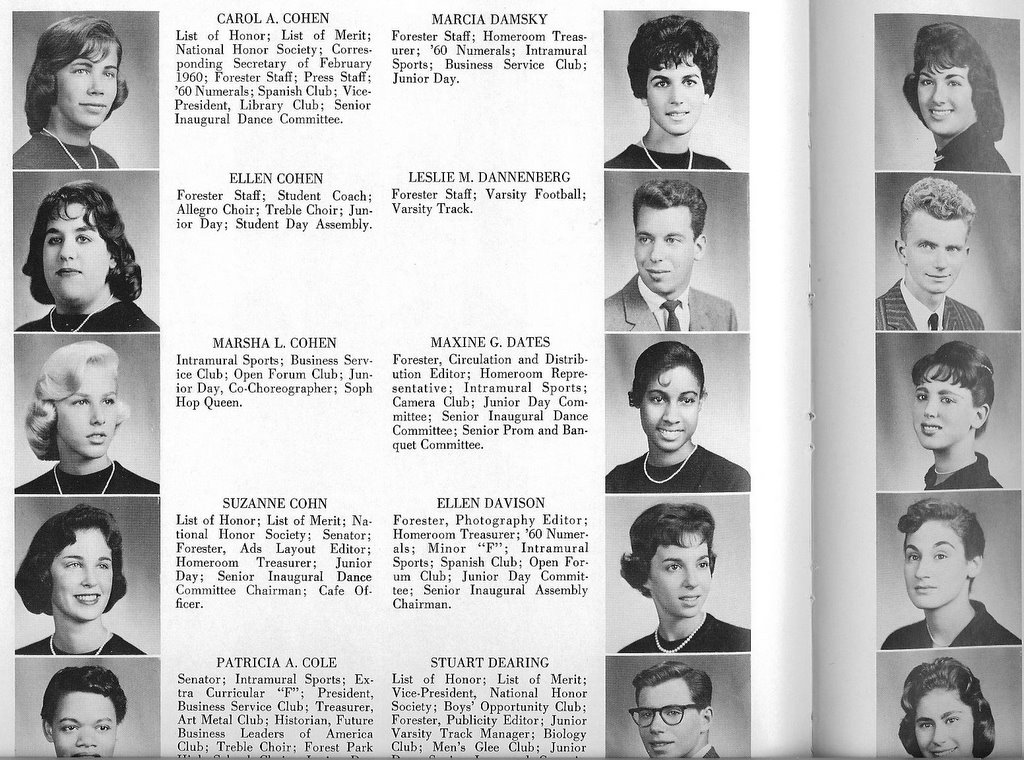
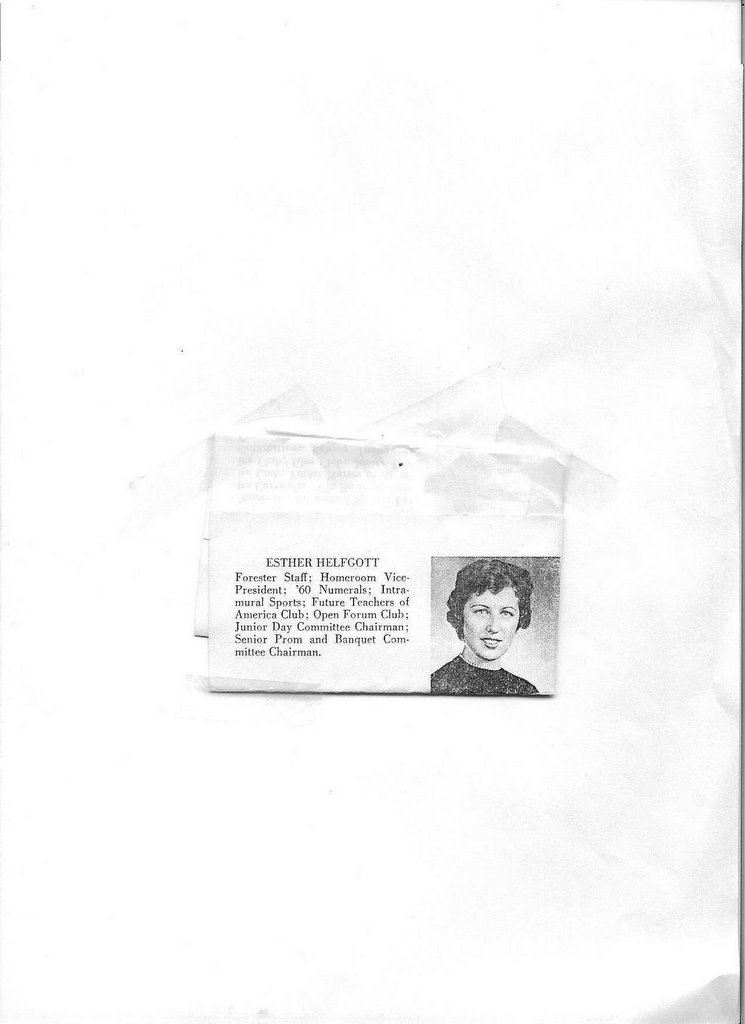 ....and we all wore pearls.
Trigger Poem, Waldman, Fast Speaking Woman, Women's Writing Groups, Cancer Lifeline, Week of Nov. 28th
from Fast Speaking Woman by Anne Waldman
because i don't have to spit
because I don't have rubbish
because i don't have dust
because i don't have that which is in air
because I am air
let me try you with my magic power:
from Fast Speaking Woman by Anne Waldman, City Lights Books, 1999
because i don't have to spit
because I don't have rubbish
because i don't have dust
because i don't have that which is in air
because I am air
let me try you with my magic power:
I'm a shouting woman
I'm a speech woman
I'm an atmosphere woman
I'm an airtight woman
I'm a flesh woman
I'm a flexible woman
I'm a high-heeled woman
I'm a high-style woman
I'm an automobile woman
I'm a mobile woman
I'm an elastic woman
I'm a necklace woman
I'm a silk-scarf woman
I'm a know-nothing woman
I'm a know-it-all woman
I'm a day woman
I'm a doll woman
...
from Fast Speaking Woman by Anne Waldman, City Lights Books, 1999
Wednesday, November 23, 2005
Esther's Healing Arts Writing Space
"In my healing arts writing groups we find a space for confidence- building and community formation, a place where self-esteem and courage blossoms. Here we come to look at our lives and celebrate ourselves and each other.
"My goal is for us to find a place of strength and non-marginality. No one is on the edge here, on the outskirts looking in. We are all, each one of us, smack in the middle of experience and knowledge that we lend to each other -- through non-competitive discussion, writing, and sharing of work, if and when we are ready.
"We use writing, mostly poetry, to trigger imagination, memory, friendship, love, hate, ambiguity, fear, whatever comes along, even secrets we didn't know we had.
"My goal is for us to use writing to discover our authentic voice(s) on and off the page and to develop the confidence to use our voice(s) with determination.
"I am most concerned with writing process and writing as process; and though we work toward making our words clearer for others to understand and to understand ourselves better, worldly (or wordly) success is not an ingredient of the healing arts space, all the while we take pride in our accomplishments and in each other's accomplishments.
"Here in my healing arts writing groups, we listen to each other so we can hear more of ourselves; and we quiet ourselves so we can hear that much more of all those others who share our writing/living spaces with us."
If you are a cancer patient, recovering cancer patient, caregiver, co-worker, relative, friend or acquaintance of someone with cancer and would like to join us, please call Cancer Lifeline at 297-2100 or visit on-line.
Thanks for visiting,
Esther Altshul Helfgott
"My goal is for us to find a place of strength and non-marginality. No one is on the edge here, on the outskirts looking in. We are all, each one of us, smack in the middle of experience and knowledge that we lend to each other -- through non-competitive discussion, writing, and sharing of work, if and when we are ready.
"We use writing, mostly poetry, to trigger imagination, memory, friendship, love, hate, ambiguity, fear, whatever comes along, even secrets we didn't know we had.
"My goal is for us to use writing to discover our authentic voice(s) on and off the page and to develop the confidence to use our voice(s) with determination.
"I am most concerned with writing process and writing as process; and though we work toward making our words clearer for others to understand and to understand ourselves better, worldly (or wordly) success is not an ingredient of the healing arts space, all the while we take pride in our accomplishments and in each other's accomplishments.
"Here in my healing arts writing groups, we listen to each other so we can hear more of ourselves; and we quiet ourselves so we can hear that much more of all those others who share our writing/living spaces with us."
If you are a cancer patient, recovering cancer patient, caregiver, co-worker, relative, friend or acquaintance of someone with cancer and would like to join us, please call Cancer Lifeline at 297-2100 or visit on-line.
Thanks for visiting,
Esther Altshul Helfgott
Monday, November 21, 2005
Trigger Poem, Walcott, Love After Love, Women's Writing Groups, Cancer Lifeline, Week of Nov. 21st
Love After Love
The time will come
when, with elation
you will greet yourself arriving
at your own door, in your own mirror
and each will smile at the other's welcome,
and say, sit here. Eat.
You will love again the stranger who was your self.
Give wine. Give bread. Give back your heart
to itself, to the stranger who has loved you
all your life, whom you ignored
for another, who knows you by heart.
Take down the love letters from the bookshelf,
the photographs, the desperate notes,
peel your own image from the mirror.
Sit. Feast on your life.
- Derek Walcott
from Collected Poems 1948—1984 by Derek Walcott.
Copyright © 1986 by Derek Walcott.
The time will come
when, with elation
you will greet yourself arriving
at your own door, in your own mirror
and each will smile at the other's welcome,
and say, sit here. Eat.
You will love again the stranger who was your self.
Give wine. Give bread. Give back your heart
to itself, to the stranger who has loved you
all your life, whom you ignored
for another, who knows you by heart.
Take down the love letters from the bookshelf,
the photographs, the desperate notes,
peel your own image from the mirror.
Sit. Feast on your life.
- Derek Walcott
from Collected Poems 1948—1984 by Derek Walcott.
Copyright © 1986 by Derek Walcott.
Trigger Poem, Nye, You Have to Be Careful, Women's Writing Groups, Cancer Lifeline, Week of Nov. 14th
You Have to Be Careful
You have to be careful telling things.
Some ears are tunnels.
Your words will go in and get lost in the dark.
Some ears are flat pans like the miners used
looking for gold.
What you say will be washed out with the stones.
You look for a long time til you find the right ears.
Til then, there are birds and lamps to be spoken to,
a patient cloth rubbing shine in circles,
and the slow, gradually growing possibility
that when you find such ears
they already know.
-Naomi Shihab Nye
"You Have to Be Very Careful" from Words Under the Words: Selected Poems by Naomi Shihab Nye. Copyright © 1995.
You have to be careful telling things.
Some ears are tunnels.
Your words will go in and get lost in the dark.
Some ears are flat pans like the miners used
looking for gold.
What you say will be washed out with the stones.
You look for a long time til you find the right ears.
Til then, there are birds and lamps to be spoken to,
a patient cloth rubbing shine in circles,
and the slow, gradually growing possibility
that when you find such ears
they already know.
-Naomi Shihab Nye
"You Have to Be Very Careful" from Words Under the Words: Selected Poems by Naomi Shihab Nye. Copyright © 1995.
Monday, November 14, 2005
Trigger Poem, Weil, The Paper Bag, Women's Writing Groups, Cancer Lifeline, Week of Nov. 7th
The Paper Bag
Fill up a paper bag with
Spring sounds and
Open it in December
Fill up a paper bag with
Snow flurries and
Use them to decorate your bedroom
Fill up a paper bag with
Ribbons and
Fly them when you want a word with the wind
Fill up a paper bag with
Winter quiet and
Open it when it's time to be alone
Fill up a paper bag with
Your favorite words and
Shake it till a good story comes out
Fill up a paper bag with
Secrets and
Share them with a friend every so often
Fill up a paper bag with
Velvet
Just to have it
-Zaro Weil
“Paper Bag” from Mud, Moon and Me by Zaro Weil
copyright © 1989 by Zaro Weil
Fill up a paper bag with
Spring sounds and
Open it in December
Fill up a paper bag with
Snow flurries and
Use them to decorate your bedroom
Fill up a paper bag with
Ribbons and
Fly them when you want a word with the wind
Fill up a paper bag with
Winter quiet and
Open it when it's time to be alone
Fill up a paper bag with
Your favorite words and
Shake it till a good story comes out
Fill up a paper bag with
Secrets and
Share them with a friend every so often
Fill up a paper bag with
Velvet
Just to have it
-Zaro Weil
“Paper Bag” from Mud, Moon and Me by Zaro Weil
copyright © 1989 by Zaro Weil
Wednesday, November 09, 2005
After He's Gone
I will dwell
where I am
and use
what is
in me
to remember.
~~~~~~~~~~~~~~~~~~~~~~~~~~~~~~~~~~~~~~~~~~
~~~~~~~~~~~~~~~~~~~~~~~~~~~~~~~~~~~~~~~~~~
Nov. 23 '05
I think the above, Nov. 09, '05 diary-entry, will be my last for awhile on Alzheimer's, at least to publish here. The disease is taking its toll, and I must move my writing and thinking forward into other spaces, all the while I continue caring for my husband (at home) and interacting with this nightmarish disease.
where I am
and use
what is
in me
to remember.
~~~~~~~~~~~~~~~~~~~~~~~~~~~~~~~~~~~~~~~~~~
~~~~~~~~~~~~~~~~~~~~~~~~~~~~~~~~~~~~~~~~~~
Nov. 23 '05
I think the above, Nov. 09, '05 diary-entry, will be my last for awhile on Alzheimer's, at least to publish here. The disease is taking its toll, and I must move my writing and thinking forward into other spaces, all the while I continue caring for my husband (at home) and interacting with this nightmarish disease.
Tuesday, November 08, 2005
Ativan, a Blessing?
After two weeks
of sleep
deprivation
for both of us
I give him the Ativan
and get a whole night's sleep.
(Well, almost).
And so does he.
(Well, almost),
but he wobbles in the morning.
(At least).
And getting up from a chair
is har
der.
And in adult care
he sleeps,
so they'll
keep him there.
Until
I pick him up
and night
begins
again, as day
doesn't.
of sleep
deprivation
for both of us
I give him the Ativan
and get a whole night's sleep.
(Well, almost).
And so does he.
(Well, almost),
but he wobbles in the morning.
(At least).
And getting up from a chair
is har
der.
And in adult care
he sleeps,
so they'll
keep him there.
Until
I pick him up
and night
begins
again, as day
doesn't.
Sunday, November 06, 2005
Spouse as Home
I didn't know he
was my shul
my language
my mother tongue
and prayer
the zeyde I lost,
and bubbies
I never had.
Or that he was my homeland.
And exile.
My nakedness.
I didn’t know
when I met him
twenty five years ago
that I had needed
a place to
dwell
in.
Or that knowing
turned less
into more
And more
into
less.
Oh,
where
shall I dwell
when he’s
gone
Where
shall
I
when
he’s
Where
I
-Esther Altshul Helfgott
was my shul
my language
my mother tongue
and prayer
the zeyde I lost,
and bubbies
I never had.
Or that he was my homeland.
And exile.
My nakedness.
I didn’t know
when I met him
twenty five years ago
that I had needed
a place to
dwell
in.
Or that knowing
turned less
into more
And more
into
less.
Oh,
where
shall I dwell
when he’s
gone
Where
shall
I
when
he’s
Where
I
-Esther Altshul Helfgott
Friday, November 04, 2005
As I Sit In Class
I think of him
wanting
to come home,
how I pinned
my business card
to his undershirt.
On the back
I wrote:
You're in Adult Day Care.
I'm going to class.
I'll pick you up
at 1:30 p.m.
He reads the words
with me. I kiss him
goodbye,
give the nurse
a plastic baggie
filled with tylenol
and a just-in-case Ativan.
In class,
Jeanne, Mary
and I
write
and talk
about writing.
We read Bill Stafford's
What's In My Journal
while my first cell phone
sits unringing
but ready
on the desk by the door.
-Esther Altshul Helfgott
wanting
to come home,
how I pinned
my business card
to his undershirt.
On the back
I wrote:
You're in Adult Day Care.
I'm going to class.
I'll pick you up
at 1:30 p.m.
He reads the words
with me. I kiss him
goodbye,
give the nurse
a plastic baggie
filled with tylenol
and a just-in-case Ativan.
In class,
Jeanne, Mary
and I
write
and talk
about writing.
We read Bill Stafford's
What's In My Journal
while my first cell phone
sits unringing
but ready
on the desk by the door.
-Esther Altshul Helfgott
Tuesday, November 01, 2005
Analytic Entrapment
The Fall 2005 issue of American Imago came in the mail this weekend. It's an important compendium of essays on various forms of imprisonment. I am pleased to say that my essay, Analytic Entrapment , concerning my psychoanalytic experience is included. I thank Peter L. Rudnytsky, editor of American Imago and Murray M. Schwartz, guest editor, for their important comments while the essay was in progress and for the integrity they demonstrate in printing an essay from the analysand's point of view.
Abstract: This essay examines a four-and-a-half year, five-day-a-week psychoanalysis, with a traditional male analyst, from the point of view of a female analysand. Drawing on diaries she kept during this period, January 1990 – June 1994, as well as on those she wrote before and after the analysis, the author argues that an erotic transference that is not supervised well by the analyst, especially when he does not control his erotic countertransference, can produce feelings of psychological entrapment on the part of the analysand. The analyst’s refusal to deal with the here and now between him and the analysand can damage an otherwise creative analytic relationship and it can threaten psychoanalysis as an art form.
The essays can be accessed through Project Muse at any university library. In Seattle, at Suzzallo, our wonderful librarians (I adore librarians. How would we live without them!)on the periodicals floor will offer you a friendly hand.
American Imago
Volume 62, Number 3, Fall 2005
Special Issue: Experiences of Imprisonment
Guest Editor: Murray M. Schwartz
The Johns Hopkins University Press
CONTENTS
Schwartz, Murray M.
Preface
Hopkins, Brooke.
Winnicott and Imprisonment
Subjects:
Winnicott, D. W. (Donald Woods), 1896-1971.
Juvenile delinquency -- Psychological aspects.
Imprisonment -- Psychological aspects.
Solitude -- Psychological aspects.
Davis, Walter A. (Walter Albert), 1942-
Between Two Deaths: Life on the Row
Subjects:
Drama.
Skorczewski, Dawn.
Bergman, Anni, 1919-
Getting Attica Out of Her Mind: A Psychoanalytic Memoir
Subjects:
Autistic children -- Case studies.
Helfgott, Esther Altshul.
Analytic Entrapment
Subjects:
Helfgott, Esther Altshul.
Women analysands -- Biography.
Psychotherapist and patient.
Transference (Psychology)
Psychoanalysis -- Moral and ethical aspects.
Letter from London
Kahr, Brett.
Why Freud Turned Down $25,000: Mental Health Professionals in the Witness Box
Subjects:
Freud, Sigmund, 1856-1939.
Leopold, Nathan Freudenthal, 1904 or 5-1971 -- Trials, litigation, etc.
Loeb, Richard A., 1905 or 6-1936 -- Trials, litigation, etc.
Book Reviews
Schapiro, Barbara A.
The Death-Ego and the Vital Self: Romances of Desire in Literature and Psychoanalysis (review)
Sharon-Zisser, Shirley, 1962-
The Cambridge Companion to Lacan (review)
as per American Imago
Abstract: This essay examines a four-and-a-half year, five-day-a-week psychoanalysis, with a traditional male analyst, from the point of view of a female analysand. Drawing on diaries she kept during this period, January 1990 – June 1994, as well as on those she wrote before and after the analysis, the author argues that an erotic transference that is not supervised well by the analyst, especially when he does not control his erotic countertransference, can produce feelings of psychological entrapment on the part of the analysand. The analyst’s refusal to deal with the here and now between him and the analysand can damage an otherwise creative analytic relationship and it can threaten psychoanalysis as an art form.
The essays can be accessed through Project Muse at any university library. In Seattle, at Suzzallo, our wonderful librarians (I adore librarians. How would we live without them!)on the periodicals floor will offer you a friendly hand.
American Imago
Volume 62, Number 3, Fall 2005
Special Issue: Experiences of Imprisonment
Guest Editor: Murray M. Schwartz
The Johns Hopkins University Press
CONTENTS
Schwartz, Murray M.
Preface
Hopkins, Brooke.
Winnicott and Imprisonment
Subjects:
Winnicott, D. W. (Donald Woods), 1896-1971.
Juvenile delinquency -- Psychological aspects.
Imprisonment -- Psychological aspects.
Solitude -- Psychological aspects.
Davis, Walter A. (Walter Albert), 1942-
Between Two Deaths: Life on the Row
Subjects:
Drama.
Skorczewski, Dawn.
Bergman, Anni, 1919-
Getting Attica Out of Her Mind: A Psychoanalytic Memoir
Subjects:
Autistic children -- Case studies.
Helfgott, Esther Altshul.
Analytic Entrapment
Subjects:
Helfgott, Esther Altshul.
Women analysands -- Biography.
Psychotherapist and patient.
Transference (Psychology)
Psychoanalysis -- Moral and ethical aspects.
Letter from London
Kahr, Brett.
Why Freud Turned Down $25,000: Mental Health Professionals in the Witness Box
Subjects:
Freud, Sigmund, 1856-1939.
Leopold, Nathan Freudenthal, 1904 or 5-1971 -- Trials, litigation, etc.
Loeb, Richard A., 1905 or 6-1936 -- Trials, litigation, etc.
Book Reviews
Schapiro, Barbara A.
The Death-Ego and the Vital Self: Romances of Desire in Literature and Psychoanalysis (review)
Sharon-Zisser, Shirley, 1962-
The Cambridge Companion to Lacan (review)
as per American Imago
Saturday, October 29, 2005
More
All the while
he loses language
he develops
the ability
to find
and use words
that du-
plicate his
emotions.
In this aw-
ful season
of rain,
he's found
a new way
of learning,
of teaching him
self
more
about him
self
and his
seventy-seven
years
of life.
In so doing,
this moment
in our lives
together
gifts me
gifts him
gifts us
with unraveling
questions
and apostrophes
between us.
This new use of language -
the mumblings and ramblings –
(that others think are meaningless
unhooked together sentences of drivel)
contains answers I have looked for
throughout our twenty-five
year-old marriage bed.
Now,
indecipherable
speech
is breath
ing
moreness
into
our
unused up
lives.
-Esther Altshul Helfgott
he loses language
he develops
the ability
to find
and use words
that du-
plicate his
emotions.
In this aw-
ful season
of rain,
he's found
a new way
of learning,
of teaching him
self
more
about him
self
and his
seventy-seven
years
of life.
In so doing,
this moment
in our lives
together
gifts me
gifts him
gifts us
with unraveling
questions
and apostrophes
between us.
This new use of language -
the mumblings and ramblings –
(that others think are meaningless
unhooked together sentences of drivel)
contains answers I have looked for
throughout our twenty-five
year-old marriage bed.
Now,
indecipherable
speech
is breath
ing
moreness
into
our
unused up
lives.
-Esther Altshul Helfgott
Reading with Alzheimer's
Sprawled out
in the recliner
wearing
a tie-dyed shirt
the kids
gave him,
a Middle Eastern
yarmulke
on his head,
he holds
a book of stories
in his hands,
turns
the pages
as he always did:
carefully,
respectfully,
leaning, learning
words the brain loses
before he under-
stands.
-Esther Altshul Helfgott
in the recliner
wearing
a tie-dyed shirt
the kids
gave him,
a Middle Eastern
yarmulke
on his head,
he holds
a book of stories
in his hands,
turns
the pages
as he always did:
carefully,
respectfully,
leaning, learning
words the brain loses
before he under-
stands.
-Esther Altshul Helfgott
Wednesday, October 26, 2005
No Ativan This Night, He’s Home With Me
He did not need an Ativan last night.
He did not need restraint,
even redirection.
He was with me
here at home
sleeping comfortably
in his own bed.
Bessie Burton’s Alzheimer’s
unit is supposed to be one of the best
in the city. I beg your pardon.
I doubt if there is a best
in any city when speaking
of Alzheimer’s.
There is no differentiation
between high functioning, as Abe is,
and low functioning
where people take their clothes
off in the halls, need constant redirection
and restraint.
Is it not the psychotropic drugs
that psychiatrists and drug companies
push down our throats – and it is our throats,
all of ours –
to keep us out of danger
as they say,
that make Alzheimer’s patients
that way in the first place,
instead of calming them down,
as they’re supposed to do.
I could not leave him in that place of horror
where people are doped
up and warehoused
without concern
for individuality.
He didn’t need Ativan last night
and I doubt if he needed it in the hospital.
What he needs, of course:
lips on the forehead
a back massage
and the strength that I give him.
As I gave to my children
(even as a single parent)
and to my mother (or tried to).
And I can give it to him,
even more than I did then.
Because I am, believe it or not -
it is true - wiser
for the age
I have been given,
so far.
May age be for a blessing
instead of a curse.
Amen.
-Esther Altshul Helfgott
He did not need restraint,
even redirection.
He was with me
here at home
sleeping comfortably
in his own bed.
Bessie Burton’s Alzheimer’s
unit is supposed to be one of the best
in the city. I beg your pardon.
I doubt if there is a best
in any city when speaking
of Alzheimer’s.
There is no differentiation
between high functioning, as Abe is,
and low functioning
where people take their clothes
off in the halls, need constant redirection
and restraint.
Is it not the psychotropic drugs
that psychiatrists and drug companies
push down our throats – and it is our throats,
all of ours –
to keep us out of danger
as they say,
that make Alzheimer’s patients
that way in the first place,
instead of calming them down,
as they’re supposed to do.
I could not leave him in that place of horror
where people are doped
up and warehoused
without concern
for individuality.
He didn’t need Ativan last night
and I doubt if he needed it in the hospital.
What he needs, of course:
lips on the forehead
a back massage
and the strength that I give him.
As I gave to my children
(even as a single parent)
and to my mother (or tried to).
And I can give it to him,
even more than I did then.
Because I am, believe it or not -
it is true - wiser
for the age
I have been given,
so far.
May age be for a blessing
instead of a curse.
Amen.
-Esther Altshul Helfgott
Friday, October 21, 2005
Laboratory Visit
The first time
I see him
hold a colon,
blood dripping
through the fingers
of his latex
gloves, I
want to flee
the laboratory
and the team
of hovering
technicians, this one
handing him a scalpel
that one, the scissors
he took from home.
But instead of running
as I want to,
and I really really want to, I
slump ouside the door
as he cuts.
The procedure ended,
my breath just back,
we return to his office
with the sign: Dr. Schweid,
on the door. I watch him
change from his white lab coat
to a tweed sports jacket
in time for a meeting
and a tuna salad sandwich
I can't touch.
-Esther Altshul Helfgott
I see him
hold a colon,
blood dripping
through the fingers
of his latex
gloves, I
want to flee
the laboratory
and the team
of hovering
technicians, this one
handing him a scalpel
that one, the scissors
he took from home.
But instead of running
as I want to,
and I really really want to, I
slump ouside the door
as he cuts.
The procedure ended,
my breath just back,
we return to his office
with the sign: Dr. Schweid,
on the door. I watch him
change from his white lab coat
to a tweed sports jacket
in time for a meeting
and a tuna salad sandwich
I can't touch.
-Esther Altshul Helfgott
The Old Pathologist
I hold him
in my arms
as if he were
the remnants
of the baby au-
topsy he did
that day
in 1990
when I lost
those forty pages
of my writing
to the broken harddrive.
And looked, as he said,
as stricken
as the infant's mother
when the doctor said:
Your child is dead.
Now his head in my lap,
I stroke his brow and kiss his lips.
Our tears fill each other's mouths
as we gasp for sounds of one more tomorrow
and give us back our yesterdays.
-Esther Altshul Helfgott
in my arms
as if he were
the remnants
of the baby au-
topsy he did
that day
in 1990
when I lost
those forty pages
of my writing
to the broken harddrive.
And looked, as he said,
as stricken
as the infant's mother
when the doctor said:
Your child is dead.
Now his head in my lap,
I stroke his brow and kiss his lips.
Our tears fill each other's mouths
as we gasp for sounds of one more tomorrow
and give us back our yesterdays.
-Esther Altshul Helfgott
Friday, October 14, 2005
Tuesday, October 11, 2005
The Tragedy of Alzheimer's
Nobody knows what to do, including/especially the doctors, at least those I am associated with at Group Health. They have absolutely no idea what it means to go from A to B with an Alzheimer's victim, no understanding of what it means to get him dressed and into a car to take him to an appointment.
Too exhausted to go on with this, just to say he needs a hospital bed and we're waiting for one to become available, no thanks to his MD.
Thanks everyone for calling/emails/etc. Keep 'em coming. This is a most isolating experience for both of us.
Too exhausted to go on with this, just to say he needs a hospital bed and we're waiting for one to become available, no thanks to his MD.
Thanks everyone for calling/emails/etc. Keep 'em coming. This is a most isolating experience for both of us.
Monday, October 10, 2005
Movies I've Watched This Week
The Sea of Grass (1947) - drama/western - Hepburn and Tracy
The Locket (1946) - film-noire - Loraine Day, Robert Mitchum, Brian Ahern
To Have and Have Not (1944) - thriller - Bogart and Bacall, Walter Brennan
Dangerous (1935) - drama - Bette Davis, Franchot Tone
The Locket (1946) - film-noire - Loraine Day, Robert Mitchum, Brian Ahern
To Have and Have Not (1944) - thriller - Bogart and Bacall, Walter Brennan
Dangerous (1935) - drama - Bette Davis, Franchot Tone
Tuesday, October 04, 2005
Nursing home? I don't think so, Doctor!
On this first day of Rosh Hashanah, Abe and I pay a visit to his doctor, a geriatrician, trained to deal with the illnesses that develop as a result of growing old. Even though Alzheimer's/visits/the homes/of young adults, it is generally found in the brains of the old and the old old; so one would expect that medical personnel treating people with this disease would have information in their knowledge banks that includes resources and advice broader than time for a nursing home.
The words didn't come out exactly in that form, but for the third time in a row, nursing home emerged from this doctor's mouth within two minutes of my talk with him. (This time, after Abe was out of the room and a volunteer had come to take him for an EKG). Never mind, the geriatrician didn't ask me what I thought of such a suggestion, much less Abe.
After all, this is an HMO and 15 minutes, maybe it's ten, isn't enough time for discussing the hospital's approach to Alzheimer's, as the good doctor informed me. He had to see other patients and we were late anyway. Never mind, I've waited in that hospital 30 to 40 minutes to see health care workers.
There seems to be a policy, written or not, that once a person is diagnosed with Alzheimer's the attitude that follows is: be gone, be gone. If Abe is treated this way - he was a physician for 43 years, 20 at this particular hospital - how are others treated? I'll be darn if I'll squirrel someone away, anyone, - and certainly not my husband - just because society, including the medical establishment, doesn't know how to confront a disease that is growing in leaps and bounds in our 21st century.
I do not want my husband to go to a nursing home. If we got to the point where I absolutely couldn't take care of him, that would be one thing, but we have help and I'm doing a good job. We have a lovely home with a porch that sits in the sun (or rain) and he has a favorite chair and loves to watch the trees.
We had an elevator put in the house and are in the midst of enstalling grab bars in just the right places. All I ask of the medical establishment is to treat Abe as a whole person rather than what can I do for you today, what seems to be the problem? I had spent half an hour on the phone trying to get through to the doctor's office, including explaining to the nurse what was happening. The doctor said he only got a sketchy report. So you start to tell Mr. Professional and he says, oh, we can only talk about one thing today. Is it chest pains or agitation? Well, the two are entwined.... Hello? Are you there?
I'd like to discuss the possibility of hospice or other resources helping out. From what I understand 6 months is no longer the bar... that's when nursing home popped up and I wonder what a hospital system gets out of pushing (or suggesting)nursing home care on patients who are not ready for it and on families who don't want it. What is behind not helping patients stay in their own homes? Who's getting paid off here? Tomorrow I'll call for an appointment with the chief-of-staff.
Another peeve: shouldn't a geriatrician be cognizant of the fact that an Alzheimer patient has greater needs than most people and that slowness is characteristic of the disease, along with a long list of other physical and social impairments that not only affect him but his primary caregiver? Isn't there a place in the system for something happening along the way, regardless of the time you start out for the appoinment, that could immobilize progress toward the practitioner's door?
I guess that's enough ranting for tonight... I'll either read or find some junk on tv. I wish I had some chocolate in the house. What possessed me to pass it by when picking things off the super market shelves? oy!
Did I mention that I have three major articles coming out and got this last one done in August while taking care of Abe? That doctor didn't ask us one question about what I thought was best for Abe and me. Maybe he just assumes it's too much for you. That's the standard comment. Well, let me be the judge of that, Sir. Of course it's a Sir.
And I'll tell you something else, if the situation were reversed, Abe would be holding my hand every step of the way. He wouldn't put me in a nursing home unless he absolutely couldn't take care of me, and that's what happened with my mother. I just couldn't take care of her anymore (in many ways). But I still can, Abe, and until then, I will. To the best of my ability.
The words didn't come out exactly in that form, but for the third time in a row, nursing home emerged from this doctor's mouth within two minutes of my talk with him. (This time, after Abe was out of the room and a volunteer had come to take him for an EKG). Never mind, the geriatrician didn't ask me what I thought of such a suggestion, much less Abe.
After all, this is an HMO and 15 minutes, maybe it's ten, isn't enough time for discussing the hospital's approach to Alzheimer's, as the good doctor informed me. He had to see other patients and we were late anyway. Never mind, I've waited in that hospital 30 to 40 minutes to see health care workers.
There seems to be a policy, written or not, that once a person is diagnosed with Alzheimer's the attitude that follows is: be gone, be gone. If Abe is treated this way - he was a physician for 43 years, 20 at this particular hospital - how are others treated? I'll be darn if I'll squirrel someone away, anyone, - and certainly not my husband - just because society, including the medical establishment, doesn't know how to confront a disease that is growing in leaps and bounds in our 21st century.
I do not want my husband to go to a nursing home. If we got to the point where I absolutely couldn't take care of him, that would be one thing, but we have help and I'm doing a good job. We have a lovely home with a porch that sits in the sun (or rain) and he has a favorite chair and loves to watch the trees.
We had an elevator put in the house and are in the midst of enstalling grab bars in just the right places. All I ask of the medical establishment is to treat Abe as a whole person rather than what can I do for you today, what seems to be the problem? I had spent half an hour on the phone trying to get through to the doctor's office, including explaining to the nurse what was happening. The doctor said he only got a sketchy report. So you start to tell Mr. Professional and he says, oh, we can only talk about one thing today. Is it chest pains or agitation? Well, the two are entwined.... Hello? Are you there?
I'd like to discuss the possibility of hospice or other resources helping out. From what I understand 6 months is no longer the bar... that's when nursing home popped up and I wonder what a hospital system gets out of pushing (or suggesting)nursing home care on patients who are not ready for it and on families who don't want it. What is behind not helping patients stay in their own homes? Who's getting paid off here? Tomorrow I'll call for an appointment with the chief-of-staff.
Another peeve: shouldn't a geriatrician be cognizant of the fact that an Alzheimer patient has greater needs than most people and that slowness is characteristic of the disease, along with a long list of other physical and social impairments that not only affect him but his primary caregiver? Isn't there a place in the system for something happening along the way, regardless of the time you start out for the appoinment, that could immobilize progress toward the practitioner's door?
I guess that's enough ranting for tonight... I'll either read or find some junk on tv. I wish I had some chocolate in the house. What possessed me to pass it by when picking things off the super market shelves? oy!
Did I mention that I have three major articles coming out and got this last one done in August while taking care of Abe? That doctor didn't ask us one question about what I thought was best for Abe and me. Maybe he just assumes it's too much for you. That's the standard comment. Well, let me be the judge of that, Sir. Of course it's a Sir.
And I'll tell you something else, if the situation were reversed, Abe would be holding my hand every step of the way. He wouldn't put me in a nursing home unless he absolutely couldn't take care of me, and that's what happened with my mother. I just couldn't take care of her anymore (in many ways). But I still can, Abe, and until then, I will. To the best of my ability.
Sunday, October 02, 2005
Mary Oliver's Bone
for Abe
Today, I read him Mary Oliver's Bone.
He loves it so, he cries
and cries
until the tears
fall
into his mouth
and flood
the tide she searches for
in the ear
bone
of the pilot whale
she finds
on the beach
in Provincetown.
In Seattle,
her book re-
turned
to our shelf
I fold
our hearts
in-
to each other
as we sleep
in-
to the
wet
night.
-Esther Altshul Helfgott
Today, I read him Mary Oliver's Bone.
He loves it so, he cries
and cries
until the tears
fall
into his mouth
and flood
the tide she searches for
in the ear
bone
of the pilot whale
she finds
on the beach
in Provincetown.
In Seattle,
her book re-
turned
to our shelf
I fold
our hearts
in-
to each other
as we sleep
in-
to the
wet
night.
-Esther Altshul Helfgott
Friday, September 30, 2005
Robert Pinsky
Wednesday, September 28, 2005
Dahlia Ravikovitch
SURELY YOU REMEMBER
by Dahlia Ravikovitch (translated from the Hebrew
by Chana Bloch and Ariel Bloch)
After they all leave,
I remain alone with the poems,
some poems of mine, some of others.
I prefer poems that others have written.
I remain quiet, and slowly
the knot in my throat dissolves.
I remain.
Sometimes I wish everyone would go away.
Maybe it's nice, after all, to write poems.
You sit in your room and the walls grow taller.
Colors deepen.
A blue kerchief becomes a deep well.
You wish everyone would go away.
You don't know what's the matter with you.
Perhaps you'll think of something.
Then it all passes, and you are pure crystal.
After that, love.
Narcissus was so much in love with himself.
Only a fool doesn't understand
he loved the river, too.
You sit alone.
Your heart aches, but
it won't break.
The faded images wash away one by one.
Then the defects.
A sun sets at midnight. You remember
the dark flowers too.
You wish you were dead or alive or
somebody else.
Isn't there a country you love? A word?
Surely you remember.
Only a fool lets the sun set when it likes.
It always drifts off too early
westward to the islands.
Sun and moon, winter and summer
will come to you,
infinite treasures.
-Dahlia Ravikovitch (1936 - 2005)
She died of suicide on August 30, 2005. She was 69 and might have been just starting. Read The Guardian's obituary
I took Ravikovitch's poem above from Eric M. Selinger's blog.
by Dahlia Ravikovitch (translated from the Hebrew
by Chana Bloch and Ariel Bloch)
After they all leave,
I remain alone with the poems,
some poems of mine, some of others.
I prefer poems that others have written.
I remain quiet, and slowly
the knot in my throat dissolves.
I remain.
Sometimes I wish everyone would go away.
Maybe it's nice, after all, to write poems.
You sit in your room and the walls grow taller.
Colors deepen.
A blue kerchief becomes a deep well.
You wish everyone would go away.
You don't know what's the matter with you.
Perhaps you'll think of something.
Then it all passes, and you are pure crystal.
After that, love.
Narcissus was so much in love with himself.
Only a fool doesn't understand
he loved the river, too.
You sit alone.
Your heart aches, but
it won't break.
The faded images wash away one by one.
Then the defects.
A sun sets at midnight. You remember
the dark flowers too.
You wish you were dead or alive or
somebody else.
Isn't there a country you love? A word?
Surely you remember.
Only a fool lets the sun set when it likes.
It always drifts off too early
westward to the islands.
Sun and moon, winter and summer
will come to you,
infinite treasures.
-Dahlia Ravikovitch (1936 - 2005)
She died of suicide on August 30, 2005. She was 69 and might have been just starting. Read The Guardian's obituary
I took Ravikovitch's poem above from Eric M. Selinger's blog.
Tuesday, September 27, 2005
My Sister’s Death: Brother
Let the County bury her
is what he said
his youngest sister
not
twenty-
four hours
dead
he said:
let the County
bury her
and turned
his head.
He
turned
his
head
and
turned
his
head.
-Esther Altshul Helfgott
(the poem above
is)
Today's
found wri-
ting
from Jan 1, 2005
on a sliver
of yellow-
lined
note-
pad
while
or
ga-
niz
ing
piles of pa-
pers
in my study
what
will
i
find
tomorrow?
is what he said
his youngest sister
not
twenty-
four hours
dead
he said:
let the County
bury her
and turned
his head.
He
turned
his
head
and
turned
his
head.
-Esther Altshul Helfgott
(the poem above
is)
Today's
found wri-
ting
from Jan 1, 2005
on a sliver
of yellow-
lined
note-
pad
while
or
ga-
niz
ing
piles of pa-
pers
in my study
what
will
i
find
tomorrow?
Mistakes
I worry
about turning
right
when I might have
turned left,
letting him
sleep
instead
of getting him up
for breakfast,
following his lead
when I might have
stood firm
in my instructions
to shower, dress,
eat, go for a walk
with Hassan,
the Kenyan caregiver
who watches over him
and the house
when I'm gone.
He is
independent
today
as he used to be
all the while needy
for old times: he cries
for mother,
father
gone fifty years
brother
issues
unresolved.
There is no
peace
in this man,
not this morning
not today. Really,
my mistakes
don't matter.
-Esther Altshul Helfgott
about turning
right
when I might have
turned left,
letting him
sleep
instead
of getting him up
for breakfast,
following his lead
when I might have
stood firm
in my instructions
to shower, dress,
eat, go for a walk
with Hassan,
the Kenyan caregiver
who watches over him
and the house
when I'm gone.
He is
independent
today
as he used to be
all the while needy
for old times: he cries
for mother,
father
gone fifty years
brother
issues
unresolved.
There is no
peace
in this man,
not this morning
not today. Really,
my mistakes
don't matter.
-Esther Altshul Helfgott
Thursday, September 22, 2005
Cynthia Ozick
Last night at Seattle Arts and Lectures.
I don't appreciate her cute and false attempts to put herself down or, as she says, drop names, but her literary gossip's delicious when not ridiculous (She made Susan Sontag cry. Ho hum) and some of her writing is the finest I've ever read. Try, for instance:
Cynthia Ozick : The Shawl
includes: "Rosa” from The New Yorker, March 21, 1983
I don't appreciate her cute and false attempts to put herself down or, as she says, drop names, but her literary gossip's delicious when not ridiculous (She made Susan Sontag cry. Ho hum) and some of her writing is the finest I've ever read. Try, for instance:
Cynthia Ozick : The Shawl
includes: "Rosa” from The New Yorker, March 21, 1983
Tuesday, September 13, 2005
Peanut Butter
According to today’s PI Zone page (for students with active brains),
As I figure it from first grade through sixth, 20 days a month x 6 months = 120 sandwiches x six years = 720 sandwiches (cream cheese and jelly made me gag).
Add the weekend sandwiches, including those I carried in a brown paper bag to the Avalon Theatre and ate in front of a movie screen every saturday afternoon, and we're up to, say, well, I didn't go every Saturday, so let's just add 45.
That makes 765 peanut butter and jelly sandwiches (didn't start eating peanut butter and honey sandwiches until later and not with peanut butter (minus the jam), raisins and bananas until later still.
Now onto junior high school. Same thing: 720 sandwiches, plus 45 = 765, bringing the pre-high school grand total to 1530.
This doesn't include the peanut butter and jelly saltines- or ritz cracker-sandwiches-on-a-plate-next-to-a-monopoly set on the living room floor, either. Or, the high school or college years.
Or the peanut butter on melba toast years or the peanut butter on celery sticks years, or the eating it with a spoon straight out of the jar (these) years. Doesn't matter what kind: creamy, crunchy, Skippy's, Jiffy's, natural.
No Ritz crackers, no Saltines, no Wonder Bread or lunch box. Just good old fashioned peanut butter.
Thank you, George Washington Carver, my favorite inventor (next to my father, whose inventions, unfortunately, never panned out; but that's another story).
If you’re average you eat about 4.5 pounds of fruit spread each year – and by the time you graduate from high school, you will have eaten 1,500 peanut butter and jelly sandwiches. (p. A8)
As I figure it from first grade through sixth, 20 days a month x 6 months = 120 sandwiches x six years = 720 sandwiches (cream cheese and jelly made me gag).
Add the weekend sandwiches, including those I carried in a brown paper bag to the Avalon Theatre and ate in front of a movie screen every saturday afternoon, and we're up to, say, well, I didn't go every Saturday, so let's just add 45.
That makes 765 peanut butter and jelly sandwiches (didn't start eating peanut butter and honey sandwiches until later and not with peanut butter (minus the jam), raisins and bananas until later still.
Now onto junior high school. Same thing: 720 sandwiches, plus 45 = 765, bringing the pre-high school grand total to 1530.
This doesn't include the peanut butter and jelly saltines- or ritz cracker-sandwiches-on-a-plate-next-to-a-monopoly set on the living room floor, either. Or, the high school or college years.
Or the peanut butter on melba toast years or the peanut butter on celery sticks years, or the eating it with a spoon straight out of the jar (these) years. Doesn't matter what kind: creamy, crunchy, Skippy's, Jiffy's, natural.
No Ritz crackers, no Saltines, no Wonder Bread or lunch box. Just good old fashioned peanut butter.
Thank you, George Washington Carver, my favorite inventor (next to my father, whose inventions, unfortunately, never panned out; but that's another story).
Saturday, September 10, 2005
Mean Spirited
Garrison Keillor's pick, "poetry readings," by Charles Bukowski (not my favorite poet) for Sunday, Sept. 11th, 2005
Friday, September 09, 2005
Like Mother, Like Son?
And so many of the people in the arena here, you know, were underprivileged anyway, so this, this is working very well for them.
-Barbara Bush
I can't believe she would say such a thing. What's the matter with that family? Is a gene loose somewhere?
-Barbara Bush
I can't believe she would say such a thing. What's the matter with that family? Is a gene loose somewhere?
Thursday, September 08, 2005
Pesha Gertler, Poet Populist!
CONGRATULATIONS PESHA,
OUR SHERO
I wasn't crazy about the competition among poets, but I love the outcome; and from what I saw, everyone had a good time.
Congratulatons also to Frank and Nick of the Seattle City Council for making this work.
OUR SHERO
I wasn't crazy about the competition among poets, but I love the outcome; and from what I saw, everyone had a good time.
Congratulatons also to Frank and Nick of the Seattle City Council for making this work.
Sunday, September 04, 2005
No slack for Bush, not from me
A response to: Give him some slack.
I am astounded when citizens of our Republic, our democratic union, do not hold Bush responsible for homeland security, I think he calls it. Born into the presidency illegally, exhalted for his swift presence at Ground Zero, he made a place for himself in history as a War president. Could George W. Bush have been any other kind of president? I don't think so. I don't believe that George W. Bush would know how to fill his presidential time if not for a war, if not for vacations with cronies on his Texas ranch; if not for ignoring war resisters whose children have been killed in a war he started.
Unfortunately for Bush, but not for our nation, Bush can not make a war out of natural disasters; he cannot blame natural disasters on foreign countries or terrorists. In the case of natural disasters, along with equality between the races, along with poverty, a president must pay attention to food in the kitchen, a roof over the kitchen, good schools, a national health care system; conversations on racism and poverty in America, as well as geologic engineering and global warming. Yes, Mr. President these problems are before us.
Have you not seen poverty and racism in the news recently, in those places your helicopter flew over, in our destroyed Southern cities? Tell me Mr. President what does your gaze take in? What do your eyes see? What registers in your particular idiosyncratic Caucasian mind? In order to deal with domestic issues, our homeland if you will, you must show yourself to be a mensch, Mr. President, a human being.
To accomplish this feat of becoming a mensch, and it is a feat - it takes a lot of work - you must not show arrogance or the pretense of kindness by kissing African American heads in front of televison cameras; instead, you must demonstrate that you have the public good at heart, that you are concerned about everyday ordinary people, whether they are living in the Louisiana Bowl, in urban neighborhoods, on farms or on a fault line in the Pacific Northwest. You must demonstrate, Mr. President, that you are concerned about service, about really serving your country.
Perhaps our current catastrophe will lead you on a path to righteousness, as you are wont to say in church on Sunday mornings. Perhaps in learning to deal with domestic issues, you may even learn something about neighborliness and interacting with citizens of other countries, say Iraq.
Until then, you get no slack from me, Mr. President. Nor do your supporters. Nor does FEMA or any other government agency that has not been doing its job. And doing its job means, among other things, not killing people by instructing them to evacuate when they have no cars or money to evacuate. It means not blaming the victim!
Mr. President, you created No Child Left Behind, but you left the children behind, along with their friends, parents, cousins, aunts, uncles and grandparents. You left them to die on roof tops and in stinking contaminated water turned cesspool, which you created by your lack of efficiency and, most of all, your lack of caring for all of our citizens.
Mr. President, you and your team dishonor us. You and your team, including the head of FEMA, Michael Brown, who had the nerve to say, When evacuation warnings go out, people should realize it's for their own good, dishonor us. You and your team dishonor all of us. Shame, Mr. President, shame. You've brought shame inside our communities, into our kitchens and living rooms. I know this isn't the first time ... but, somehow, tonight, it's especially hard to sleep ...
Esther Altshul Helfgott
I am astounded when citizens of our Republic, our democratic union, do not hold Bush responsible for homeland security, I think he calls it. Born into the presidency illegally, exhalted for his swift presence at Ground Zero, he made a place for himself in history as a War president. Could George W. Bush have been any other kind of president? I don't think so. I don't believe that George W. Bush would know how to fill his presidential time if not for a war, if not for vacations with cronies on his Texas ranch; if not for ignoring war resisters whose children have been killed in a war he started.
Unfortunately for Bush, but not for our nation, Bush can not make a war out of natural disasters; he cannot blame natural disasters on foreign countries or terrorists. In the case of natural disasters, along with equality between the races, along with poverty, a president must pay attention to food in the kitchen, a roof over the kitchen, good schools, a national health care system; conversations on racism and poverty in America, as well as geologic engineering and global warming. Yes, Mr. President these problems are before us.
Have you not seen poverty and racism in the news recently, in those places your helicopter flew over, in our destroyed Southern cities? Tell me Mr. President what does your gaze take in? What do your eyes see? What registers in your particular idiosyncratic Caucasian mind? In order to deal with domestic issues, our homeland if you will, you must show yourself to be a mensch, Mr. President, a human being.
To accomplish this feat of becoming a mensch, and it is a feat - it takes a lot of work - you must not show arrogance or the pretense of kindness by kissing African American heads in front of televison cameras; instead, you must demonstrate that you have the public good at heart, that you are concerned about everyday ordinary people, whether they are living in the Louisiana Bowl, in urban neighborhoods, on farms or on a fault line in the Pacific Northwest. You must demonstrate, Mr. President, that you are concerned about service, about really serving your country.
Perhaps our current catastrophe will lead you on a path to righteousness, as you are wont to say in church on Sunday mornings. Perhaps in learning to deal with domestic issues, you may even learn something about neighborliness and interacting with citizens of other countries, say Iraq.
Until then, you get no slack from me, Mr. President. Nor do your supporters. Nor does FEMA or any other government agency that has not been doing its job. And doing its job means, among other things, not killing people by instructing them to evacuate when they have no cars or money to evacuate. It means not blaming the victim!
Mr. President, you created No Child Left Behind, but you left the children behind, along with their friends, parents, cousins, aunts, uncles and grandparents. You left them to die on roof tops and in stinking contaminated water turned cesspool, which you created by your lack of efficiency and, most of all, your lack of caring for all of our citizens.
Mr. President, you and your team dishonor us. You and your team, including the head of FEMA, Michael Brown, who had the nerve to say, When evacuation warnings go out, people should realize it's for their own good, dishonor us. You and your team dishonor all of us. Shame, Mr. President, shame. You've brought shame inside our communities, into our kitchens and living rooms. I know this isn't the first time ... but, somehow, tonight, it's especially hard to sleep ...
Esther Altshul Helfgott
Saturday, September 03, 2005
Mike Moore to George W
Subject: Vacation is Over... an open letter from Michael Moore to George W. Bush
Friday, September 2nd, 2005
Dear Mr. Bush:
Any idea where all our helicopters are? It's Day 5 of Hurricane Katrina and thousands remain stranded in New Orleans and need to be airlifted. Where on earth could you have misplaced all our military choppers? Do you need help finding them? I once lost my car in a Sears parking lot. Man, was that a drag.
Also, any idea where all our national guard soldiers are? We could really use them right now for the type of thing they signed up to do like helping with national disasters. How come they weren't there to begin with?
Last Thursday I was in south Florida and sat outside while the eye of Hurricane Katrina passed over my head. It was only a Category 1 then but it was pretty nasty. Eleven people died and, as of today, there were still homes without power. That night the weatherman said this storm was on its way to New Orleans. That was Thursday! Did anybody tell you? I know you didn't want to interrupt your vacation and I know how you don't like to get bad news. Plus, you had fundraisers to go to and mothers of dead soldiers to ignore and smear. You sure showed her!
I especially like how, the day after the hurricane, instead of flying to Louisiana, you flew to San Diego to party with your business peeps. Don't let people criticize you for this -- after all, the hurricane was over and what the heck could you do, put your finger in the dike?
And don't listen to those who, in the coming days, will reveal how you specifically reduced the Army Corps of Engineers' budget for New Orleans this summer for the third year in a row. You just tell them that even if you hadn't cut the money to fix those levees, there weren't going to be any Army engineers to fix them anyway because you had a much more important construction job for them -- BUILDING DEMOCRACY IN IRAQ!
On Day 3, when you finally left your vacation home, I have to say I was moved by how you had your Air Force One pilot descend from the clouds as you flew over New Orleans so you could catch a quick look of the disaster. Hey, I know you couldn't stop and grab a bullhorn and stand on some rubble and act like a commander in chief. Been there done that.
There will be those who will try to politicize this tragedy and try to use it against you. Just have your people keep pointing that out. Respond to nothing. Even those pesky scientists who predicted this would happen because the water in the Gulf of Mexico is getting hotter and hotter making a storm like this inevitable. Ignore them and all their global warming Chicken Littles. There is nothing unusual about a hurricane that was so wide it would be like having one F-4 tornado that stretched from New York to Cleveland.
No, Mr. Bush, you just stay the course. It's not your fault that 30 percent of New Orleans lives in poverty or that tens of thousands had no transportation to get out of town. C'mon, they're black! I mean, it's not like this happened to Kennebunkport. Can you imagine leaving white people on their roofs for five days? Don't make me laugh! Race has nothing -- NOTHING -- to do with this!
You hang in there, Mr. Bush. Just try to find a few of our Army helicopters and send them there. Pretend the people of New Orleans and the Gulf Coast are near Tikrit.
Yours,
Michael Moore
MMFlint@aol.com
www.MichaelMoore.com
P.S. That annoying mother, Cindy Sheehan, is no longer at your ranch. She and dozens of other relatives of the Iraqi War dead are now driving across the country, stopping in many cities along the way. Maybe you can catch up with them before they get to DC on September 21st.
Friday, September 2nd, 2005
Dear Mr. Bush:
Any idea where all our helicopters are? It's Day 5 of Hurricane Katrina and thousands remain stranded in New Orleans and need to be airlifted. Where on earth could you have misplaced all our military choppers? Do you need help finding them? I once lost my car in a Sears parking lot. Man, was that a drag.
Also, any idea where all our national guard soldiers are? We could really use them right now for the type of thing they signed up to do like helping with national disasters. How come they weren't there to begin with?
Last Thursday I was in south Florida and sat outside while the eye of Hurricane Katrina passed over my head. It was only a Category 1 then but it was pretty nasty. Eleven people died and, as of today, there were still homes without power. That night the weatherman said this storm was on its way to New Orleans. That was Thursday! Did anybody tell you? I know you didn't want to interrupt your vacation and I know how you don't like to get bad news. Plus, you had fundraisers to go to and mothers of dead soldiers to ignore and smear. You sure showed her!
I especially like how, the day after the hurricane, instead of flying to Louisiana, you flew to San Diego to party with your business peeps. Don't let people criticize you for this -- after all, the hurricane was over and what the heck could you do, put your finger in the dike?
And don't listen to those who, in the coming days, will reveal how you specifically reduced the Army Corps of Engineers' budget for New Orleans this summer for the third year in a row. You just tell them that even if you hadn't cut the money to fix those levees, there weren't going to be any Army engineers to fix them anyway because you had a much more important construction job for them -- BUILDING DEMOCRACY IN IRAQ!
On Day 3, when you finally left your vacation home, I have to say I was moved by how you had your Air Force One pilot descend from the clouds as you flew over New Orleans so you could catch a quick look of the disaster. Hey, I know you couldn't stop and grab a bullhorn and stand on some rubble and act like a commander in chief. Been there done that.
There will be those who will try to politicize this tragedy and try to use it against you. Just have your people keep pointing that out. Respond to nothing. Even those pesky scientists who predicted this would happen because the water in the Gulf of Mexico is getting hotter and hotter making a storm like this inevitable. Ignore them and all their global warming Chicken Littles. There is nothing unusual about a hurricane that was so wide it would be like having one F-4 tornado that stretched from New York to Cleveland.
No, Mr. Bush, you just stay the course. It's not your fault that 30 percent of New Orleans lives in poverty or that tens of thousands had no transportation to get out of town. C'mon, they're black! I mean, it's not like this happened to Kennebunkport. Can you imagine leaving white people on their roofs for five days? Don't make me laugh! Race has nothing -- NOTHING -- to do with this!
You hang in there, Mr. Bush. Just try to find a few of our Army helicopters and send them there. Pretend the people of New Orleans and the Gulf Coast are near Tikrit.
Yours,
Michael Moore
MMFlint@aol.com
www.MichaelMoore.com
P.S. That annoying mother, Cindy Sheehan, is no longer at your ranch. She and dozens of other relatives of the Iraqi War dead are now driving across the country, stopping in many cities along the way. Maybe you can catch up with them before they get to DC on September 21st.
Thursday, September 01, 2005
Excuse me?
The president has wanted to visit the area as soon as possible," [White House press secretary Scott] McClellan said. "We didn't go sooner because we didn't want to be disruptive of efforts on the ground.
Bush Taps Father, Clinton for Relief Help
By NEDRA PICKLER, Associated Press Writer
52 minutes ago, comcast news
Or, perhaps, he didn't go sooner because, unlike with Sept. 11th, he couldn't blame a foreign country, thus, fill his presidency with another war.
Bush Taps Father, Clinton for Relief Help
By NEDRA PICKLER, Associated Press Writer
52 minutes ago, comcast news
Or, perhaps, he didn't go sooner because, unlike with Sept. 11th, he couldn't blame a foreign country, thus, fill his presidency with another war.
Wednesday, August 31, 2005
Iraq and New Orleans
The poor and black are in Iraq.
Which is better,
there?
Or, on a roof top
here
(in New
Or-
leans)
?
Good for Slate magazine's Jack Shafer for pointing out the inadequacies in our media's reportage.
Which is better,
there?
Or, on a roof top
here
(in New
Or-
leans)
?
Good for Slate magazine's Jack Shafer for pointing out the inadequacies in our media's reportage.
Saturday, August 27, 2005
note card, biography
I've been spending the last few days with Patricia Bosworth's biography of Diane Arbus (1923-1971), accessible and, from her point of view, honest. Bosworth was the daughter of Bartley Crum, one of the six lawyers who defended the Hollywood Ten. He was ruined, as those he defended were, having named names of two of the Hollywood Ten's defense lawyers; he committed suicide in 1959.
Patricia Bosworth's life was defined by her father's work and she, her mother and brother (who also suicided), suffered from his long absences. But Patricia transcend family hardship. Her father always taught her that she could do whatever she wanted. As a child, she modelled for the Diane and Allan Arbus Studio. As an adult she became a free-lance journalist and eventually a biographer, writing about those whose lives she, in some way, identified with, including Monty Clift, Marlon Brando and Arbus.
I like Bosworth's style. Arbus comes alive for me. Bosworth makes me love Diane but then she pulls me into reality to show the photographer's idiosyncrasies and shortcomings, her courage run amuck, along with the drive and talent she developed and used to deal with conflicts concerning sense of self, position in the family as daughter, sister, wife, mother and artist.
Diane Arbus came from a wealthy family. Her mother, Gertrude Russek, inherited her parents' New York Department Store, Russeks, which was eventually run by her philandering husband David Nemerov. Arbus was the sister of poet Howard Nemerov (1920-1991) and the sculptor, Renee Sparkia. She was married to photographer-turned-actor, Allan Arbus.
On July 27, 1971 at age 48, Diane was found in her bathtubm, wrists slit and, as the autopsy reported, filled with barbiturates. She left two children, Doon, now 58 and a playwright and Amy, a photographer, now 49. Allan Arbus, who played the psychiatrist, Maj. Sidney Freedman, in M.A.S.H. is 87 years old.
Although Bosworth didn't get such hot reviews - she's not an academic or an arty writer - so what - she writes a page turner, and I would do well to keep her style and commitment in mind while working on the Buxbaum book.
Patricia Bosworth's life was defined by her father's work and she, her mother and brother (who also suicided), suffered from his long absences. But Patricia transcend family hardship. Her father always taught her that she could do whatever she wanted. As a child, she modelled for the Diane and Allan Arbus Studio. As an adult she became a free-lance journalist and eventually a biographer, writing about those whose lives she, in some way, identified with, including Monty Clift, Marlon Brando and Arbus.
I like Bosworth's style. Arbus comes alive for me. Bosworth makes me love Diane but then she pulls me into reality to show the photographer's idiosyncrasies and shortcomings, her courage run amuck, along with the drive and talent she developed and used to deal with conflicts concerning sense of self, position in the family as daughter, sister, wife, mother and artist.
Diane Arbus came from a wealthy family. Her mother, Gertrude Russek, inherited her parents' New York Department Store, Russeks, which was eventually run by her philandering husband David Nemerov. Arbus was the sister of poet Howard Nemerov (1920-1991) and the sculptor, Renee Sparkia. She was married to photographer-turned-actor, Allan Arbus.
On July 27, 1971 at age 48, Diane was found in her bathtubm, wrists slit and, as the autopsy reported, filled with barbiturates. She left two children, Doon, now 58 and a playwright and Amy, a photographer, now 49. Allan Arbus, who played the psychiatrist, Maj. Sidney Freedman, in M.A.S.H. is 87 years old.
Although Bosworth didn't get such hot reviews - she's not an academic or an arty writer - so what - she writes a page turner, and I would do well to keep her style and commitment in mind while working on the Buxbaum book.
Tuesday, August 23, 2005
Suzzallo, a place of worship
I can't
remember
when it was
the last time
I walked
these stacks.
The smell
of nineteenth-
century
tomes:
the sound
of dark-
ness. The touch
of cracked
leath-
er. The taste.
Up
and down
the aisles
of centuries.
The feel
of dead
people
seeing
me.
-Esther Altshul Helfgott
remember
when it was
the last time
I walked
these stacks.
The smell
of nineteenth-
century
tomes:
the sound
of dark-
ness. The touch
of cracked
leath-
er. The taste.
Up
and down
the aisles
of centuries.
The feel
of dead
people
seeing
me.
-Esther Altshul Helfgott
Sunday, August 21, 2005
If at first you don't succeed ...
Adult day is history. I've hired a couple for in-home care. No more sitting around watching a game of balloon volley ball or interacting with staring strangers. He'll stay home, do what he wants: work at his desk, read, listen to music, think, get out the telescope, feed the dog, sit on the porch, peruse the roof tops and when it's clear as it has been, bask in the rays of The Mountain, nurturing, watchful mountain, Mama and Papa Ranier, hovering ....
Saturday, August 20, 2005
the brain, the powerful brain
On a selfish level, the worst part is not having him to talk to, stopping in the middle of a conversation I’m trying to have with him, a question I'm beginning to ask - what's this bone in the body or that - realizing I’m doing something wrong: taxing his brain.
It's almost the same as when I was seven, sitting at the kitchen table, trying to teach my brain damaged Uncle Benny how to read. But not quite.
He got lost yesterday; now I’m filling in the Alzheimer’s Association’s application for Safe Return.It's already taken an hour.
Why does everything have to take so damned long?
It's almost the same as when I was seven, sitting at the kitchen table, trying to teach my brain damaged Uncle Benny how to read. But not quite.
He got lost yesterday; now I’m filling in the Alzheimer’s Association’s application for Safe Return.It's already taken an hour.
Why does everything have to take so damned long?
Thursday, August 18, 2005
no two days are alike
This is what I wrote on Aug 13th:
Abe went to Adult Care twice this week and I see light at the end of the tunnel, at least on a daily basis. The Center is just a few blocks from our house - amazingly - and holds a warm loving atmosphere. He is physically and emotionally safe and I am. I was able to go to a doctor's appointment yesterday w/o worry and food shopping by myself for the first time in ages. I hate food shopping - that was something Abe always did - but this time I actually feel as if I am on vacation, both at the doctor’s office and at QFC.
Thurs Aug 18
Today’s a different story. He doesn’t want to go. It’s a prison, he says. There are big people there who have you under their thumb. I don’t want him to go either. I don’t have to work today or go for light treatments, so why does he have to go? We can stay home together, just hang out.
But, no, I think, we both need a schedule. He needs to get used to a safe environment without me, and I have to write without him standing over me, and I have to get the car fixed and walk around Greenlake (fat chance), and go food shopping, and read all those books I bought on Alzheimer’s, and go to the library to check on the footnotes for that essay I have to finish.
So I say I think we better get up and go, then I take away the I think, and am sure we need to get up and go and when I’m sure, he becomes so, and gets up from the bed (where he’s massaging my toes), and says ok, I’ll go. Now he’s in the shower, soaping up, and readier for the day than I am.
Abe went to Adult Care twice this week and I see light at the end of the tunnel, at least on a daily basis. The Center is just a few blocks from our house - amazingly - and holds a warm loving atmosphere. He is physically and emotionally safe and I am. I was able to go to a doctor's appointment yesterday w/o worry and food shopping by myself for the first time in ages. I hate food shopping - that was something Abe always did - but this time I actually feel as if I am on vacation, both at the doctor’s office and at QFC.
Thurs Aug 18
Today’s a different story. He doesn’t want to go. It’s a prison, he says. There are big people there who have you under their thumb. I don’t want him to go either. I don’t have to work today or go for light treatments, so why does he have to go? We can stay home together, just hang out.
But, no, I think, we both need a schedule. He needs to get used to a safe environment without me, and I have to write without him standing over me, and I have to get the car fixed and walk around Greenlake (fat chance), and go food shopping, and read all those books I bought on Alzheimer’s, and go to the library to check on the footnotes for that essay I have to finish.
So I say I think we better get up and go, then I take away the I think, and am sure we need to get up and go and when I’m sure, he becomes so, and gets up from the bed (where he’s massaging my toes), and says ok, I’ll go. Now he’s in the shower, soaping up, and readier for the day than I am.
Saturday, August 13, 2005
illness and new awareness
His illness is teaching me how to care for myself and to be concerned about my own needs as well as other people's; this, in quite astonishingly new ways. Most of all, that I have the right to acknowledge the work I do -- at home and outside the home -- in my teaching and writing and other activities. Incredible how little we/I know... in this my sixth decade.
The seond day of Adult Care went splendidly. When I picked him up, got him in the car and asked, how'd it go? , he said: what a dramatic day... Nice people ... are getting ... to know each other. He is physically and emotionally safe: We couldn't ask for anything more.
And oh, did I mention, we have a new grandchild, Little Boy Schweid, 8 lbs. 10 ounces, 21 " long. Abe's first from his own children. I printed the pictures out, hung them on the wall and he sits smiling at them. When one life wanes, another comes along to bring us new pleasure - which we can certainly use at this time - and new hope. He even remembered the name of his first wife today. And mine too - I think. Better go check! Do you believe I can still get jealous! Oh, the human condition: our smallnesses and foibles, at least mine...
The seond day of Adult Care went splendidly. When I picked him up, got him in the car and asked, how'd it go? , he said: what a dramatic day... Nice people ... are getting ... to know each other. He is physically and emotionally safe: We couldn't ask for anything more.
And oh, did I mention, we have a new grandchild, Little Boy Schweid, 8 lbs. 10 ounces, 21 " long. Abe's first from his own children. I printed the pictures out, hung them on the wall and he sits smiling at them. When one life wanes, another comes along to bring us new pleasure - which we can certainly use at this time - and new hope. He even remembered the name of his first wife today. And mine too - I think. Better go check! Do you believe I can still get jealous! Oh, the human condition: our smallnesses and foibles, at least mine...
Wednesday, August 10, 2005
first day
today the first day of adult day care i rush back before the designated time so fearful for the minutes spent away from me and safety. in a round room two more elderly men aware and not aware, smile and don't smile. a younger woman in a wheel chair. a table. an aide. a jigsaw puzzle. abe reads the national geographic, looks up, sees me. he's happy to see me, wondered was i coming back ...
Sunday, August 07, 2005
they'll page me when you get here

hospital all night
doctors
think
he's fine
forgetting to hear
the forty-five minutes
he backed and forthed
into a chair
trying to remember
how to sit down
what do they teach
in medical school?
possible TIA
he can go home
what about the test to predict if he'll have a full-blown stroke in seven days it won't do any good you wouldn't want him to have that big a surgery in his condition would you why not he could die he's dying anyway every day another piece of him is gone what about an angiogram? an mri? ... they'll page me when you get here. we'll talk. He didn't have a TIA; he'd had a fever, which kicked up the Alzheimer's, fast.
The doc turned out to be lovely, stayed with me more than an hour. She has a 6 month old baby and her mother has Alzheimer's. She called in a social worker for us, and on a Sunday. While the social worker was in the room, I saw that piece of Alzheimer's I'd only read about before tonight - more of the repetitive movements, again and again the folding: a bedspread here, a nightgown there.
Over and over, the folding, until corners matched up just so, the folds just right/precise. They had to be precise. It was his job and he was doing it, just as he had to find a way to sit in the chair by himself. It might have taken him 45 minutes, but he completed the task.
He found a way to sit down, without my help. He might as well have been at work reading a slide or performing an autopsy, so filled with concentration was he. By the time he snapped out of it, I'd finish sobbing; our rhythm was just right too.
The social worker said: You've never seen him do that before? No. Get used to it. That's what they do.
Saturday, August 06, 2005
the words won't stick to my cortex
To
night
I
ad
mit
he
can
no
lon
ger
read
all
the
while
he
sits
at
the
ta
ble
bent
o
ver
his
pa
per
pois-ed
to
read
I ask him:
What's happening?
The words won't to my cortex,
he says.
Stick?
Yes, stick.
The
wor
ds
wo
n't
sti
ck
to
my
cor
tex
swee
har
t.
night
I
ad
mit
he
can
no
lon
ger
read
all
the
while
he
sits
at
the
ta
ble
bent
o
ver
his
pa
per
pois-ed
to
read
I ask him:
What's happening?
The words won't to my cortex,
he says.
Stick?
Yes, stick.
The
wor
ds
wo
n't
sti
ck
to
my
cor
tex
swee
har
t.
Subscribe to:
Posts (Atom)

