Sometimes
if you move carefully
through the forest
breathing
like the ones
in the old stories
who could cross
a shimmering bed of dry leaves
without a sound.
you come
to a place
whose only task
is to trouble you
with tiny
but frightening requests
conceived out of nowhere
but in this place
beginning to lead everywhere.
Request to stop what
you are doing right now,
and
to stop what you
are becoming
while you do it,
questions
that can make
or unmake
a life,
questions
that have patiently
waited for you,
questions
that have no right
to go away.
©2003 by David Whyte
from Everything is Waiting for You
published by Many Rivers Press
Friday, January 27, 2006


Wednesday, January 18, 2006
Lea Goldberg poem, week of Jan 16 '06
Lea Goldberg (1911–1970), Israeli poet. Translation by Rachel Tzvia Black
Toward Myself
The years have made up my face
with memories of love
and have adorned my hair with light silver threads
making me most beautiful.
In my eyes
landscapes are reflected.
And the paths I have trod
have strengthened my stride-
tired and lovely steps.
If you should see me now
you would not recognize your yesterdays-
I am walking toward myself
bearing the face you searched for in vain
when I was walking toward you.
(From, "Selected Poetry and Drama," Toby Press, 2005, translated by Rachel
Tzvia Black and prose by T. Carmi)
Saturday, January 14, 2006
Inside Tales
Emily's job was to think.
She was the only one of us
who had that to do,
said Emily's
sister,
Lavinia,
on telling
her family's
inside
tales.
Whereas
in my family,
I took on the job
of think
er a
nd everyone else -
Mother
Father
Sister
Brother -
thought too,
think
ing was not
an act
that any one
of us
pronounced
useable.
It just was -
under
neath the bad
air,
fights
and scruffy furniture -
a way of liv
ing
with
the ag
o
ny
of
sel
f.
-Esther Altshul Helfgott
OR
Inside Tales
Emily's job was to think.
She was the only one of us
who had that to do,said Emily's
sister,
Lavinia,
on telling
her family's
inside
tales.
Whereas
in my family,
I took on the job
of thinker
and everyone else -
Mother
Father
Sister
Brother -
thought too,
thinking was not
an act
that any one of us
pronounced useable.
It just was -
underneath
the bad air,
fights
and scruffy furniture -
a way of living
with the agony
of self.
*******
No, I like the first one ...
She was the only one of us
who had that to do,
said Emily's
sister,
Lavinia,
on telling
her family's
inside
tales.
Whereas
in my family,
I took on the job
of think
er a
nd everyone else -
Mother
Father
Sister
Brother -
thought too,
think
ing was not
an act
that any one
of us
pronounced
useable.
It just was -
under
neath the bad
air,
fights
and scruffy furniture -
a way of liv
ing
with
the ag
o
ny
of
sel
f.
-Esther Altshul Helfgott
OR
Inside Tales
Emily's job was to think.
She was the only one of us
who had that to do,said Emily's
sister,
Lavinia,
on telling
her family's
inside
tales.
Whereas
in my family,
I took on the job
of thinker
and everyone else -
Mother
Father
Sister
Brother -
thought too,
thinking was not
an act
that any one of us
pronounced useable.
It just was -
underneath
the bad air,
fights
and scruffy furniture -
a way of living
with the agony
of self.
*******
No, I like the first one ...
Monday, January 09, 2006
Esther’s Classes, Trigger poem by Cathy Song, Week of Jan. 9, '06
A Poet in the House
by
Cathy Song
Emily’s job was to think.
She was the only one of us
who had that to do. - Lavinia Dickinson
Seemingly small her work,
minute to the point of invisibility –
she vanished daily into paper, famished,
hungry for her next encounter –
but she opened with a string of humble
words necessity,
necessary as the humble work
of bringing well to water, roast to knife, cake to frost,
the course, loud, grunting labor of the rest of us
who complained not at all
for the noises she heard
we deemed divine, if
claustrophobic and esoteric –
and contented ourselves to the apparent,
the menial, set our heads
to the task of daily maintenance,
the simple order at the kitchen table,
while she struggled with a different thing –
the pressure seized upon her mind –
we could ourselves not bear such strain
and, in gratitude, heaved the bucket,
squeezed the rag, breathed the sweet,
homely odor of soap.
Lifting dirt from the floor
I swear
we could hear her thinking.
Cathy Song, in Sweeping Beauty: contemporary women poets do housework, ed by Pamela Gemin, Univ of Iowa Prss, 2005
If anyone can figure out why the poet wrote the following lines in just so fashion, please let me know:
but she opened with a string of humble
words necessity,
necessary as the humble work
Don’t forget: CLL’s Women Writers Reading Series begins Jan. 18th at Ravenna 3rd Place Books, 6 pm. Sign up with Esther
Thursday, December 29, 2005
Two More Days for William Cumming Exhibit at the Frye
I just made it to the William Cumming exhibit at the Frye. Last day is Dec. 31st. His paintings of working people going about their daily lives --I love his drawings on newspaper: a man carrying boxes, a bag lady, a boy on a merry-go-round - the nudes, sculptures and cowboys - are striking for their accessibility, color, texture and motion.
I wish I could have gotten to the lectures and films - the Frye is so filled with erudition and magic! - associated with this Northwest painter's life, work and politics. I did venture into their seductive gift shop for curator Matthew Kangas' William Cumming: The Image of Consequence and Cummings' 1934 Memoir to keep my memory pumped.
Cummings is 89, I think, maybe 90 by now, and still painting here in Seattle. He reminds me of poet Stanley Kunitz. Wouldn't it be fun to match up some of Kunitz's poems with Cumming's paintings. Hmmm, and Philip Levine's too. Remember the not so long ago Poets and Writers Calendar? Don't you just miss hanging it up on your kitchen wall the first day of the New Year?
Friday, December 16, 2005
Preamble, 2
begun 12/12/05
Part II - Weaknesses
When I ended the last poem
(After He's Gone/Nov 9th)
I thought I ended the manuscript
it was over
then I passed through four weeks
of nothing
and limbo
I stayed
with myself
in that form
until one morning
I realized
the book was not
over, anymore than the lives
and the disease
I was writing about were.
I see now that the book is
in two parts (at least)
and I had not yet written
(or lived)
the second
what I did in Part One
was
write about
the good parts
only, and with them
glorified
romanticized
idealized
marriage
as if the loving
kindly
part was all that was there
Thursday, December 15, 2005
Death, the Unholy
Long before he should have,
he eluded decisions
about his death.
He did not want to tend
a mirage of promised
and unimagined
pleasures
when he knew
there were none, only
indecipherable
directions
to a non-existent
thoroughfare.
Now,
he looks back
on un-
filled spaces,
especially those
that held the word: Yes,
and in no uncertain
terms, he says:
Death is un-holy.
Un-holy. Pro-
fane.
In its lack.
-Esther Altshul Helfgott
This poem came about as a result of Rebecca Louden's exercise to do an Opposite Poem. She instructs: Take someone else's poem, and for each word, write what you think is its complete opposite. I began by following her directions and using Pesha Gertler's poem, The Healing Time. As I was working though, an idea emerged which felt more important to follow through on than word-play. Since my husband's Alzheimer's and death are on my mind, what evolved was the unholiness of Death in the face of Pesha's holy holy, the holiness of life. But now, as I write, I realize that it is Alzheimer's that is un-holy, and not Death.
Monday, December 12, 2005
This morning, his language
skills are good
and he uses them
to the utmost.
In the shower,
he yells:
Let me out of here!
Dressing him,
he pouts:
I can’t wear that.
Fixing his hair,
he says:
You must be
tearing
holes in my scalp.
Every time
you brush
my
head hurts.
I suppose,
I need
to find a gentler
faucet,
and a softer
brushing hand,
one with the child
still in it.
-Esther Altshul Helfgott
Pesha Gertler's Healing Time, trigger poem, Cancer Lifeline, Week of Dec. 12 '05
The Healing Time
Finally on my way to yes
I bump into
all the places
where I said no
to my life
all the untended wounds
the red and purple scars
those hieroglyphs of pain
carved into my skin, my bones,
those coded messages
that send me down
the wrong street
again and again
where I find them
the old wounds
the old misdirections
and I lift them
one by one
close to my heart
and I say holy
holy.
- Pesha Gertler
Copyright by Pesha Gertler
Tuesday, December 06, 2005
Trigger Poems from Emily Dickinson, Women's Writing Groups, Cancer Lifeline, Week of Dec. 5th
Poems "1587" and "1665" by Emily Dickinson from The Complete Poems of Emily Dickinson © Little, Brown. Reprinted with permission.
1587
He ate and drank the precious Words—
His Spirit grew robust—
He knew no more that he was poor,
Nor that his frame was Dust—
He danced along the dingy Days
And this Bequest of Wings
Was but a Book—What Liberty
A loosened spirit brings—
1665
I know of people in the Grave
Who would be very glad
To know the news I know tonight
If they the chance had had.
'Tis this expands the least event
And swells the scantest deed—
My right to walk upon the Earth
If they this moment had.
**************************************
Dickinson lived from 1830 - 1886. She wrote 1789 poems and provided titles to 24.
Sunday, December 04, 2005
Irena Klepfisz, Loss and the Poetry of Exile, Journal of Poetry Therapy, Fall 2005
Although my essay, Irena Klepfisz, Loss and the Poetry of Exile, is out from the Journal of Poetry Therapy, I still haven't received my copy. Here's the abstract from the Routledge/Taylor and Francis website:
E.A. Helfgott - Abstract:
In her use of the poetic form, Holocaust poet, Irena Klepfisz, confronts guilt, fear, loss and anger. While her poems are filled with mourning, trauma, ambivalence and the recollection of extremity, they are also filled with hope. This essay concerns Klepfisz's early poems, primarily “POW's”, “Death camp”, “Searching for my father's body” and “The house”, which appeared in her 1975 work, Periods of stress and demonstrates that Klepfisz's poetry reflects her ability and her tendency to confront grief and loss by way of the poetic form.
--------------------------------------------------------------------------------
Keywords: Grief, Holocaust, loss, poetry, trauma, writing
--------------------------------------------------------------------------------
It's a re-worked section of my doctoral dissertation: Irena Klepfisz: A Life in Print - The Early Years: 1975-1992, University of Washington, 1994, which I finally got out from under my desk last summer.
--------------------------------------------------------------------------------
In the same issue is my favorable review of Maxine Kumin's Inside the Halo and Beyond: the Anatomy of a Recovery, Norton, 2000.
Wednesday, November 30, 2005
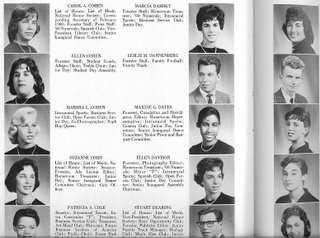
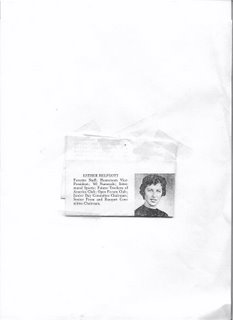
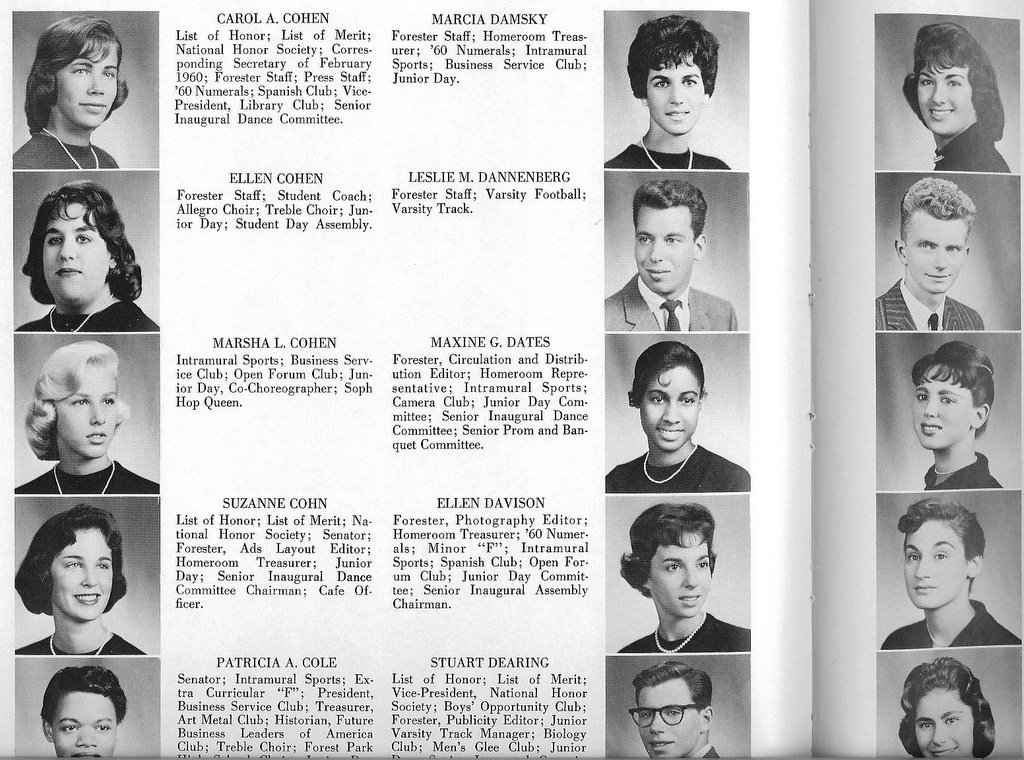
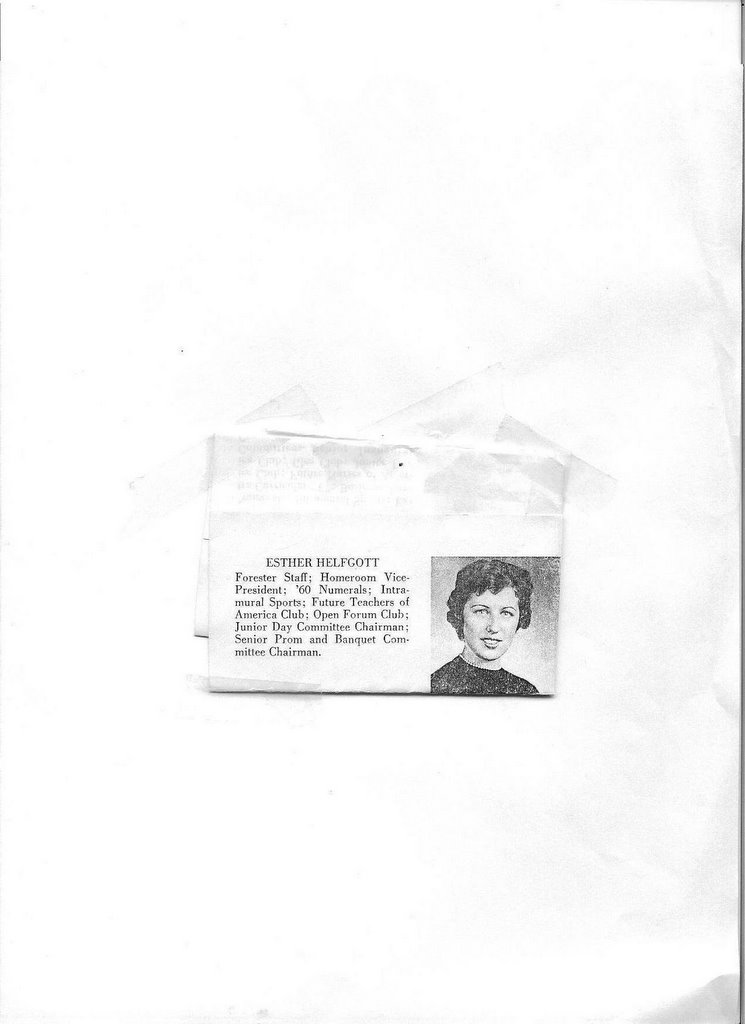
Mama Cass, Forest Park High, Feb. 1960
I'm watching California Dreamin' (The Mamas and the Papas) on Ch. 9 and just had to dig out my Forest Park High School yearbook. Mama Cass is on the Cohen page. I knew her as Ellen. This is what I remember: When she came over to Baltimore from Washington, D.C., I think when we were in the 11th grade, she had been in Sigma Pi Sigma, a high school sorority; now she walks into Upper Park Heights and the girls at Forest Park won't let her join their snotty Baltimore chapter.
The Cohen under Ellen's picture also died young. I think Ellen died first. Marsha was a beauty queen and acrobat and our prom queen. I knew her from 7th grade on. She smiled maybe twice that I can remember (although she made Phi Delta); whereas, Ellen smiled, joked, sang and laughed all she could.
This was the Forest Park High and Baltimore of Barry Levinson's Diner, a much different place for teenage boys than for teenage girls (at least the girls I knew), but not a paradise for any of us.
Ellen Cohen (soon to become Mama Cass) second from top left
 ....and we all wore pearls.
The Cohen under Ellen's picture also died young. I think Ellen died first. Marsha was a beauty queen and acrobat and our prom queen. I knew her from 7th grade on. She smiled maybe twice that I can remember (although she made Phi Delta); whereas, Ellen smiled, joked, sang and laughed all she could.
This was the Forest Park High and Baltimore of Barry Levinson's Diner, a much different place for teenage boys than for teenage girls (at least the girls I knew), but not a paradise for any of us.
Ellen Cohen (soon to become Mama Cass) second from top left
 ....and we all wore pearls.
Trigger Poem, Waldman, Fast Speaking Woman, Women's Writing Groups, Cancer Lifeline, Week of Nov. 28th
from Fast Speaking Woman by Anne Waldman
because i don't have to spit
because I don't have rubbish
because i don't have dust
because i don't have that which is in air
because I am air
let me try you with my magic power:
from Fast Speaking Woman by Anne Waldman, City Lights Books, 1999
because i don't have to spit
because I don't have rubbish
because i don't have dust
because i don't have that which is in air
because I am air
let me try you with my magic power:
I'm a shouting woman
I'm a speech woman
I'm an atmosphere woman
I'm an airtight woman
I'm a flesh woman
I'm a flexible woman
I'm a high-heeled woman
I'm a high-style woman
I'm an automobile woman
I'm a mobile woman
I'm an elastic woman
I'm a necklace woman
I'm a silk-scarf woman
I'm a know-nothing woman
I'm a know-it-all woman
I'm a day woman
I'm a doll woman
...
from Fast Speaking Woman by Anne Waldman, City Lights Books, 1999
Wednesday, November 23, 2005
Esther's Healing Arts Writing Space
"In my healing arts writing groups we find a space for confidence- building and community formation, a place where self-esteem and courage blossoms. Here we come to look at our lives and celebrate ourselves and each other.
"My goal is for us to find a place of strength and non-marginality. No one is on the edge here, on the outskirts looking in. We are all, each one of us, smack in the middle of experience and knowledge that we lend to each other -- through non-competitive discussion, writing, and sharing of work, if and when we are ready.
"We use writing, mostly poetry, to trigger imagination, memory, friendship, love, hate, ambiguity, fear, whatever comes along, even secrets we didn't know we had.
"My goal is for us to use writing to discover our authentic voice(s) on and off the page and to develop the confidence to use our voice(s) with determination.
"I am most concerned with writing process and writing as process; and though we work toward making our words clearer for others to understand and to understand ourselves better, worldly (or wordly) success is not an ingredient of the healing arts space, all the while we take pride in our accomplishments and in each other's accomplishments.
"Here in my healing arts writing groups, we listen to each other so we can hear more of ourselves; and we quiet ourselves so we can hear that much more of all those others who share our writing/living spaces with us."
If you are a cancer patient, recovering cancer patient, caregiver, co-worker, relative, friend or acquaintance of someone with cancer and would like to join us, please call Cancer Lifeline at 297-2100 or visit on-line.
Thanks for visiting,
Esther Altshul Helfgott
Monday, November 21, 2005
Trigger Poem, Walcott, Love After Love, Women's Writing Groups, Cancer Lifeline, Week of Nov. 21st
Love After Love
The time will come
when, with elation
you will greet yourself arriving
at your own door, in your own mirror
and each will smile at the other's welcome,
and say, sit here. Eat.
You will love again the stranger who was your self.
Give wine. Give bread. Give back your heart
to itself, to the stranger who has loved you
all your life, whom you ignored
for another, who knows you by heart.
Take down the love letters from the bookshelf,
the photographs, the desperate notes,
peel your own image from the mirror.
Sit. Feast on your life.
- Derek Walcott
from Collected Poems 1948—1984 by Derek Walcott.
Copyright © 1986 by Derek Walcott.
Trigger Poem, Nye, You Have to Be Careful, Women's Writing Groups, Cancer Lifeline, Week of Nov. 14th
You Have to Be Careful
You have to be careful telling things.
Some ears are tunnels.
Your words will go in and get lost in the dark.
Some ears are flat pans like the miners used
looking for gold.
What you say will be washed out with the stones.
You look for a long time til you find the right ears.
Til then, there are birds and lamps to be spoken to,
a patient cloth rubbing shine in circles,
and the slow, gradually growing possibility
that when you find such ears
they already know.
-Naomi Shihab Nye
"You Have to Be Very Careful" from Words Under the Words: Selected Poems by Naomi Shihab Nye. Copyright © 1995.
Monday, November 14, 2005
Trigger Poem, Weil, The Paper Bag, Women's Writing Groups, Cancer Lifeline, Week of Nov. 7th
The Paper Bag
Fill up a paper bag with
Spring sounds and
Open it in December
Fill up a paper bag with
Snow flurries and
Use them to decorate your bedroom
Fill up a paper bag with
Ribbons and
Fly them when you want a word with the wind
Fill up a paper bag with
Winter quiet and
Open it when it's time to be alone
Fill up a paper bag with
Your favorite words and
Shake it till a good story comes out
Fill up a paper bag with
Secrets and
Share them with a friend every so often
Fill up a paper bag with
Velvet
Just to have it
-Zaro Weil
“Paper Bag” from Mud, Moon and Me by Zaro Weil
copyright © 1989 by Zaro Weil
Fill up a paper bag with
Spring sounds and
Open it in December
Fill up a paper bag with
Snow flurries and
Use them to decorate your bedroom
Fill up a paper bag with
Ribbons and
Fly them when you want a word with the wind
Fill up a paper bag with
Winter quiet and
Open it when it's time to be alone
Fill up a paper bag with
Your favorite words and
Shake it till a good story comes out
Fill up a paper bag with
Secrets and
Share them with a friend every so often
Fill up a paper bag with
Velvet
Just to have it
-Zaro Weil
“Paper Bag” from Mud, Moon and Me by Zaro Weil
copyright © 1989 by Zaro Weil
Wednesday, November 09, 2005
After He's Gone
I will dwell
where I am
and use
what is
in me
to remember.
~~~~~~~~~~~~~~~~~~~~~~~~~~~~~~~~~~~~~~~~~~
~~~~~~~~~~~~~~~~~~~~~~~~~~~~~~~~~~~~~~~~~~
Nov. 23 '05
I think the above, Nov. 09, '05 diary-entry, will be my last for awhile on Alzheimer's, at least to publish here. The disease is taking its toll, and I must move my writing and thinking forward into other spaces, all the while I continue caring for my husband (at home) and interacting with this nightmarish disease.
Tuesday, November 08, 2005
Ativan, a Blessing?
After two weeks
of sleep
deprivation
for both of us
I give him the Ativan
and get a whole night's sleep.
(Well, almost).
And so does he.
(Well, almost),
but he wobbles in the morning.
(At least).
And getting up from a chair
is har
der.
And in adult care
he sleeps,
so they'll
keep him there.
Until
I pick him up
and night
begins
again, as day
doesn't.
Sunday, November 06, 2005
Spouse as Home
I didn't know he
was my shul
my language
my mother tongue
and prayer
the zeyde I lost,
and bubbies
I never had.
Or that he was my homeland.
And exile.
My nakedness.
I didn’t know
when I met him
twenty five years ago
that I had needed
a place to
dwell
in.
Or that knowing
turned less
into more
And more
into
less.
Oh,
where
shall I dwell
when he’s
gone
Where
shall
I
when
he’s
Where
I
-Esther Altshul Helfgott
Subscribe to:
Posts (Atom)
