I am finally getting the psychoanalytic diaries together and publishing them in diary form. I have always envisioned presenting Psychoanalysis: The Magic and The Lie as a diary, a representation of the self over time. But my decision has been years in the making, back and forth from non-fiction to fiction (no matter I disown myself within the mindset of fiction and have never been comfortable there, except as Reader) to non-fiction, essay and poem, to fiction and back again, gratefully, to non-fiction in diary form.
I have been afraid of putting the whole truth on the page, to have it out there in plain sight, all the while it is only the truth I mean to tell, but always, and to tell it primarily to myself. I resisted publishing primary source material. How much easier to escape into secondary source, to turn the self into one. I neglected the diaries when, from the beginning, I knew the story of my analytic relationship needed to be published in the mode I had written it in, while I was experiencing it.
Finding my inoculation certificate and writing about Dr. Whittle the other day helped me understand once again how important fragmentary writing is to showing the writer’s work on the move, of discovering a piece of paper and remembering through its touch and absence of sound, how frantic and loud the past.
A half dozen pages or so of my fragments will appear soon in Olivia Dresher’s anthology, In Pieces: An Anthology of Fragmentary Writing, Impassio Press (2006). In these pages I write about my mother’s death, easier to hang out in the air, I suppose, than the dirt in the analytic relationship, which held her and all the rest.
-Esther Altshul Helfgott
Tuesday, June 28, 2005


Saturday, June 25, 2005
Dr. Whittle
Dr. Henry Lyman Whittle of 1229 N. Calvert St. signed the certificate below. He was our pediatrician even after we moved up from East Baltimore. I never saw such a doctor. When Dot and I were sick he'd sit by our beds and draw us Disney characters - Mickey and Minnie riding bikes, Donald and Goofy on skates. He told Mother she didn't have to go to all the trouble of making a pot of chicken soup; a can of Campbell's was just as good, together with warm tea, toast and apple sauce. We could also have an Orangeade: half a glass orange juice, another half water and a ton of sugar stirred in. After he gifted us with his spectacular drawings (he could have worked for Disney), he'd sit at the kitchen table, sip a cup of tea with out parents and politely answer Daddy's questions about our brother becoming a doctor, all part of the $2.00 house call. It seemed every visit was the same, even when we had to charge it.

I wonder why, if I got the shot in 1942, did it take until 1944 to issue the certificate.
I wonder why, if I got the shot in 1942, did it take until 1944 to issue the certificate.
Friday, June 24, 2005
Neologisms
Neologisms of an Ornithologist in a Quiet Room
Curled like a bird in its mother's nest
the patient lies on a cot mumbling: Roomboom.
Quietroom. Booby-hatch my egrets'
regrets. Magpie, tell Wagatail:
strap me to swallowlegs.
Blue-throated doc butcherbirds my brains
again and again. Nutcracker nurse nightjars my back.
Sniper trails me. Yellow-bellied sapsucker
twists. Oh, my arms pintail my sage.
Oh, girl, whippoorwilling
girl. Swallow me. Let the wren.
Let the quail, swallow me.
-Esther Altshul Helfgott
from the Homeless One: A Poem in Many Voices
originally published in Seattle by Kota press, 2000
Now, thanks to the German psychotherapist, Dr. Rudolf Suesske of Cologne, Homeless has a website and is available for theatre use and in academic environments. It has been particularly effective in abnormal psychology classes.
Curled like a bird in its mother's nest
the patient lies on a cot mumbling: Roomboom.
Quietroom. Booby-hatch my egrets'
regrets. Magpie, tell Wagatail:
strap me to swallowlegs.
Blue-throated doc butcherbirds my brains
again and again. Nutcracker nurse nightjars my back.
Sniper trails me. Yellow-bellied sapsucker
twists. Oh, my arms pintail my sage.
Oh, girl, whippoorwilling
girl. Swallow me. Let the wren.
Let the quail, swallow me.
-Esther Altshul Helfgott
from the Homeless One: A Poem in Many Voices
originally published in Seattle by Kota press, 2000
Now, thanks to the German psychotherapist, Dr. Rudolf Suesske of Cologne, Homeless has a website and is available for theatre use and in academic environments. It has been particularly effective in abnormal psychology classes.
Tuesday, June 21, 2005
terza rima
|
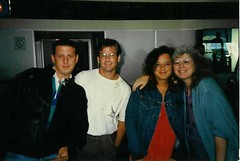
Me and the Kids, 1991
At Sea-Tac
& off to grad school ...
We all finished.
I took the longest,
16 years.
& off to grad school ...
We all finished.
I took the longest,
16 years.
Children
I'm no more your mother
Than the cloud that distills a mirror to reflect its own slow
Effacement at the wind's hand. - Sylvia Plath, Morning Song
Children,
I can’t imagine
not being your mother.
Who else could
be, with your eyes like mine
and your curly heads of hair.
The three of you, parents now
in your own right,
mirroring your children
as they mirror you
and you me
with your smiles
and idiosyncracies,
community involvement.
Not that you don’t
suggest
your father too,
but I don’t think of other sides
of you (as much as I should).
I think of me
and you with me
the single parent years
of roaming the house
with absences
we tried
to fill.
-Esther Altshul Helfgott
Than the cloud that distills a mirror to reflect its own slow
Effacement at the wind's hand. - Sylvia Plath, Morning Song
Children,
I can’t imagine
not being your mother.
Who else could
be, with your eyes like mine
and your curly heads of hair.
The three of you, parents now
in your own right,
mirroring your children
as they mirror you
and you me
with your smiles
and idiosyncracies,
community involvement.
Not that you don’t
suggest
your father too,
but I don’t think of other sides
of you (as much as I should).
I think of me
and you with me
the single parent years
of roaming the house
with absences
we tried
to fill.
-Esther Altshul Helfgott
Anna Swir's A Woman Writer Does Laundry
I have introduced a number of Anna Swir's poems to my classes. Today I used A Woman Writer Does Laundry from Talking to My Body to trigger and discuss writing. I had planned to use it in another class, but I'll stop here. I think there's a translation problem. Read it and ask yourself if you know or have known of any woman who would use the word relaxation after doing laundry, especially in the old style. Perhaps the male translators forgot the question mark after Relaxation? And why interrogation marks chosen instead of question marks ? Politics? On second thought, I'll use it in Friday's class too. Some good work and discussion resulted, and I'd like to know what others think, especially of the translation. Is the poet being sarcastic? Or is she genuinely relaxed after doing her laundry? But, of course, this is not the point of the poem, is it?
A Woman Writer Does Laundry
Enough typing.
Today I am doing laundry
in the old style.
I wash, I wash, rinse, wring
as did my grandmothers and great-grandmothers.
Relaxation.
Doing laundry is healthful and useful
like a washed shirt. Writing
is suspect.
Like three interrogation marks
typed on a page.
-Anna Swir
Translated by Czeslaw Milosz & Leonard Nathan
Copper Canyon Press, 1996
A Woman Writer Does Laundry
Enough typing.
Today I am doing laundry
in the old style.
I wash, I wash, rinse, wring
as did my grandmothers and great-grandmothers.
Relaxation.
Doing laundry is healthful and useful
like a washed shirt. Writing
is suspect.
Like three interrogation marks
typed on a page.
-Anna Swir
Translated by Czeslaw Milosz & Leonard Nathan
Copper Canyon Press, 1996
Sunday, June 19, 2005
Iser, 1899-1964
Iser is pronounced 'eeser' and is Yiddish for Isidor
He died on August 15, 1964,
during that hot hot summer.
Mother sent his clothes down to Mississippi
for the Freedom Riders,
or anyone else who needed them.
I wish she would have saved just one item for me,
something with his smell still on it.
One of his shirts, maybe, with the stained collar
or the worn down brown Oxfords
that he always polished.
I would have loved the fedora he wore all winter
or a pair of white socks
that he filled with Dr. Scholl's foot powder.
She could have left me anything: a handkerchief,
his bathing suit, an undershirt,
or those thin black leather shoe laces
he always broke.
I would have liked the shaving brush I bought him.
or the striped tie he spilled soup on.
His false teeth and the cup he put them in,
the tall glass he sipped hot tea from.
His Russian-English dictionary.
Or his bifocals and damn racing forms.
She could have left me anything:
even the belt he hit my brother with.
-Esther Altshul Helfgott
He died on August 15, 1964,
during that hot hot summer.
Mother sent his clothes down to Mississippi
for the Freedom Riders,
or anyone else who needed them.
I wish she would have saved just one item for me,
something with his smell still on it.
One of his shirts, maybe, with the stained collar
or the worn down brown Oxfords
that he always polished.
I would have loved the fedora he wore all winter
or a pair of white socks
that he filled with Dr. Scholl's foot powder.
She could have left me anything: a handkerchief,
his bathing suit, an undershirt,
or those thin black leather shoe laces
he always broke.
I would have liked the shaving brush I bought him.
or the striped tie he spilled soup on.
His false teeth and the cup he put them in,
the tall glass he sipped hot tea from.
His Russian-English dictionary.
Or his bifocals and damn racing forms.
She could have left me anything:
even the belt he hit my brother with.
-Esther Altshul Helfgott
Thursday, June 16, 2005
Can A Diva Blog?
for Puah
To blog is to unmask the self -
(forgive the cliche).
So I ask you,
Dear former diva:
Can a diva blog?
You say:
The ever-present
and mysterious wall
between stage and audience,
not to mention the orchestra,
never allows such naked presence.
When diva-ing, you say,
one always wears the persona,
the mask.
Yet, the blogger
spills herself into the public domain.
Hiding is anathema.
Even omissions tell a story.
So how do you, a former diva,
taught to unknow the self,
reconcile the difference
between who you were then
and who you are now?
How does the poet in you,
the wanting-to-tell poet,
survive all those soprano deaths
on the stage?
-Esther Altshul Helfgott
To blog is to unmask the self -
(forgive the cliche).
So I ask you,
Dear former diva:
Can a diva blog?
You say:
The ever-present
and mysterious wall
between stage and audience,
not to mention the orchestra,
never allows such naked presence.
When diva-ing, you say,
one always wears the persona,
the mask.
Yet, the blogger
spills herself into the public domain.
Hiding is anathema.
Even omissions tell a story.
So how do you, a former diva,
taught to unknow the self,
reconcile the difference
between who you were then
and who you are now?
How does the poet in you,
the wanting-to-tell poet,
survive all those soprano deaths
on the stage?
-Esther Altshul Helfgott
Monday, June 13, 2005
Sylvia Plath's Morning Song
For the week of June 13, 2005, I will be using Morning Song from Ariel to trigger and discuss writing in all three Cancer Lifeline classes:
Morning Song
by Sylvia Plath
Love set you going like a fat gold watch.
The midwife slapped your footsoles, and your bald cry
Took its place among the elements.
Our voices echo, magnifying your arrival. New statue.
In a drafty museum, your nakedness
Shadows our safety. We stand round blankly as walls.
I'm no more your mother
Than the cloud that distills a mirror to reflect its own slow
Effacement at the wind's hand.
All night your moth-breath
Flickers among the flat pink roses. I wake to listen:
A far sea moves in my ear.
One cry, and I stumble from bed, cow-heavy and floral
In my Victorian nightgown.
Your mouth opens clean as a cat's. The window square
Whitens and swallows its dull stars. And now you try
Your handful of notes;
The clear vowels rise like balloons.
From Ariel by Sylvia Plath, published by Harper & Row, 1966. Copyright © 1966 by Ted Hughes. All rights reserved. Academy of American Poets Used by arrangement with HarperCollins Publishers, Inc.
Morning Song
by Sylvia Plath
Love set you going like a fat gold watch.
The midwife slapped your footsoles, and your bald cry
Took its place among the elements.
Our voices echo, magnifying your arrival. New statue.
In a drafty museum, your nakedness
Shadows our safety. We stand round blankly as walls.
I'm no more your mother
Than the cloud that distills a mirror to reflect its own slow
Effacement at the wind's hand.
All night your moth-breath
Flickers among the flat pink roses. I wake to listen:
A far sea moves in my ear.
One cry, and I stumble from bed, cow-heavy and floral
In my Victorian nightgown.
Your mouth opens clean as a cat's. The window square
Whitens and swallows its dull stars. And now you try
Your handful of notes;
The clear vowels rise like balloons.
From Ariel by Sylvia Plath, published by Harper & Row, 1966. Copyright © 1966 by Ted Hughes. All rights reserved. Academy of American Poets Used by arrangement with HarperCollins Publishers, Inc.
Dear Esther: Sexism & Poetry
I recently attended a poetry reading to support a friend and to read during open mike. I had attended this venue before though not for several months .... My main reason for staying home is that I have read as a featured writer for this particular venue but always left feeling “outside” the regular group of (white) men who all know and support each other, while tolerating women with the courage to read. Theirs is a style of writing that is clever, witty, and fast paced, with a kind of heartless verbal flippancy (I am being generous here) that does not speak to me. I have chosen to avoid it.
By organizing groups for women only, you have tapped into a deep vein of longing within me to be heard and appreciated BECAUSE I am a woman with experiences unique to women and where I don't have to adopt the verbal phyrotechnics and testoserone-laced punchiness of the male writer's clique. I remember reading a bio of Sylvia Plath and the behaviors that endeared her to her male colleagues, drinking, smoking, running in their circles. Still, she got away with writing about mothering, female sexuality and subjects men were not writing about.
The other night, one man walked around the room growling his poetry, singling out a pretty young woman for some choice lines. It bordered on offensive behavior, but the men loved it. Clever word play, allusions to jazz, mean streets, made-up characters etc. I hope you know what I mean. I would no sooner read a poem about birth or "womanly" things to these men than I would read naked. Women who grab their attention often speak in the same voice and I hear the same stridency. I hope you will post this on your blog. I would like to hear what others have to say on this subject.
Signed,
Frustrated in Seattle
By organizing groups for women only, you have tapped into a deep vein of longing within me to be heard and appreciated BECAUSE I am a woman with experiences unique to women and where I don't have to adopt the verbal phyrotechnics and testoserone-laced punchiness of the male writer's clique. I remember reading a bio of Sylvia Plath and the behaviors that endeared her to her male colleagues, drinking, smoking, running in their circles. Still, she got away with writing about mothering, female sexuality and subjects men were not writing about.
The other night, one man walked around the room growling his poetry, singling out a pretty young woman for some choice lines. It bordered on offensive behavior, but the men loved it. Clever word play, allusions to jazz, mean streets, made-up characters etc. I hope you know what I mean. I would no sooner read a poem about birth or "womanly" things to these men than I would read naked. Women who grab their attention often speak in the same voice and I hear the same stridency. I hope you will post this on your blog. I would like to hear what others have to say on this subject.
Signed,
Frustrated in Seattle
Sunday, June 12, 2005
Sylvia Plath? I don't think so ...
Don't believe this quizz result for one minute. I love being alone, and Despair is not my middle name. Nor am I particularly ambitious. Who writes these ridiculous quizzes anyway?

You are Sylvia Plath. People think you are sweet
and pretty, but inside you are raging pit of
ambition and despair. Darkness is your friend,
and you would do well to avoid being alone.
Which Famous Modern American Poet Are You?
brought to you by Quizilla
Actually when I write poems that are filled with darkness and despair, I feel quite liberated afterwards, for having gotten the junk out. Now, if people can't read my work because it is filled with the stuff of childhood that makes some poets cringe, so be it. I write primarily to survive, not to produce a great product. If I happen to create poems or prose that editors want to publish, lovely; gravy. Meanwhile, I'm still alive and can contribute to the well-being of others. Sylvia Plath has always pissed me off; I don't blame, and never have blamed, Ted Hughes for her suicide. End of soap box.
You are Sylvia Plath. People think you are sweet
and pretty, but inside you are raging pit of
ambition and despair. Darkness is your friend,
and you would do well to avoid being alone.
Which Famous Modern American Poet Are You?
brought to you by Quizilla
Actually when I write poems that are filled with darkness and despair, I feel quite liberated afterwards, for having gotten the junk out. Now, if people can't read my work because it is filled with the stuff of childhood that makes some poets cringe, so be it. I write primarily to survive, not to produce a great product. If I happen to create poems or prose that editors want to publish, lovely; gravy. Meanwhile, I'm still alive and can contribute to the well-being of others. Sylvia Plath has always pissed me off; I don't blame, and never have blamed, Ted Hughes for her suicide. End of soap box.
Saturday, June 11, 2005
Me and Dot

Me & Dot in front of Sussman's Drugstore, next to the tailor shop at 3603 Park Heights Ave,where we lived with our parents and brother. (In back was the kitchen and upstairs were the living room, bathroom and bedrooms). Mother made us these outfits. She liked to dress us as twins. c 1948.
Across the street was Goldberg's with the fruit and vegetable bins out on the sidewalk. Inside were groceries and two pinball machines. Out on the stoop, neighbors whispered that people bet Numbers over there. (I think the police on the beat did).
Three or four doors down was Gottlieb's Cheese shop and down from there, the kosher butcher which wasn't supposed to be open on Sundays so he let everyone in the back door and the cops pretended not to see, probably because they were paid off.
Up the street was the six year old German boy we played with. He owned the one television on the block, at least the one we knew about. His mother let us come in to watch Howdy Doody, but our father didn't like those people because they were German and next door to them was a bubbe with purple numbers on her arm.

Friday, June 10, 2005
Dear Pat
Stop worrying about my instructions.
They're not that difficult.
First, you crouch down. Squat.
Take a deep breath.
suck in, hold it, and slowly let go.
Dream of completion and sky.
Then, push.
Don't think about blacking out.
You won't. And if you did, so what.
Nine women will be with you.
The men will be in another room.
The women will sing.
They will hum. They will rub your back.
And chant.
Take a deep breath, Pat.
Suck in, hold it, and slowly let go.
Dream of completion and sky.
Then, push.
Push.
- Esther Altshul Helfgott
originally published in Midway Review
They're not that difficult.
First, you crouch down. Squat.
Take a deep breath.
suck in, hold it, and slowly let go.
Dream of completion and sky.
Then, push.
Don't think about blacking out.
You won't. And if you did, so what.
Nine women will be with you.
The men will be in another room.
The women will sing.
They will hum. They will rub your back.
And chant.
Take a deep breath, Pat.
Suck in, hold it, and slowly let go.
Dream of completion and sky.
Then, push.
Push.
- Esther Altshul Helfgott
originally published in Midway Review
Thursday, June 09, 2005
Mercy
This morning I wanted to set up the Orion Telescope CD for my husband, the one that accompanied the telescope I gave him for his 76th birthday last year, but every time I try to get him to use the computer, even if it doesn’t concern email or the internet, he turns his nose up, as if it comes from a different world; and, indeed, it does. I’ve thought I could tempt him with Science since he’s a retired pathologist and ever since he was a kid, went to the Bronx High School of Science, won the Westinghouse Science Talent Search Award and I don’t know how many others, he has been hypnotized by anything Science. But now his eyes go elsewhere, and I give up the notion of learning more about planetary systems with him, at least for today. I start to get up to do the dishes, but his words stop me:
This room has so much mercy in it
I sit back down. What do you mean?
The goodness of it...
Hmmm?
the books, the words
that fall from the shelves
The quiet ... the softness ... and poetry
The whole aura of this place
With Bach playing in the background?
Yes and the bananas ...
There’s a certain tenderness in bananas
In the oatmeal
with the milk poured over it?
Yes, and the picture in front of the Freud books
it has a certain peacefulness to it
The one of you and Butchie?
Yes, on the porch,
in the sun.
We’re almost praying
Praying?
Yes, praying ...
for things future … for things past ...
I've always thought of the kitchen table in our library/family/everything-in-it room as a crowded mess. Not until now and this conversation with my husband, tired and infirm, have I considered that there could be anything as grand or as simple as mercy here in our scrambled lives.
Esther Altshul Helfgott
This room has so much mercy in it
I sit back down. What do you mean?
The goodness of it...
Hmmm?
the books, the words
that fall from the shelves
The quiet ... the softness ... and poetry
The whole aura of this place
With Bach playing in the background?
Yes and the bananas ...
There’s a certain tenderness in bananas
In the oatmeal
with the milk poured over it?
Yes, and the picture in front of the Freud books
it has a certain peacefulness to it
The one of you and Butchie?
Yes, on the porch,
in the sun.
We’re almost praying
Praying?
Yes, praying ...
for things future … for things past ...
I've always thought of the kitchen table in our library/family/everything-in-it room as a crowded mess. Not until now and this conversation with my husband, tired and infirm, have I considered that there could be anything as grand or as simple as mercy here in our scrambled lives.
Esther Altshul Helfgott
Tuesday, June 07, 2005
Write a 4-line Personal Ad: Include a Muse
This exercise is derived from Suzanne Redding's Personal Ad
in Claiming the Spirit Within: A Source Book of Women's Poetry, edited by Marilyn Sewell, New York: Beacon Press, p.144.
Here's mine:
in Claiming the Spirit Within: A Source Book of Women's Poetry, edited by Marilyn Sewell, New York: Beacon Press, p.144.
Personal Ad
skeleton woman seeking flesh
heart needed for drumming
have bones, will sing
-Suzanne Redding
Here's mine:
Ad
Thought Woman seeks pen,
paper needed for Mnemosyne
has dictionary, will browse
in garden, will plant.
-Esther Altshul Helfgott
Driving Home From Mother's House
As I drive through the bower
of old oak trees
scanning 68th and 20th avenues northeast
I am scared by the moon.
It is so low in the sky this night
I think it will smack me in the face.
I try to turn the wipers on,
but strands of hair white as paste
cover the window like thick rain.
A woman's mouth stretches open
in a silent scream. Bent fingers claw
until they reach my chest.
Some nights I lose my way home.
-Esther Altshul Helfgott
originally published by Switched-on-Gutenberg
of old oak trees
scanning 68th and 20th avenues northeast
I am scared by the moon.
It is so low in the sky this night
I think it will smack me in the face.
I try to turn the wipers on,
but strands of hair white as paste
cover the window like thick rain.
A woman's mouth stretches open
in a silent scream. Bent fingers claw
until they reach my chest.
Some nights I lose my way home.
-Esther Altshul Helfgott
originally published by Switched-on-Gutenberg
Monday, June 06, 2005
Don’t Turn Away: Poems About Breast Cancer
2003, paperback, 21 pages, $4.00
PWJ PublishingBox 238
Tehama, CA. 96090
Patricia Wellingham-Jones, author of a twenty-poem chap book, Don’t Turn Away: Poems About Breast Cancer, has written a spirited and courageous account of her breast cancer experience. From her first discovery of a lump in her left breast through the doctor’s diagnosis and a mastectomy, Wellingham-Jones shares the joy of living each day, while at the same time undergoing treatment for this disease that has claimed her grandmother and friends. The author gives me, a woman who does not have cancer (so far), strength to move forward in my own aging process.
Wellingham-Jones’ poems sing the note of the baby robin learning to fly. All the while she confronts the loss of one small/huge piece of herself, there is a newness of spirit and tone in her chest that spurs her to ask the nurse for her notebook and pen. Wellingham-Jones is a woman who remembers not to whine (not that there is anything wrong with whining) at the moment of swallowing her daily dose of tamoxifen.
In Estrogen Free, the poet confides that sweating is better than cancer, and on the day that she dons her first good new bra, she recalls in the poem Put A Sock In It, her pre-teen self padding her mother’s brassiere. Out of the corner of her eye, watching the twinkle in her father’s, she pulls on her older sister’s best sweater and smoothes my front into place enjoying her mother’s gasp and her sister’s shriek.
The poem that might have been most heart-breaking, Don’t Turn Away, about love-making after surgery, brings my hands to my heart in a love for this poet whose life record gives others courage to write on.
Read Don’t turn Away: Poems About Breast Cancer. You will want to keep it on your shelf and order a copy for your favorite library.
-Esther Altshul Helfgott
National Association of Poetry Therapy, Museletter, Fall 2005
PWJ PublishingBox 238
Tehama, CA. 96090
Patricia Wellingham-Jones, author of a twenty-poem chap book, Don’t Turn Away: Poems About Breast Cancer, has written a spirited and courageous account of her breast cancer experience. From her first discovery of a lump in her left breast through the doctor’s diagnosis and a mastectomy, Wellingham-Jones shares the joy of living each day, while at the same time undergoing treatment for this disease that has claimed her grandmother and friends. The author gives me, a woman who does not have cancer (so far), strength to move forward in my own aging process.
Wellingham-Jones’ poems sing the note of the baby robin learning to fly. All the while she confronts the loss of one small/huge piece of herself, there is a newness of spirit and tone in her chest that spurs her to ask the nurse for her notebook and pen. Wellingham-Jones is a woman who remembers not to whine (not that there is anything wrong with whining) at the moment of swallowing her daily dose of tamoxifen.
In Estrogen Free, the poet confides that sweating is better than cancer, and on the day that she dons her first good new bra, she recalls in the poem Put A Sock In It, her pre-teen self padding her mother’s brassiere. Out of the corner of her eye, watching the twinkle in her father’s, she pulls on her older sister’s best sweater and smoothes my front into place enjoying her mother’s gasp and her sister’s shriek.
The poem that might have been most heart-breaking, Don’t Turn Away, about love-making after surgery, brings my hands to my heart in a love for this poet whose life record gives others courage to write on.
Read Don’t turn Away: Poems About Breast Cancer. You will want to keep it on your shelf and order a copy for your favorite library.
-Esther Altshul Helfgott
National Association of Poetry Therapy, Museletter, Fall 2005
Sunday, June 05, 2005
The Daughters of Dementia
She’ll be coming for them soon
dolled up in her dangling earrings,
purple lips and orange hair.
She’ll be coming in her layers
of mix-matched dresses and pants,
garments to shield her sacraments.
But until then the daughters
will be sitting around the table
sculpting syllables into words,
sucking chocolate-covered raisins
and sipping plum brandy.
Oh yea, Mother.
She’ll be coming for those daughters
soused up, talking Jesus,
never again,
and Chinese Jews.
Grandma Dementia’s waiting for her girls
and don’t they know it
all wrapped up in meter and line.
They’re expecting to be found.
But not now, Sisters, not now.
-Esther Altshul Helfgott
originally published by Poetry Bay On-Line Magazine
dolled up in her dangling earrings,
purple lips and orange hair.
She’ll be coming in her layers
of mix-matched dresses and pants,
garments to shield her sacraments.
But until then the daughters
will be sitting around the table
sculpting syllables into words,
sucking chocolate-covered raisins
and sipping plum brandy.
Oh yea, Mother.
She’ll be coming for those daughters
soused up, talking Jesus,
never again,
and Chinese Jews.
Grandma Dementia’s waiting for her girls
and don’t they know it
all wrapped up in meter and line.
They’re expecting to be found.
But not now, Sisters, not now.
-Esther Altshul Helfgott
originally published by Poetry Bay On-Line Magazine
If You Can't Remember, Invent
Monique Wittig:
There was a time
when you were not a slave,
remember that.
You walked alone,
full of laughter,
you bathed bare-bellied.
You say you have lost all recollection of it,
remember.
You say there are no words to describe this time,
you say it does not exist.
But remember.
Make an effort to remember.
Or failing that, invent.
-Monique Wittig
There was a time
when you were not a slave,
remember that.
You walked alone,
full of laughter,
you bathed bare-bellied.
You say you have lost all recollection of it,
remember.
You say there are no words to describe this time,
you say it does not exist.
But remember.
Make an effort to remember.
Or failing that, invent.
-Monique Wittig
After Dorothy’s Death
I awaken from dreams
un-remembering,
as if nocturnal photographs
shattered a plan
turned
in the moment of death
unendurable.
Now my sister is gone
our father and mother years asleep,
our brother a dead poem,
I am in process myself
of deadening,
of un-becoming
one I hate to know
of re-becoming in-
to another,
always another -
I'd hope to know.
-Esther Altshul Helfgott
March 2005 - 3 months after Dorothy died
un-remembering,
as if nocturnal photographs
shattered a plan
turned
in the moment of death
unendurable.
Now my sister is gone
our father and mother years asleep,
our brother a dead poem,
I am in process myself
of deadening,
of un-becoming
one I hate to know
of re-becoming in-
to another,
always another -
I'd hope to know.
-Esther Altshul Helfgott
March 2005 - 3 months after Dorothy died
At Sixteen
When I was sixteen, I had a boyfriend who wasn't supposed to go out with me. He was from Canada and went to TA, the Talmudical Academy, across the street from where I lived. Nine months of the year he lived at TA with the other out-of-town boys; then he went back home. We met because when Marilyn and I played tennis on TA's brick wall the boys would watch us from their upstairs windows and they would call down to us and we would talk up and down to each other and they liked us and we liked them and they'd say stay/don't leave/we're coming down, and Marilyn and I would watch to make sure the shammos and the rabbis weren't around/and the boys would come outside/and they'd take our rackets away from us and we'd throw the tennis balls at them/and they'd give us our rackets back. We would laugh and have fun. But the rabbis said don't look at a girl because you'll want to talk to her and, then, you'll want to hold her hand; and if you hold her hand, you'll want to kiss her. And, then, it'll be over for you. It's a sin. So my TA boy and I/we'd walk through Druid Hill Park holding hands/ knowing all the while/a good TA boy (who grew up to become a rabbi) was following us. My TA boy kissed me on a park bench once. And in the brush behind TA he taught me how to smoke. And kiss. And in spring / before summer took him away from us, we necked downstairs in my hallway. A lot.
-Esther Altshul Helfgott
-Esther Altshul Helfgott
Saturday, June 04, 2005
Well, socialist and dreamy abstraction maybe ...

You are Percy Bysshe Shelley! Famous for your
dreamy abstraction and your quirky verse,
you're the model "sensitive poet." A
vegetarian socialist with great personal charm
and a definite way with the love poem, you
remain an idol for female readers. There are
dozens of cute anecdotes about you, and I love
you.
Which Major Romantic Poet Would You Be (if You Were a Major Romantic Poet)?
brought to you by Quizilla
My Brother’s Closet
I never looked in my brother’s closet.
I don’t remember where it was.
I wouldn’t have looked in it anyway.
It was somewhere in the small room
he slept in - off the living room,
the side porch - and the bathroom.
His room was really like a closet,
but with three doors.
The bathroom had three doors too.
When I went to pee or take a bath
I had to lock each one,
especially my brother’s.
I don’t remember
where his closet was,
but he kept mean things in it.
-Esther Altshul Helfgott
I don’t remember where it was.
I wouldn’t have looked in it anyway.
It was somewhere in the small room
he slept in - off the living room,
the side porch - and the bathroom.
His room was really like a closet,
but with three doors.
The bathroom had three doors too.
When I went to pee or take a bath
I had to lock each one,
especially my brother’s.
I don’t remember
where his closet was,
but he kept mean things in it.
-Esther Altshul Helfgott
Thursday, June 02, 2005
My Father’s Tzimmes, 1956
tzimmes: pronounced tzih-miss
a sweet stew
a big production
common usage: she caused a big tzimmes
sometimes spelled tsimmes
He made a tzimmes out of everything, just as I do. He’d get his feelings hurt at the drop of a hat, so why wouldn’t I, his favorite child, make tzimmes out of his tzimmes. He lost the rent money, gave it to the horses a day before the phone was turned off and the electric came due.
Not for want of Mother’s sewing her fingers to the bone or my brother selling newspapers in the freezing cold or my sister, Dot, babysitting or me collating brochures in Uncle Izzy's print shop. Not for want of his own hard work and the hours on end in unemployment lines. He, a first generation American, an immigrant, yearning for a Russia where language was his own. No, not for want of anyone trying.
Still, on that day when the racing form was right and his horse came in, when he brought home fruit, two pounds of chuck, vegetables and a jar of honey from Lexington Street market. Filled our aluminum pot, stirred in the raisins and potatoes while he listened for the door to open and our feet to climb the steps. Not after he set the table and watched for us to eat would I eat his tzimmes. Everyone else did, my brother and sister. Mother too. But I wouldn’t taste his tzimmes, or even lick the spoon he offered.
-Esther Altshul Helfgott
a sweet stew
a big production
common usage: she caused a big tzimmes
sometimes spelled tsimmes
He made a tzimmes out of everything, just as I do. He’d get his feelings hurt at the drop of a hat, so why wouldn’t I, his favorite child, make tzimmes out of his tzimmes. He lost the rent money, gave it to the horses a day before the phone was turned off and the electric came due.
Not for want of Mother’s sewing her fingers to the bone or my brother selling newspapers in the freezing cold or my sister, Dot, babysitting or me collating brochures in Uncle Izzy's print shop. Not for want of his own hard work and the hours on end in unemployment lines. He, a first generation American, an immigrant, yearning for a Russia where language was his own. No, not for want of anyone trying.
Still, on that day when the racing form was right and his horse came in, when he brought home fruit, two pounds of chuck, vegetables and a jar of honey from Lexington Street market. Filled our aluminum pot, stirred in the raisins and potatoes while he listened for the door to open and our feet to climb the steps. Not after he set the table and watched for us to eat would I eat his tzimmes. Everyone else did, my brother and sister. Mother too. But I wouldn’t taste his tzimmes, or even lick the spoon he offered.
-Esther Altshul Helfgott
Wednesday, June 01, 2005
I DREAM OF UNCLE BENNY AND STRAWBERRIES
I’m eight years old, and Uncle Benny doesn’t have to go back to the Rosewood State Training Center for Boys out in Reisterstown, Maryland anymore. He never ever has to go back because he lives in our house now and guess what his room is filled with strawberry ice cream. The walls are covered with ice cream. The chairs are. Uncle Benny’s bed is made of strawberry, and the carpet is strawberry plush. In my dream, Uncle Benny’s sitting at his desk, which mother and I bought for him. The desk is the color of strawberry. Uncle Benny's sitting at the desk and he’s writing. He’s copying letters out of my first grade reader, my Dick and Jane book. All of a sudden, a strawberry walks into his room. She touches Uncle Benny's shoulder. She touches his shoulder and it’s no longer twisted into his sternum. Now, the strawberry touches Uncle Benny’s spine and he sits straight up. She touches his knees and he gets out of the chair, stands straight to the sky and throws his cane into the strawberry waste basket. He bends down to pick up the cane and it turns into a strawberry ice cream soda. Uncle Benny drinks the ice cream soda and then in a voice that is no longer unintelligible, he reads Dick and Jane to me, the whole story, about Sally and Spot and the little kitty Puff. I awaken from my dream and run into the kitchen to find Mother wiping strawberry ice cream off of Uncle Benny’s unshaven chin, which won't get shaved until Uncle Izzy comes home from the print shop. Then we’ll get back in the car and drive out to Rosewood where we’ll leave my Uncle Benny on the steps of his cottage.
-Esther Altshul Helfgott
-Esther Altshul Helfgott
Eight Years Old
Cupcakes
with sprinkles
on top: my
birthday
party. Herbie
Thaulberger’s
here, and I’m
happy.
His parents
are Communists
too.
-Esther Altshul Helfgott
* Herbie Thaulberger is a pseudonym.
with sprinkles
on top: my
birthday
party. Herbie
Thaulberger’s
here, and I’m
happy.
His parents
are Communists
too.
-Esther Altshul Helfgott
* Herbie Thaulberger is a pseudonym.
dorothy
maybe dorothy
was an angel,
god's test
for the rest of us
to see
how we
would treat
a member
of his flock
who's star
was
always
missing
-Esther Altshul Helfgott
early Jan '05,
a few days after she died,
maybe right after
was an angel,
god's test
for the rest of us
to see
how we
would treat
a member
of his flock
who's star
was
always
missing
-Esther Altshul Helfgott
early Jan '05,
a few days after she died,
maybe right after
Druid Hill Park, Baltimore 1950
All summer
Dot and I
tumble
down
hills
laughing
to the rhymes
of lakes
taking pictures
of our knees
and the pulse
of tadpoles
turned frogs
the moment our bottoms
hit ground
and we bounce back up,
wave
to our parents
un-smiling
in trees
on top
of the steepest
hill.
-Esther Altshul Helfgott
Dot and I
tumble
down
hills
laughing
to the rhymes
of lakes
taking pictures
of our knees
and the pulse
of tadpoles
turned frogs
the moment our bottoms
hit ground
and we bounce back up,
wave
to our parents
un-smiling
in trees
on top
of the steepest
hill.
-Esther Altshul Helfgott
Letter to Dorothy
I had hoped that maybe when we grew old,
our spouses gone, we might mend the rifts between us,
patch us up and live the other end of life together
learn songs our parents didn’t teach us,
talk across twin beds
the way we (sometimes) did in childhood.
But our lives between then and now
spoke a different ending
with you dying
younger
than your life
expectancy
and me
the older sister
left behind
to write
and wonder
how we
squandered
so much
precious
time
and when
it was
(how old were we?)
when
I
left
you.
- Esther Altshul Helfgott
our spouses gone, we might mend the rifts between us,
patch us up and live the other end of life together
learn songs our parents didn’t teach us,
talk across twin beds
the way we (sometimes) did in childhood.
But our lives between then and now
spoke a different ending
with you dying
younger
than your life
expectancy
and me
the older sister
left behind
to write
and wonder
how we
squandered
so much
precious
time
and when
it was
(how old were we?)
when
I
left
you.
- Esther Altshul Helfgott
Subscribe to:
Posts (Atom)
